

Spain at a Turning Point: Don Quixote and Virginia Woolf
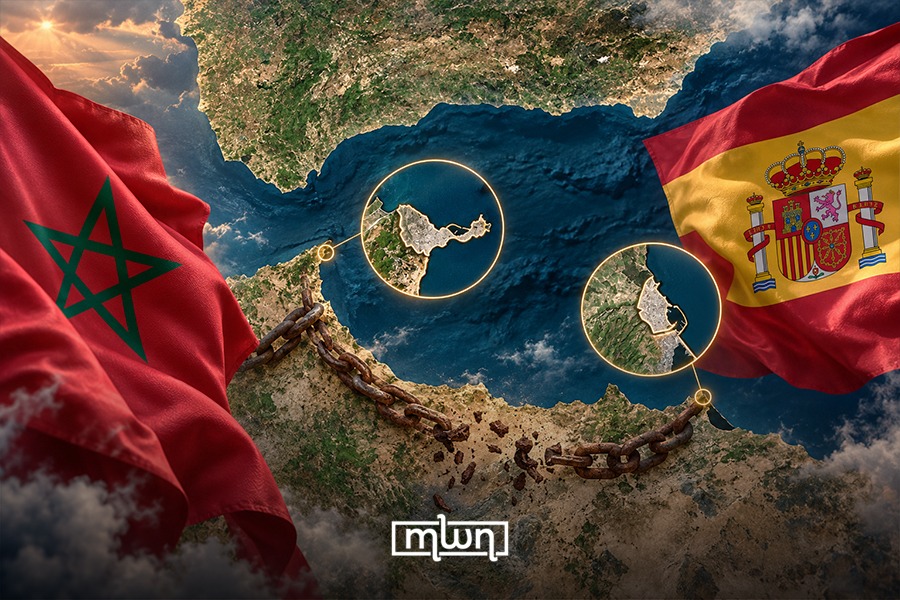
Ramon Cuerda Riva inked an article titled “Greater Morocco & ‘authentic borders’: Why claims over Ceuta, Melilla and the Canaries persist,” published on August 27, 2026, in the defense and international security publication Escudo Digital, which brought back to memory one of my drama readings as a university student in Anglo-Saxon studies: Edward Albee’s “Who’s Afraid of Virginia Woolf?”
Written in 1962, the play’s title is a parody of the 1933 song “Who’s Afraid of the Big Bad Wolf,” from the cartoon “Three Little Pigs”, which became a cultural anthem for resilience and optimism during the Great Depression.
The name Virginia Woolf (1882-1941), an English novelist and modernist author of the 20th century, serves as the play’s metaphor, representing intellectual depth, psychological instability, and existential anxiety.
The play’s central theme revolves around the fear of facing reality without the comforting illusions the couple (George and Martha) constructed by creating a fictional child, wherein both sought to find psychological shelter to help them give meaning to their conflicting relationship.
The final act of the play reveals how the couple finally agrees they can no longer live inside this fiction, when George announces to Martha that their imaginary ‘son’ is dead.
A spin-out from this literary background, to comment on Cuerda’s geopolitical reading of the ongoing crisis between Rabat and Madrid over Ceuta (a city called Sebta, in north Morocco, occupied by Spain since 1415) reveals how deeply rooted illusion is in post-colonial politics.
Lost narratives in brave new world
This is evident in the narrative developed in Cuerda’s article, regarding Spanish ‘territorial rights’ that nurtures a latent hostility towards Morocco and excludes everything that contradicts it, ignoring or rejecting the fact that regional changes are imposed by evolving conditions, not permanent occupation.
By labeling the authentic borders of the Kingdom of Morocco as “irredentism’’ and by equating Greater Morocco with “German Anschluss’’, Cuerda’s article attempts to justify an occupation that occurred centuries ago as merely an ethnicity issue, while it involves national identity, historical facts, territorial integrity, and sovereignty.
In doing so, he denies, on purpose, that Spanish irredentism too has historically involved claims that territories outside the Iberic space should be incorporated into “Greater Spain’’. This is evident in the case of Gibraltar, on which Madrid has maintained its claim since Britain acquired the territory under the Treaty of Utrecht (1713).
Although it has pursued the issue through diplomacy and negotiation, rather than by military force, Spain’s irredentism has been and continues to be guided by its own Carlist and Falangist currents in the first half of the twentieth century and by its radical nationalist parties in the present time.
Morocco, whose geographical space was fragmented by European colonialism, also has the right to maintain that decolonization should not stop at the borders of former French and Spanish protectorates.
Spain uses a territorial argument in Gibraltar that is structurally identical to Morocco’s claim on Ceuta and Melilla. Yet, Madrid holds that the two cases are different and non-negotiable, while disputing sovereignty over the British-held Gibraltar, and maintaining that Ceuta and Melilla are integral parts of Spain and of Europe, even though the territory lies on the southern side of the Strait and is part and parcel of the African continent.
Irredentism in a double standard mode
This does not imply Spain is pursuing a territorial expansion towards North Africa; the world context has dramatically changed, and Madrid’s stand on Ceuta and Melilla is today essentially defensive. However, reiterating in August 2026 the “territorial integrity’’ of Spain as non-negotiable is misleading, as it combines status-quo nationalism with active irredentism.
This state of affairs denotes two different historical logics operating simultaneously. On the one hand, Spain argues that Ceuta and Melilla have been Spanish for centuries and are therefore fundamentally different from territories that were administered as colonies, which provokes Morocco to maintain that the process of decolonization remains incomplete as long as Ceuta and Melilla continue to be under Spanish control, which in turn further complicates the possibility of reconciling sovereignty with territorial integrity.
As early as 1987, the late King Hassan II deconstructed this conflicting logic and proposed the establishment of a Moroccan-Spanish joint committee, called the “reflection group”, to examine the future of Ceuta and Melilla rather than to force the way for a bilateral negotiation over sovereignty.
King Hassan II’s approach, which some scholars refer to as “the Hassan II Doctrine”, linked the question of Ceuta and Melilla with Gibraltar as a way to reach a negotiated, long-term solution.
This fact made the approach an advanced geopolitical mechanism that cannot sustain being labeled an irredentist claim, but rather an essentially clairvoyant method of exploring feasible solutions, without prejudging their final outcome.
Through this strategic linkage, King Hassan II sought to place the geopolitically sophisticated issue on sovereignty — the question of Ceuta and Melilla — within the broader geography of the Gibraltar Strait.
Pragmatism in good faith
It has since then been demonstrated that Morocco was and remains open to managing the issue over the long term, rather than using it as a means of pressure or making it a permanent cause of confrontation.
The intellectual logic of the late King’s approach not only contradicts irredentism but also confirms, through Morocco’s highest institution, that a territorial dispute can remain unresolved while the conflicting parties work towards establishing a system of practical cooperation that helps create a functional integration with Morocco’s most immediate European neighbor and economic partner.
In turn, King Mohammed VI elevated this approach to an even higher level, more pragmatic in substance but in continuity with the vision laid out by King Hassan II.
Through the 2022 strategic rapprochement, King Mohammed VI has transformed the Hassan II Doctrine from institutionalized dialogue to a pragmatic leverage that brought Rabat and Madrid much closer.
That is why the wiser way to contain the ongoing crisis would be to agree to establish a bilateral mechanism to resolve the issue, especially after the new Gibraltar arrangement between Spain and the United Kingdom (July 14, 2026) provided, for the first time, a concrete European precedent for precisely this type of functional approach.
In his work Why the West Rules — For Now (2021), Ian Morris explores one of history’s deepest questions: why nation-states bound by old rivalries remain incapable of managing global risks, while technological forces evolve beyond control, survival depends on cooperation, renewable energy, and the creation of a global political framework capable of governing planetary civilization. Morris concludes that political evolution is lagging far behind.
Credit: Source link