

Putin says Russia is outgrowing the world
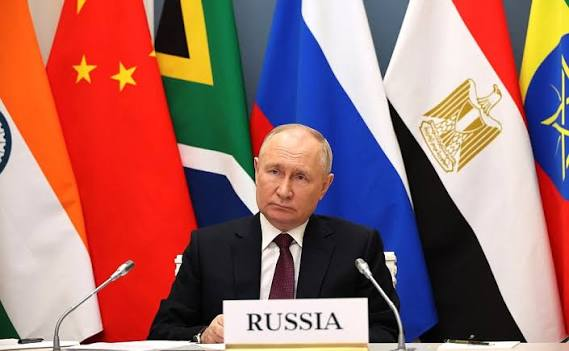
Russian President Vladimir Putin has claimed that Russia’s
economy outpaced global growth over the past three years, but
official international data indicates that the global economy
expanded slightly faster over the same period.
Speaking at the BRICS summit in New Delhi on September 11, Putin
said Russia’s gross domestic product had grown by 10.3% between
2023 and 2025.
Putin attributed the performance to structural changes in the
Russian economy, arguing that the country had strengthened its
resilience despite facing more than 30,000 international
sanctions.
Addressing leaders including Chinese President Xi Jinping,
Indian Prime Minister Narendra Modi and Iranian President Masoud
Pezeshkian, Putin also criticised Western economies, citing rising
sovereign debt, widening budget deficits and what he described as
an 8% decline in European Union industrial production.
However, figures from the International Monetary Fund and
Eurostat paint a different picture.
IMF data shows that the global economy grew by 10.7% between
2023 and 2025, slightly exceeding Russia’s reported 10.3%
expansion.
Russia did outperform the global economy in 2023 and 2024, when
wartime government spending provided a major boost to economic
activity. But growth slowed sharply in 2025, falling to around 1%,
while the global economy expanded by 3.5%.
Eurostat data also challenges Putin’s assessment of European
industrial production. EU industrial output declined in 2023 and
2024 before recovering in 2025, resulting in a net decline of about
0.6% over the three-year period, rather than the 8% contraction
cited by the Russian president.
Russia’s own economic forecasts suggest the gap with the global
economy could widen further.
The Russian Ministry of Economic Development expects GDP growth
of just 0.4% in 2026, compared with an IMF forecast of 3% for
global growth.
The Russian forecast also puts growth at 1.4% in 2027, 1.9% in
2028 and 2.4% in 2029. Even combined, those figures point to only
modest expansion over the coming years.
The slowdown is already visible in recent economic indicators.
Russia’s economy grew by 1.3% year on year in the second quarter of
2026, while first-half growth was just 0.6%, according to the
figures cited in the report.
That represents a significant slowdown from the pace recorded
during the wartime expansion of 2023 and 2024.
Fiscal pressures are also increasing. Putin acknowledged on
September 3 that Russia’s federal budget deficit was widening, with
the January-July shortfall reaching 2.8% of GDP, compared with the
government’s full-year target of 1.6%.
Putin has argued that sanctions have strengthened Russia’s
economic sovereignty and encouraged Moscow to deepen trade with
non-Western partners.
But the country’s wartime economy continues to face significant
constraints, including labour shortages, persistent inflation, high
interest rates and growing fiscal pressures.
Ukrainian strikes on Russian energy infrastructure have added to
those difficulties. Repeated attacks on refineries during 2026 have
disrupted domestic fuel processing and contributed to Moscow
imposing restrictions on fuel exports.
The disruptions have also affected aviation, with restrictions
on refuelling reportedly introduced at major Russian airports.
While the Kremlin continues to present Russia as an economically
resilient model for the Global South, slowing growth, rising fiscal
pressures and supply constraints are increasingly challenging that
narrative.