

“It is not just rebuilding, it is preserving a culture”: three years since the Morocco earthquake
Aisha stays on the sidelines, sitting on a stone between the rubble and the new houses that are under construction. In front of her, her village community is celebrating an Amazigh wedding. Even though it is a festive day, her thoughts are anchored to a pain too deep to let go. She holds it between her hands, tightly interlaced over her skirt, before lifting her head and telling me: “Life goes on, but my heart still hurts.” The earthquake took the older of her two children, who died while sleeping under the rubble of the house, of which now only the memory remains. Since the earthquake, three years ago now, she has lived in a tent in a camp without basic services. Water arrives intermittently, and electricity depends on a few solar panels that are often covered by the dust and debris stirred up by the strong winds of the high mountains.
Like her, many other Amazigh people of the High Atlas mountains have spent the years following the earthquake trapped between the pain of what they lost and the wait for aid that did not arrive in time. Almost three years after the earthquake, construction has begun in some villages and has already finished in others. The new houses, often made of reinforced concrete, rise up the rustic slopes of the Atlas mountains. Next to these new constructions, the rubble of the collapsed homes still remains, along with the emergency tents where kitchens and improvised living spaces have been used since the days immediately following the earthquake.
The earthquake of September 8, 2023, with a magnitude of 6.8, was the most devastating in the recent history of Morocco: it caused the death of nearly 3,000 people and destroyed tens of thousands of houses in urban centers and in Amazigh villages mixed and scattered throughout the Atlas range, near the epicenter.
The difficulties of reconstruction in a country like Morocco -in full growth process, but which, as has been seen with the Ceuta crisis, still has areas with serious development problems- highlight how poorly prepared it was to deal with earthquakes of this magnitude and can be a warning for some of the countries that have suffered similar disasters in 2026. Although the number of major earthquakes has not been higher than in other years, their devastating consequences have been, as they have impacted impoverished areas with precarious infrastructure like that of Venezuela, where more than 6,300 people died in a double earthquake of 7.2 and 7.5 degrees last June 24th. Colombia, the Philippines, Tonga, or Japan are other states that have registered high-intensity earthquakes this summer, with the difference that in the latter case, that of the Japanese state, emergency protocols for these catastrophes are very robust and the vast majority of buildings are earthquake-resistant.
In Morocco, on the other hand, as is currently happening in Venezuela or Colombia, most buildings and structures are not built to withstand earthquakes, especially in rural and mountainous areas like the High Atlas. In the days following the tragedy, the Moroccan government announced a five-year plan of 120 billion dirhams –the equivalent of about 11 billion euros– to rebuild the affected areas and grant monthly subsidies of 2,500 dirhams to displaced families. The plan was ambitious, although difficult to carry out.
FABIO LOVATI

FABIO LOVATI Reconstruction in the High Atlas three years after Morocco’s worst earthquake.
FABIO LOVATI
Despite everything, the program was soon marked by delays, exclusions, and a lack of transparency in the distribution of aid. These problems fueled a sense of disappointment and frustration that translated into repeated protests throughout the following months and years. The first demonstrations broke out in Amizmiz and Talat N’Yacoub, and spread to major cities like Marrakesh and Rabat. In September of last year, on the second anniversary of the earthquake, the Amazigh communities that were still without housing demonstrated in front of Parliament. They demanded that the reconstruction of the areas affected by the earthquake receive the same attention as major national projects, especially at a time when the country was accelerating investments to prepare for the Africa Cup of Nations and the 2030 Football World Cup.
However, the reasons for the delays were not just administrative. Rebuilding in the Amazigh villages, isolated between the valleys and plateaus of the High Atlas, has proven to be much more complex than rebuilding in urban centers and more accessible areas. Added to the logistical difficulties of reaching the villages and transporting materials is the lack of specialized technical workers. Rebuilding in such fragile mountain areas requires an approach that balances safety and the urgency of the intervention with respect for the cultural and territorial identity of the affected areas.
Concrete instead of traditional materials
Historically, throughout the centuries, various Amazigh peoples have been preserving ancient construction techniques, developed to respond to the challenges of the complex mountain environment, marked by sudden changes in temperature, strong winds, and steep, unstable terrain. In these conditions, Moroccan vernacular architecture offers important lessons for dealing with these challenges, such as the ability to carry out quick and affordable repairs, use lightweight materials available locally, and adapt to high mountain environments. However, after the earthquake, many houses built with raw earth, stone, and wood began to be associated with vulnerability and the main causes of structural failure. As a result, many families – as well as technical and administrative officials – felt that reinforced concrete was the fastest and safest reconstruction option.
FABIO LOVATI Areas still devastated three years after the earthquake in Morocco.
FABIO LOVATI
According to official figures, reconstruction programs have accelerated. By mid-March 2026, 54,425 homes were completed and more than 3,000 were in the construction process. In the Al-Haouz province, one of the areas most affected by the earthquake and under a narrower media focus, Moroccan authorities announced in 2025 that more than 90% of the destroyed buildings had already been rebuilt. Entire villages were rebuilt from scratch and replaced by modern reinforced concrete structures.
Despite everything, in the most isolated areas close to the epicenter, reconstruction is advancing at a different speed and with methods that do not necessarily comply with uniform protocols. In fact, the works that began after the earthquake have followed diverse approaches, ranging from the use of modern materials to attempts to resort to traditional vernacular practices, often without a coordinated and technically validated strategy. This has raised concerns about the suitability of some of the materials being used in such a sensitive environment.
The weaknesses of various construction models were documented in theStEER report, prepared by an international team of engineers after the earthquake. The report mentioned that many raw earth houses collapsed due to known defects, such as the separation between walls and ceilings, lateral overturning, and the absence of reinforcements. At the same time, several reinforced concrete buildings also showed signs of failure due to inadequate foundations, structural overloads, and the use of materials that were too rustic and heavy, which did not adjust to the characteristics of the high mountain soil.
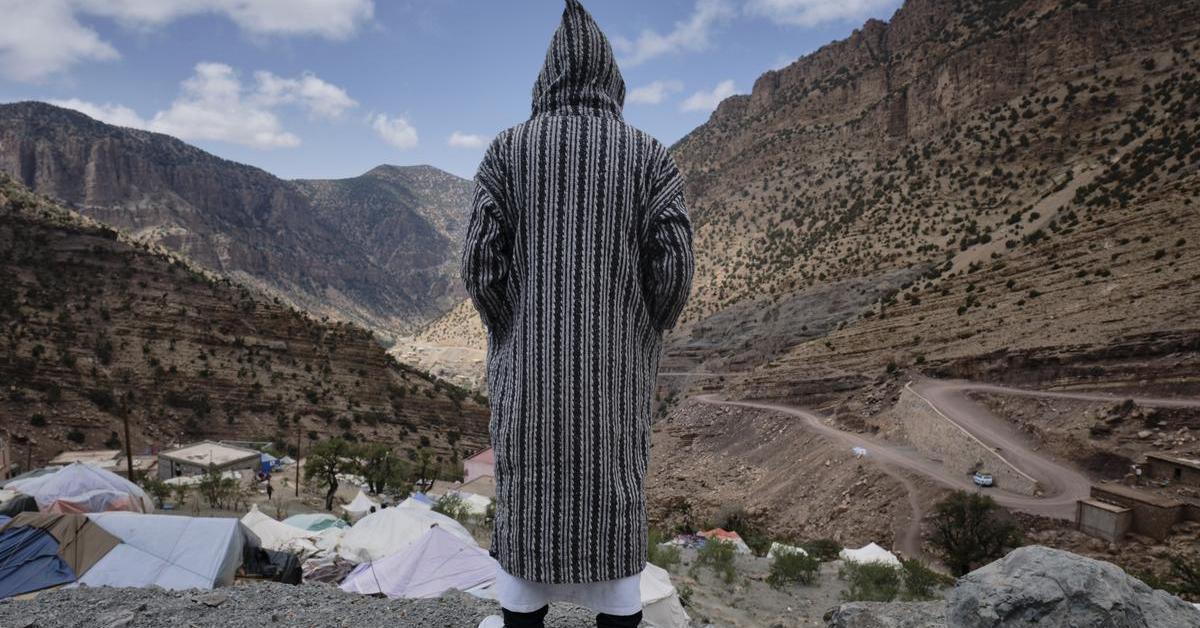
FABIO LOVATI Provisional camps three years after the Morocco earthquake.
FABIO LOVATI
In other words, the report points out that no single material can guarantee safety. The difference in a construction project lies elsewhere: in the quality of execution, the soil study, and maintenance. In a territory exposed to risks, difficult to access, and with extreme weather conditions, a heavy and rigid house can be as problematic as a traditional structure without reinforcement. Salima Naji, an architect and anthropologist committed to the protection of Morocco’s vernacular architecture, has articulated her work based on this premise.
“The use of traditional techniques allows us to work quickly, overcome logistical challenges, and effectively offer safe housing to the communities affected by the earthquake,” says Naji as she shows me a project she is supervising in the Ourika Valley, not far from the epicenter of the earthquake. In this area, Salima Naji collaborates with seismic engineer Aliou Bah on a construction project that combines traditional techniques with contemporary anti-seismic standards.
“If we stick to seismic building codes, the buildings will not collapse,” explains Bah, who addresses another central point: what safety means in a seismic context. “The goal of an earthquake-resistant building is not to avoid damage, but to ensure that people survive and to limit damage as much as possible, even in the event of structural failure.”
FABIO LOVATI A member of the Amazigh communities affected by the 2023 Morocco earthquake three years later.
FABIO LOVATI
Resilient Amazigh techniques
In this sense, certain aspects of traditional architecture can be considered strengths. For example, the flexibility of local materials and the use of buttresses and structural ties that distribute the building’s weight more effectively can be incorporated into Amazigh construction techniques. This makes the buildings more resistant to seismic stress.
In these valleys, Amazigh residents participate in the construction process, which has led to a participatory design approach. “The neighbors showed us where we could find the materials: just behind the hill where the village stands,” says Bah. “This saved us from long logistical delays. The strength of the project lies in sharing and transmitting knowledge. Without this dialogue, many solutions would be unfeasible,” he continues.
This approach makes the contribution of the communities essential. The residents know the materials, the land, and the traditional construction practices on which the reconstruction is based better than anyone. “They are building the houses for their children. Who could take more care in this work than they do?” reflects Naji.
It is difficult to impose these practices from above, which is why they are rarely included in official plans. However, a form of co-design from the grassroots – which has been tested in this area – can help to go beyond standardized reconstruction and propose a model that can be replicated in other mountain areas that are still awaiting funds. This model depends on the training and transmission of local knowledge, which is essential to preserve not only the buildings themselves, but also the architectural culture that conceived and renovated them. As Salima Naji reminds us: “It is not just about rebuilding, but also about preserving a social fabric and a collective knowledge that must be protected today more than ever”.
FABIO LOVATI A boy carrying sand for reconstruction in the High Atlas of Morocco three years after the earthquake.
FABIO LOVATI
FABIO LOVATI Reconstruction in the High Atlas three years after the earthquake.
FABIO LOVATI
Credit: Source link