

House Pledges to Fasttrack Boakai’s Road Agenda | Development
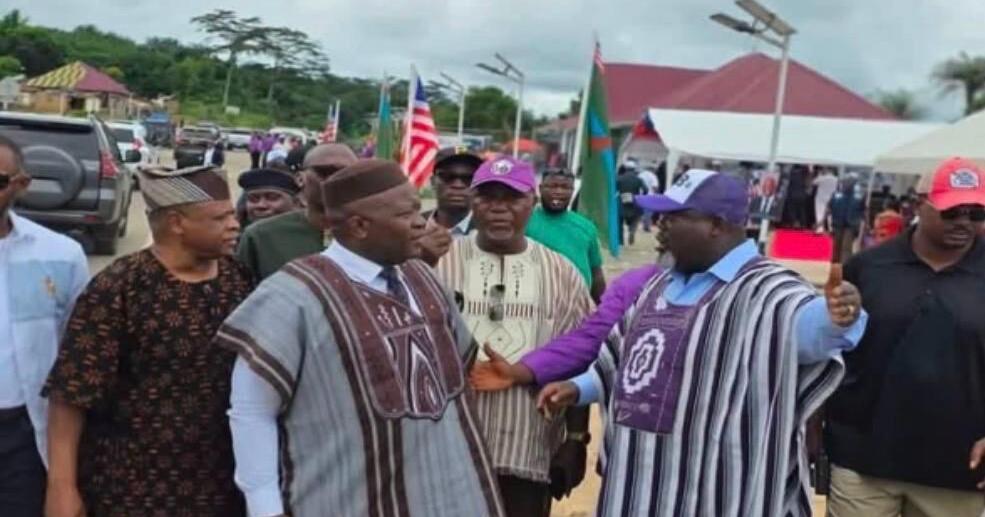
Deputy Speaker of the House of Representatives Thomas P. Fallah, speaking on behalf of Speaker Richard N. Koon and the leadership of the House of Representatives, has reaffirmed the Legislature’s unwavering commitment to partnering with the Executive Branch in advancing President Joseph Nyuma Boakai, Sr.’s ambitious national road infrastructure agenda.
Deputy Speaker Fallah made the commitment on Tuesday during the official dedication of the newly completed Gbarnga–Salayea Highway, describing the project as a landmark investment in Liberia’s national infrastructure programme and a major milestone in the country’s pursuit of sustainable socio-economic transformation.
The commissioning of the strategic highway represents another significant achievement in the Government of Liberia’s efforts to modernize the nation’s transport infrastructure, strengthen regional connectivity, facilitate domestic and cross-border commerce, enhance agricultural productivity, and improve access to education, healthcare, markets, and other essential public services throughout the north-western region.
Addressing the dedication ceremony on behalf of the House Leadership, Deputy Speaker Fallah assured President Boakai that the Legislature would accord the highest parliamentary priority to all Executive communications and legislative instruments relating to road development and strategic public infrastructure.
He disclosed that every legislative proposal connected to road infrastructure—including Executive Bills, loan agreements, sovereign borrowing instruments, financing arrangements, concession agreements, supplementary appropriations, ratification instruments, public investment authorizations, and enabling legislation—would receive what he described as a “10G passage.”
According to Fallah, the phrase signifies the House Leadership’s determination to ensure expeditious parliamentary consideration, committee action, and legislative disposition of infrastructure-related matters.
“Our commitment is to ensure that every legislative instrument intended to support the President’s road development agenda receives prompt parliamentary consideration. Liberia cannot achieve sustainable economic transformation without modern infrastructure,” Deputy Speaker Fallah declared.
The Deputy Speaker’s remarks immediately generated discussion within legislative, constitutional, and parliamentary circles regarding the procedural implications of the phrase “10G passage.”
Although the expression has no formal definition under the Constitution of Liberia or the Standing Rules of the House of Representatives, it has been widely interpreted as a policy commitment by the House Leadership to utilize every lawful parliamentary mechanism to expedite Executive communications and infrastructure-related legislative business while preserving constitutional safeguards, legislative scrutiny, committee oversight, and parliamentary due process.
Under established parliamentary practice, legislative proposals introduced before Plenary are ordinarily read for the First Time and subsequently referred by the Presiding Officer to the appropriate Standing Committee for detailed examination.
The committee stage remains one of the most substantive phases of the legislative process. At this stage, committees conduct clause-by-clause scrutiny, legal and policy analysis, fiscal and budgetary impact assessments, stakeholder consultations, technical briefings, sectoral reviews, and, where necessary, public hearings before adopting findings and recommendations for submission to Plenary through a comprehensive committee report.
Upon the committee’s discharge, the legislative measure ordinarily proceeds through the remaining parliamentary stages, including Second Reading, debate on the general principles and merits of the legislation, consideration of committee recommendations, Third Reading, and final passage before transmission to the Liberian Senate or, where constitutionally required, to the President for assent or other Executive action.
Against this parliamentary backdrop, observers believe Deputy Speaker Fallah’s reference to a “10G passage” reflects the House Leadership’s intention to fast-track infrastructure-related legislative business by according priority status to committee reports, reducing avoidable procedural delays where permissible under the Standing Rules, and ensuring that road-sector legislation is promptly placed on the Order Paper for debate and legislative disposition.
Parliamentary and constitutional scholars, however, observe that any accelerated legislative timetable must remain fully consistent with the Constitution of Liberia, the Standing Rules of the House of Representatives, established parliamentary precedents, and the principles of transparency, accountability, institutional oversight, and the doctrine of separation of powers.
Deputy Speaker Fallah further described the completion of the Gbarnga–Salayea Highway as far more than the construction of a roadway, characterizing it as a strategic investment in Liberia’s long-term economic resilience and infrastructural transformation.
“This highway represents opportunity. It will facilitate trade, reduce transportation costs, connect farmers to markets, improve access to schools and healthcare facilities, encourage private sector investment, strengthen national security, and promote regional economic integration,” he said.
He reaffirmed that the House of Representatives stands prepared to discharge its constitutional mandate by approving the legislative, fiscal, regulatory, and policy framework necessary to sustain the Government’s national infrastructure programme through robust lawmaking, budgetary appropriations, legislative oversight, and ratification of international financing arrangements.
Road infrastructure has historically remained one of Liberia’s foremost development priorities.
Following the conclusion of the country’s fourteen-year civil conflict in 2003, successive administrations prioritized the reconstruction and rehabilitation of highways, bridges, trunk roads, secondary roads, feeder roads, drainage systems, and other strategic public infrastructure destroyed or neglected during years of conflict.
During the administration of former President Ellen Johnson Sirleaf, substantial infrastructure investments undertaken in partnership with multilateral and bilateral development institutions resulted in the reconstruction of major sections of the Monrovia–Gbarnga Highway and other strategic transport corridors, significantly improving national connectivity, facilitating trade, and strengthening regional economic integration.
Former President George Manneh Weah expanded Liberia’s infrastructure portfolio through the construction and rehabilitation of several strategic highways, including the ELWA–RIA Highway, the Ganta–Saclepea Road, and numerous urban streets and feeder road projects financed through domestic appropriations and external development financing.
Building upon those achievements, President Boakai has elevated infrastructure development to a central pillar of his ARREST Agenda for Inclusive Development (AAID), committing his administration to expanding all-weather road networks, rehabilitating farm-to-market roads, strengthening regional transport corridors, and improving nationwide connectivity as catalysts for inclusive economic growth, agricultural commercialization, private-sector expansion, and structural economic transformation.
Under Liberia’s constitutional framework, the Legislature exercises authority over lawmaking, national budget appropriations, ratification of international financing agreements, approval of sovereign borrowing where required by law, and oversight of Executive implementation.
Consequently, virtually every major nationally funded or externally financed infrastructure project requires legislative concurrence before implementation.
Deputy Speaker Fallah concluded that sustained collaboration between the Executive and Legislative branches remains indispensable to achieving Liberia’s long-term infrastructure objectives.
He stressed that infrastructure development transcends partisan politics because it directly influences economic productivity, employment generation, investment promotion, agricultural development, regional integration, and the overall quality of life of the Liberian people.
The dedication of the Gbarnga–Salayea Highway, coupled with the House Leadership’s pledge of “10G” legislative support, underscores what government officials describe as a renewed national commitment to accelerating Liberia’s infrastructure transformation through stronger Executive–Legislative collaboration, timely parliamentary action, sound public investment, and sustained development of strategic national infrastructure.
Credit: Source link