

Germany Contributes €10 Million to Joint Resilience Programme in Somalia
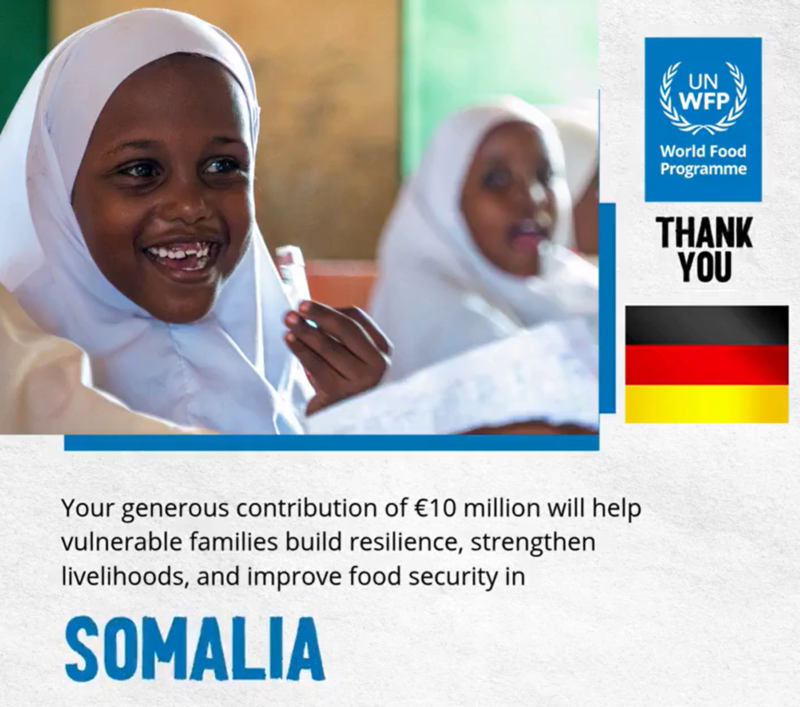
MOGADISHU — Germany has contributed €10 million to the Joint Resilience Programme in Somalia, a multi-partner initiative aimed at strengthening community resilience against recurring climate shocks including droughts and floods. The funding brings the total German contribution to the programme to EUR 30 million since its inception.
The funding, provided through the Federal Ministry for Economic Cooperation and Development (BMZ) and KfW Development Bank, supports a programme implemented jointly by the World Food Programme (WFP) and UNICEF in collaboration with the Federal Government of Somalia. The Joint Resilience Programme delivers an integrated package of interventions covering food security, health services, nutrition, water and sanitation, education, and livelihood support.
Germany has been a consistent partner in Somalia’s resilience-building efforts, serving as UNICEF’s second-largest resource partner for four consecutive years. The German government’s commitment to flexible funding has enabled the programme to respond effectively to changing needs while maintaining a focus on long-term development outcomes.
Programme Scope and Objectives
This latest contribution expands on previous phases of the Joint Resilience Programme, which have been implemented in the Gedo region since 2018 with an initial allocation of EUR 30 million from the German government. The new phase targets communities in Puntland and Galmudug states, where the programme aims to reach approximately one million people across North Galkayo, South Galkayo, Galdogob, and Dhusamareb districts over an 18-month period.
The programme focuses on households affected by malnutrition, children, pregnant and lactating women, and internally displaced persons. Key interventions include improving access to clean water and sanitation facilities, promoting equitable access to basic education, and providing nutritional support and maternal health services. The economic livelihoods and food security of target communities are also strengthened through integrated programming.
The Joint Resilience Programme operates through a collaborative framework bringing together the Federal Government of Somalia, federal member states, FAO, UNICEF, WFP, and KfW. A Project Steering Committee meeting convened in Mogadishu brought together key government ministries, development partners, and implementing agencies to address challenges and advance efforts to transition from humanitarian support to long-term sustainability through community-driven interventions in education, water and sanitation, nutrition, and livelihoods.
Measurable Impact
The Joint Resilience Programme has demonstrated measurable results since its inception. Acute malnutrition rates among children under five in the programme areas decreased from 13 percent in 2019 to approximately 10 percent in 2022. The programme has supported 100 treatment centres operating to treat acutely malnourished children affected by drought, improving the health of thousands of children and breastfeeding mothers.
In education, 95 percent of the 45,000 children in schools supported by the programme have remained in school, with 35,000 continuing to benefit from nutritious school meals. The programme has also provided free health, nutrition, water, sanitation and hygiene, and child protection services at UNICEF-supported sites, addressing the multiple drivers of vulnerability faced by displaced communities.
In Galkayo’s Bula Bisharo area, children are currently receiving lifesaving nutrition support as part of the Joint Resilience Programme initiative, which focuses on increasing access to inclusive, child-friendly education, improving water and sanitation facilities in schools, and enhancing health and nutrition services for children at pre-primary and primary levels. The initiative also aims to reduce micronutrient deficiencies among young children and pregnant and breastfeeding women, and to improve food security and livelihoods through diversified agricultural production and income generation.
The programme builds on broader resilience efforts across Somalia. The African Development Bank-supported ACALS project is strengthening agricultural and pastoral systems in Hirshabelle and Puntland states. In Galmudug, the Ministry of Health, in collaboration with UNICEF and WFP, has been providing critical nutrition services to at-risk children and families through the Joint Resilience Programme at nutrition centres, offering therapeutic feeding, community-based nutrition education, and vital health screenings.
Critical Note
The German contribution represents a significant investment in Somalia’s resilience infrastructure, but questions remain about the sustainability of such programmes beyond donor funding cycles. While the Joint Resilience Programme has achieved notable results in reducing malnutrition and improving school retention, evaluations of previous phases have highlighted challenges in maintaining positive outcomes in the face of recurring climate shocks. The programme’s effectiveness has at times been undermined by droughts and floods that erode gains made during implementation periods.
The transition from humanitarian aid to resilience-building requires not just donor funding but also strengthened government capacity to manage and sustain these systems. The federal and state governments must prioritise the handover of assets and the integration of resilience programmes into national development frameworks to prevent a return to dependency when external funding ends. Without addressing the underlying governance deficits that have historically undermined long-term development in Somalia, even well-funded resilience programmes risk becoming temporary fixes rather than lasting solutions.
Recommended Reading On ftlsomalia.com
Credit: Source link