

Twenty years after Blood Diamond, most stones are still n…
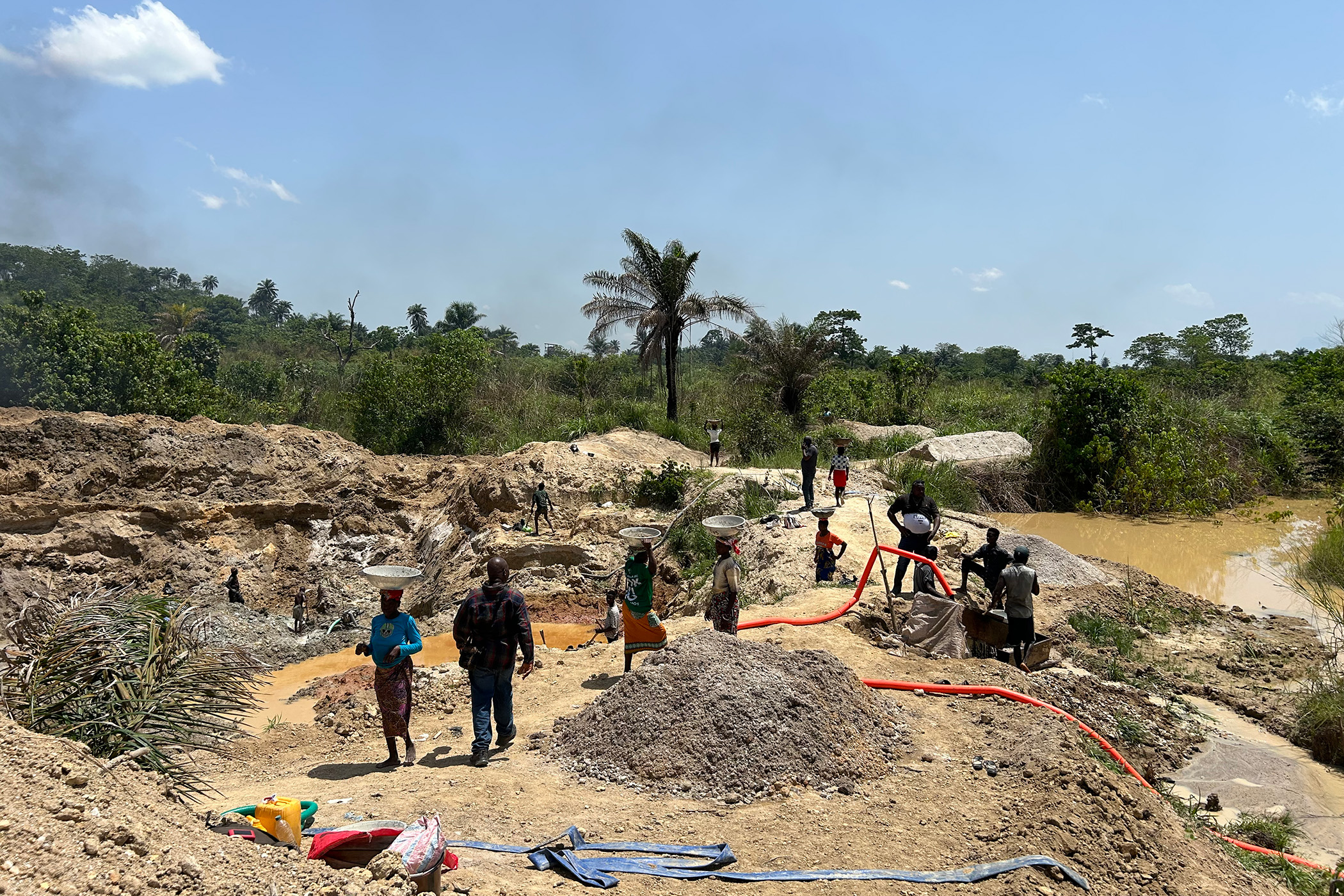
Reverend Sam may be a man of God but he didn’t get ahead in the diamond game through divine intervention.
Eight years ago he started digging for gems, and business has been good. “I’ve built three houses,” he says. “You should see my cars. I’ve put my children through university thanks to diamonds.”
It’s not yet midday in Kono, eastern Sierra Leone, but it’s already punishingly hot. Sam stands on the lip of a pit at least 30ft deep with muddy water at the bottom. Men stripped to the waist hack at the earth with shovels and pickaxes and women carry dirt up from the hole in buckets on their heads to a wooden trough, where their loads are blasted with water. From there, the stones are loaded on to a thumping jigger that vibrates them to separate them for size and weight.
Sam doesn’t own the land. Instead, he invests in the excavation, bringing his own crew of “boys”. Anything he finds is split with the landowner: Sam gets 70% of the profits, the owner 30%. The workers get a daily wage of 60 leones (about $2.50) for an eight-hour shift with a half-hour lunch break.
Reverend Sam gets 70% of the profits from the diamond mine he excavates near Kono
“There’s no contract, no insurance, no healthcare – except, you want to be human, so I try to look after [them],” Sam says. “But if they find anything, it belongs to me.”
Workers who steal, or lie about finding a stone, are fired on the spot. Occasionally, Sam gets the police involved, but usually he prefers to resolve the matter quietly. “Trust is everything in the diamond business,” he says.
Sierra Leone’s diamonds gained international notoriety during the country’s civil war, fought between 1991 and 2002, in which as many as 70,000 people were killed and more than 2.5 million displaced – more than half the country’s population at that time.
Were diamonds the cause of this misery? That was the conclusion of Blood Diamond, the 2006 thriller set largely in Kono, starring Leonardo DiCaprio as a South African diamond smuggler who teams up with a miner to find a legendary gem and the miner’s missing son. While the film sold itself as an action thriller, its political message was clear. “People back home wouldn’t buy a ring if they knew it had cost someone their hand,” one character tells another.
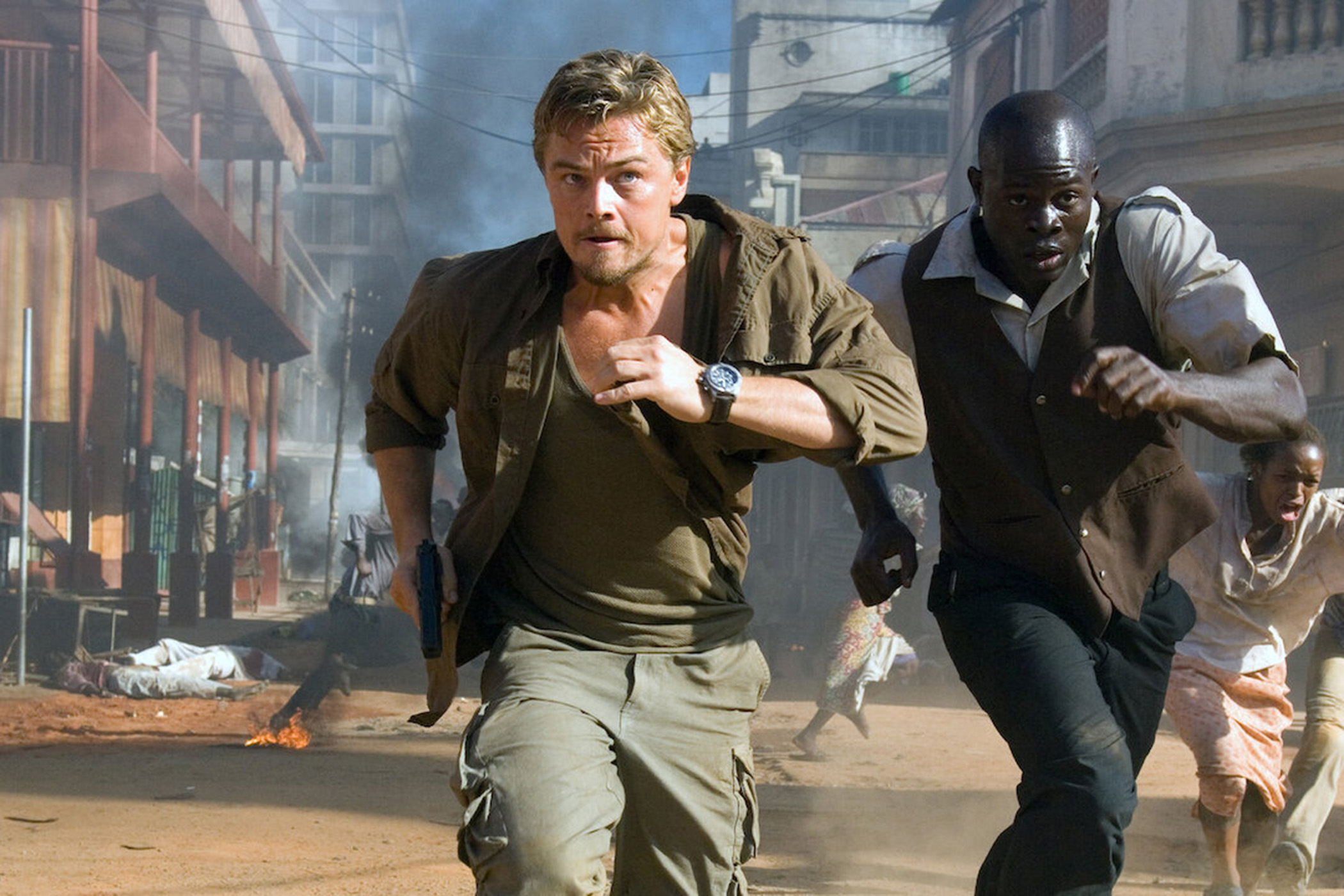
Leonardo DiCaprio and Djimon Hounsou in Blood Diamond
So effective was Blood Diamond in shaping perceptions of the industry that two decades on, many people who work in it feel they’re still playing catch-up.
“The lack of education among the public is a huge frustration,” says Phil Brilus, diamond polishing and manufacturing manager for De Beers, a company whose path to exclusive mining rights – for 99 years, beginning in 1935 – was facilitated by the British colonial government. He says the prevailing narrative on social media – that all natural diamonds are blood diamonds – is “nonsense”, and that the industry has to start telling “the good news about natural diamonds”.
Sign up to newsletters from The Observer
For information about how The Observer protects your data, read our Privacy Policy
In 2018 De Beers launched a partnership scheme with local Sierra Leonean mines, called GemFair. Mining firms that sign up must guarantee minimum working standards. In return, De Beers honours the international market price for any stones found. It also tags each stone with a unique digital ID, which is logged on a blockchain: customers can, in theory, trace their gem back to the individual miner who pulled it from the ground.
But GemFair represents only a tiny fraction of the global diamond industry. De Beers’s own estimates suggest it accounts for less than a percentage point of its annual production. So, 20 years after Blood Diamond, has the industry truly left behind the horrors of the past?
The global natural diamond market is in decline. In April the price of natural diamonds fell to its lowest level on record. Industry analysis suggests global production peaked in 2005. Mining diamonds is costly, risky and far from a sure bet: only 30 significant natural diamond mines are in production worldwide. It is getting harder to find viable deposits. In the past five years, major mines have closed, including De Beers’s flagship Venetia mine in South Africa.
The significant investment a diamond represents to customers – three months’ salary, as per a De Beers marketing slogan – tends to disguise what a risky industry it can be. For a business that sells itself on promises of durability and eternal desire, the rise of synthetic diamonds and ever-declining natural stocks are an existential threat.
Most of the world’s diamonds come from “kimberlite pipes”, gyres of superheated rock forced up from within the Earth’s crust, where the extreme pressure and temperature solidifies carbon into diamonds. Such diamonds are typically extracted through large-scale industrial mines, but in some areas these kimberlite pipes erode close to the surface, and their cargo of diamonds lies a few feet below ground. These alluvial diamonds are targeted by “artisanal” miners: small operations of perhaps a handful of workers, digging by hand with primitive equipment. While natural diamonds mined this way represent only 10-15% of the global trade, they play a large part in the economy – and culture – of poorer countries such as Angola, the Democratic Republic of Congo and Sierra Leone.
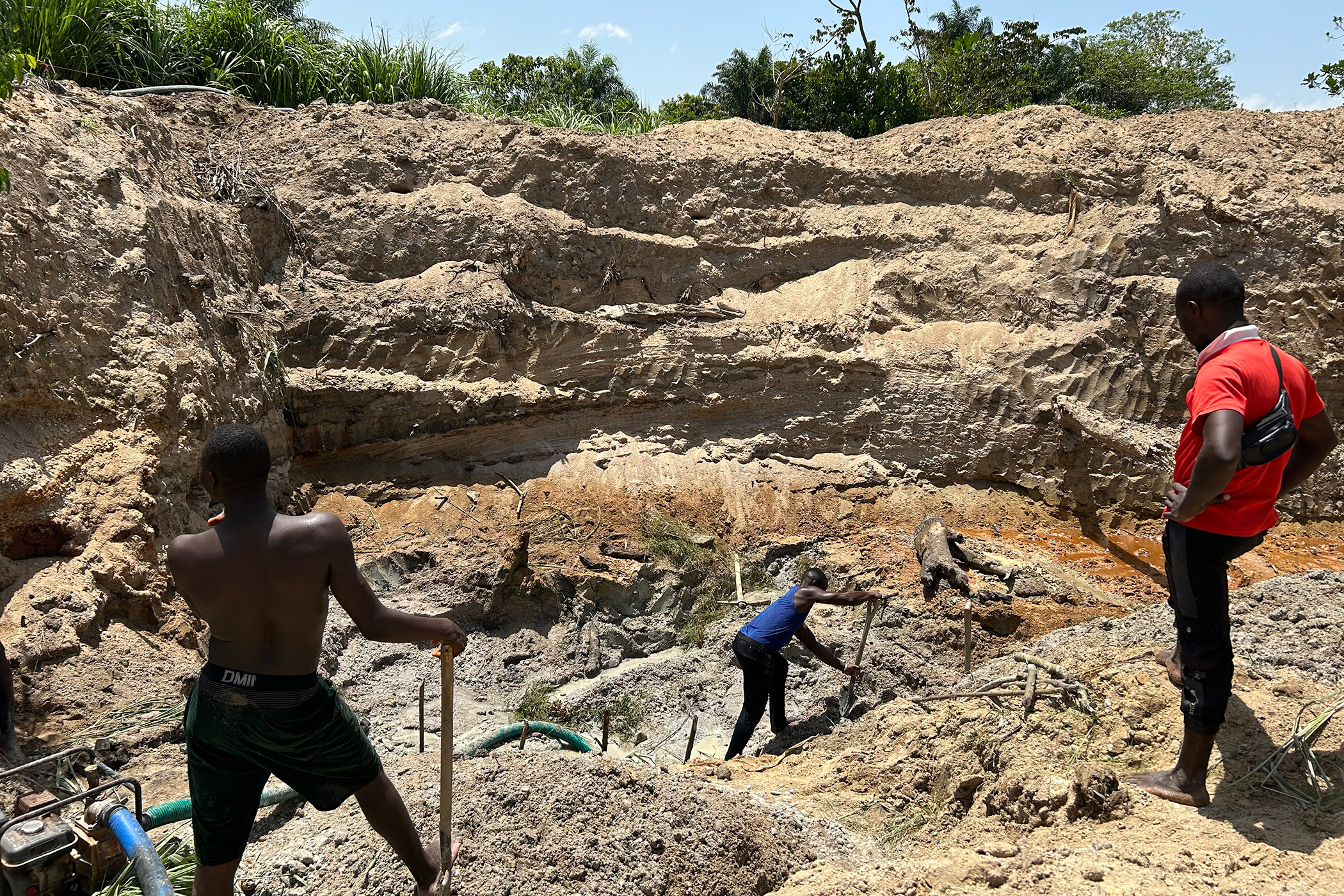
An artisanal mine near Kono
A few miles outside Koidu, in Sierra Leone’s Kono district, the landscape begins to change. The dense, hilly scrubland of eastern Sierra Leone opens into a meandering river valley. Between palm trees and green lozenges of farmland, the ground is pockmarked by craters full of stagnant water – the abandoned excavations of opportunist miners. Alluvial diamonds are the basis of Kono’s reputation: impossible riches waiting to be plucked from a bucket of gravel.
Undoubtedly, they have changed lives in Kono. And not just for a few wealthy middlemen. Sebru Joe is an artisanal miner turned community organiser. “My father had a few plots of land. We did some farming, but that was just to feed ourselves – our family was supported financially through gold and diamond mining. I was educated up to university level because of diamonds.”
‘In my grandfather’s time, you could say “put the rice on for lunch, I’m going to find you a diamond” and you could come back half an hour later with a gem’
‘In my grandfather’s time, you could say “put the rice on for lunch, I’m going to find you a diamond” and you could come back half an hour later with a gem’
Sebru Joe, community organiser in Kono
The way he tells it, when he was a young man Joe was panning for diamonds in his father’s stream. He found a hefty stone and, realising its worth, cut a hole in his sandal and hid it inside. He then walked and hitchhiked to Ghana, a journey of nearly 2,000km across three borders. He was 19 and when he arrived in Accra, he sold the stone and paid for his fees at university in the capital. After becoming homesick, he returned to Sierra Leone, where he was able to find work and continue his education, eventually getting into mining and then finance.
He doubts a similar journey would be possible now. “In my grandfather’s time, you could say: ‘Put the rice on for lunch, I’m going to find a diamond’ and you could come back half an hour later with a gem. Today, it is much more difficult – you need to dig deep, you need earth-movers, heavy equipment. Artisanal mining hasn’t completely gone, but it’s very reduced.”
An end to conflict diamonds
Before 2003, the diamond trade was all but unregulated. But since the implementation of the Kimberley Process (KP) – named after a diamond-mining region in South Africa – more than 86 countries representing almost all of global production have signed up to an international certification scheme that aims to cut conflict diamonds out of the trade.
Under the scheme, rough diamonds must be exported in clear plastic tamper-proof bags accompanied by a certificate listing their country of origin. Depending on the value of the stones inside, this “baggie” may contain goods worth hundreds of thousands of pounds.
The KP has its flaws. One is its limited definition of what constitutes a “conflict diamond”. Russian diamonds, for instance, which have been sanctioned since the full-scale invasion of Ukraine in 2022, are not classified as such.
Still, the scheme has been a success, argues Andrew Grant, an associate professor in the department of political studies at Queen’s University in Ontario, Canada, who has followed it since its implementation. “Before the KP, anything went,” he says. “Now it’s almost impossible for a consumer in the west, who is buying from a legitimate dealer, to end up with a blood diamond.”
In Koidu, though, it wasn’t hard to find evidence of the industry’s dark side. One source, a South African who called himself a diamond hunter, said: “I’ve worked for mercenary groups, terror groups, some really rich people… there’s always some illegal shit behind it somewhere.” A Koidu dealer who gave his name as Jimmy said there were overland routes through Liberia if I had “a big stone to move”. But he also admitted they were “very dangerous” – and that I might be better off stumping up the export tax.
The majority of stones that leave Sierra Leone seem to do so legally. In the 2023 update of its Mines and Minerals Act, the country promises that 70% of an exported stone’s wealth will go to its owner. “If a diamond is worth $1m, and I’m going to get 70%, that’s a lot of money for me,” notes Sam. “So I’d rather sell the diamond to the government than smuggle it through Guinea. If I know I’m going to get a fair price on the world market, what is the point in smuggling?”
‘Diamonds are like potatoes’
Traceability has its limits, though. The journey of a diamond from a mine in its origin country to a ring on someone’s finger in the west may be as short as six months. But during that time it will have changed form multiple times, and travelled thousands of miles.
Berdj Anastassian, an Antwerp-based diamond expert, is sceptical that there is full traceability in the supply chain. “Diamonds are like potatoes,” he says. “You can only really make a profit if you export in bulk.”
Tracing diamonds, he added, is “a great idea” but only works at the luxury end of the market. “The £1,500 stones every Tom, Dick and Harry is buying for their wives? Not a chance.”
In the cheaper arcades of Hatton Garden, central London’s historic diamond and jewellery district, bulky unsmiling men in dark glasses and caps stand in front of display cases of glittering jewellery. “Once it’s cut, you can’t tell where it’s come from,” one says, adding that those who are concerned about provenance should choose lab-grown diamonds. “Honestly mate, she wouldn’t even know.”
Synthetic diamonds have long been used in industry. Manufacturing them is energy-intensive but costs have come down far enough in the past decade to make them viable for jewellery. Sold on the promise of ethics and environmental responsibility – and at a fraction of the cost of natural diamonds – they have turned the trade on its head.
“The threat from synthetics and fakes is massive,” says Wulf Rabstein, whose grandfather, a Jewish refugee from Nazi-occupied Antwerp, was one of the founders of the London Diamond Bourse, and who now serves as treasurer of the trading floor and members organisation. “We’ve had to become much more academic and scientific. Every stone that passes through our hands has to be scrutinised.”
The impact of synthetics is being felt where diamonds are mined and where they are sold.
In Koidu the talk of the town is the closure last March of the Koidu Ltd diamond mine, Sierra Leone’s largest producer. Owned via various shell companies by the Israeli billionaire Beny Steinmetz, the heavily fortified site dominates the town.
It was one of the area’s biggest employers. When it shut more than 1,000 workers lost their jobs overnight, but disputes over working conditions, pollution and payment agreements drag on.
By law, mining companies in Sierra Leone must give 1% of their revenue to the local community, but one community activist has claimed that Koidu Ltd owed $800,000 in missed payments.
The company blamed the closure of the mine on a deadlock over a rights abuse lawsuit. But the suspicion among many in Kono was that it was leaving for good – the diamonds were simply exhausted. Koidu Ltd was approached for comment but did not respond.
On the “diamond floor” at the London headquarters of De Beers – a secure white room that would once have hummed with activity but is now almost deserted – a fresh shipment of rough Sierra Leone diamonds lies on a large sheet of paper, the Kimberley Process certificate that came with it nearby.
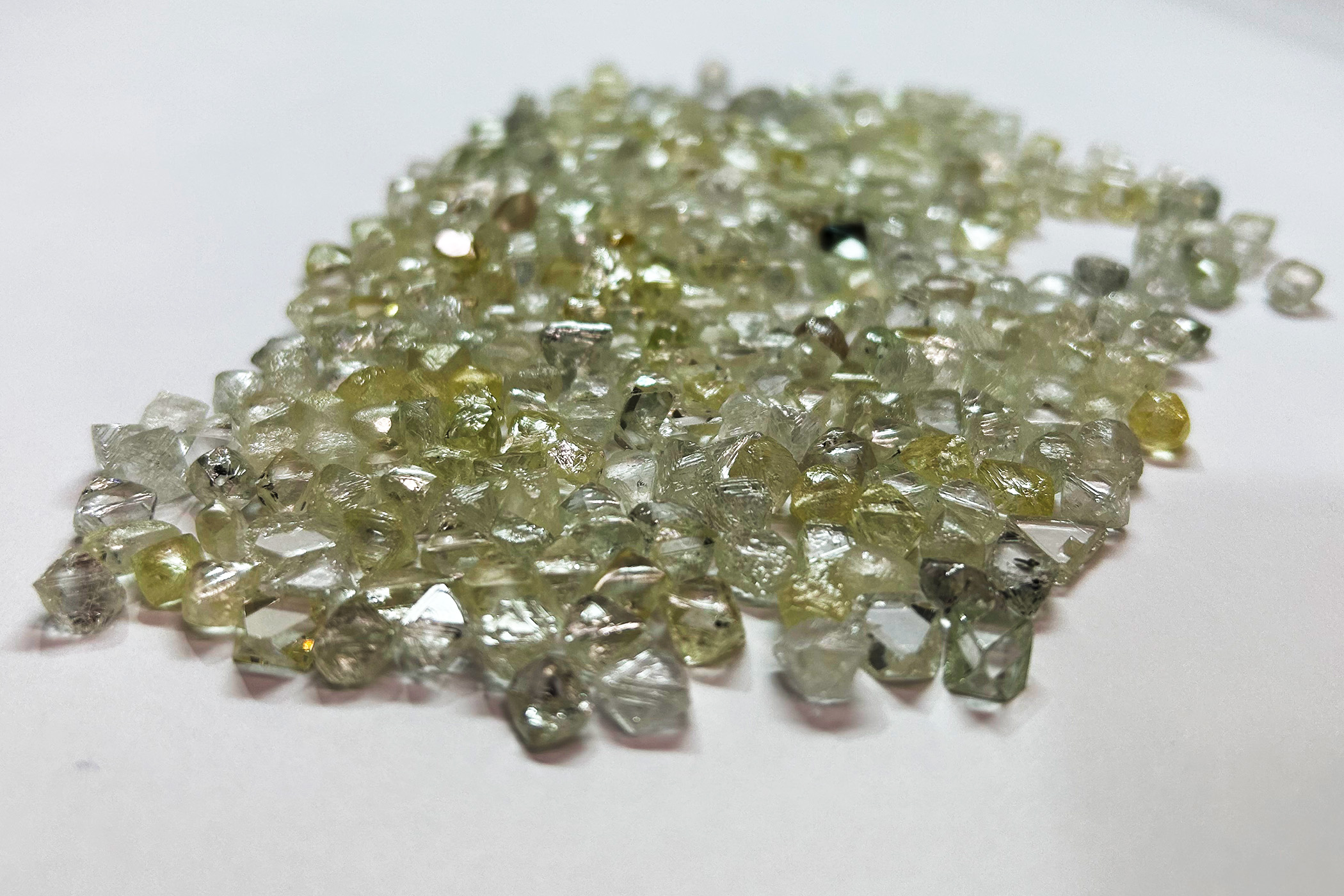
I pick up a large stone and peer at it through a loupe: the diamond’s facets are perfect, geometric, alien; the interior explodes with light.
“Diamonds are miraculous,” says Charlotte Rose, president of the London Diamond Bourse. “If you think about all the forces at play deep in the earth, all those thousands of years of heat and pressure – all to end up on someone’s finger. That’s the most wonderful story of all.”
Like many in the industry, she sees herself battling negative narratives about natural diamonds that are at least 20 years out of date. “There are no good or bad diamonds,” she says. “Only good or bad people.”
Back in Kono, nothing has yet been found and groups of exhausted workers huddle in the shade, waiting for small boys to totter over with jerrycans of water balanced on their heads – a brief respite from their unending labour.
Reverend Sam calls over his foreman, Francis. He tells me that Francis once discovered a 38-carat diamond worth as much as $7.5m (£5.5m) in today’s prices. But Francis didn’t get more for the find than his day’s wages.
Mining, Francis says, “is hard work, but it’s a job, by the grace of God”. He seems awkward in the presence of his boss, and soon slips away.
Photographs by Alex Diggins; Warner Bros. Pictures;
Credit: Source link