

The real meaning of lifelong care: Chimps at our Liberia sanctuary receive full health check-ups
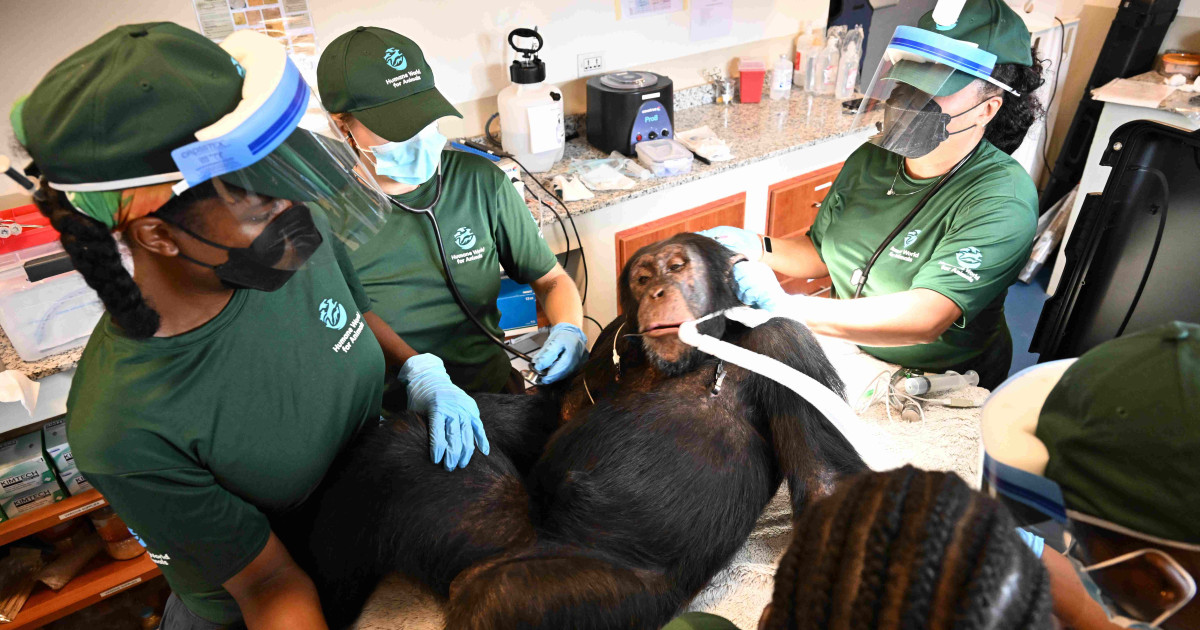
Years ago, we took on responsibility for the care of dozens of chimpanzees once used in invasive biomedical experiments at a remote site on the Atlantic coast of Liberia—now the Humane World for Animals’ Second Chance Chimpanzee Refuge Liberia. Since then, we have met the challenge of bringing high levels of care to these chimps, so they have full, happy and healthy lives.
This means providing comprehensive veterinary examinations to assess their overall health and long-term needs. And it means being able to detect early signs of disease and developing tailored treatment plans for each of them as individuals.
Last week, the sanctuary’s veterinary team, with the help of invited specialists, completed just such a round of assessments for a small group of chimps at the sanctuary’s mainland headquarters while their island home receives an upgrade (which will include its own facility for routine health checks and extreme weather sheltering).
The meaning of lifelong care for chimps
Most of the chimps at the sanctuary are part of an older cohort, and that raises unusual challenges. Many live with health conditions that developed during their years in the laboratory, where they were used in harmful experiments. Because the chimps have suffered so much, and survived so much, we take nothing for granted when it comes to their care.
The exams involved evaluations of each chimp’s eyesight, lungs, abdomen and mobility, along with blood tests and a heart scan. Each chimp received booster vaccinations. Finally, the chimps all received a full-scale teeth cleaning and a fingernail trim, which helps to maintain dexterity for climbing, foraging and manipulating food and objects.
Every chimpanzee treated was placed under an anesthetic to facilitate and carry out these examinations safely, efficiently and with minimal stress.
Overcoming their painful past, these chimps now have lives worth living
The chimpanzees who received the health checks are part of a larger population of chimps once used in invasive biomedical experiments, including being infected with hepatitis and river blindness, an eye sickness caused by a parasite.
As a result, they cannot be released; but they can and do live a near-wild existence on a series of mangrove forest-covered islands in the Farmington and Little Bassa rivers that together comprise our unique Second Chance Chimpanzee Refuge. In this habitat, they roam freely, build their nests, feed on leaves, wild nuts and interact in social groups. It’s a far cry from the want and suffering they endured after their abandonment by a U.S. laboratory, two civil wars and an outbreak of Ebola in Liberia prior to us pledging their lifetime care.
The people giving these chimps the lives they deserve
I’ve written and spoken about our dedicated staff members, but I cannot praise them enough. They are truly the guardians of the chimps and the entire enterprise that now sustains them. In many cases, their devotion to the welfare of these remarkable, resilient animals in a more difficult time built the bridge to the present day, and our role in creating and maintaining the sanctuary.
Our dedicated caregivers travel twice a day to the islands to provide the chimps with fresh, locally sourced fruits and vegetables, and appropriate medications. We use these opportunities to make assessments about veterinary care and other needs that might require hands-on medical examination.
In addition, our wardens play an essential role in keeping the chimpanzees safe and undisturbed by patrolling each island and preventing intruders from entering the sanctuary.
And they are not alone in this good work. Other team members include security personnel, maintenance technicians and office staff, who also play crucial roles in the management and operations of the sanctuary. Today, Second Chance Chimpanzee Refuge has 45 employees, most of whom are from local communities.
In addition to the incentives and benefits we provide to staff members, we have supported local initiatives that benefit communities near the sanctuary. Our colleagues at the sanctuary live in those communities, with their families and neighbors. They rely on the same roads and the same sources of drinking water that we do in carrying out our work at the sanctuary. Their children go to schools where the lessons of compassion and concern for wildlife manifested at the sanctuary will thrive long into the future.
In the same vein, Humane World for Animals Liberia also supports wildlife protection projects around the sanctuary including protecting the forest ecosystem and its wildlife inhabitants from logging, poaching and destruction for farmland.
Once abandoned to die, chimps at our Liberia sanctuary now thrive in safety, comfort and good health. And their presence in Liberia, a significant hub of global biodiversity, is a reminder not just of humankind’s moral responsibility to care for animals, and the duty of mercy we owe to them, but of their extraordinary resilience in the face of adversity. These chimps, used and discarded after experiments, are now involved in another far more benign kind of experiment, one that focuses on human-animal coexistence, and a better vision of the world, one that’s safer and better for all of us.
Kitty Block is president and CEO of Humane World for Animals. Follow Kitty Block on X.
Credit: Source link