

The Goldilocks Fallacy: The Undefined Limits of Korea’s Nuclear Role
“Unthreatening and respectful.” That is how the president of the United States described North Korea on Aug. 16, 2026, in his social media post ordering his secretary of defense to scale back joint exercises with South Korea. Two years earlier in Seoul, the U.S.-South Korean alliance agreed that South Korea’s role in an American nuclear operation would involve exercises and training, formalizing those guidelines at a Nuclear Consultative Group meeting co-chaired by Vipin Narang, then-acting assistant secretary of defense for space policy.
Three weeks before the president’s post, on July 24, Narang spoke at the second Deterrence Symposium hosted by South Korea’s Strategic Command. Under the title “Goldilocks of the Nuclear Extended Deterrence,” he delivered a clear diagnosis of South Korea’s nuclear policy. The policies South Korea can pursue, he said, divide broadly into three. Denuclearizing North Korea is for now close to a delusion, and South Korea’s own nuclear armament brings long-term pain and risk, so the optimal policy for meeting North Korea’s advancing nuclear and missile threat is the Goldilocks choice of strengthening American extended deterrence — the “just right” option that avoids both extremes.
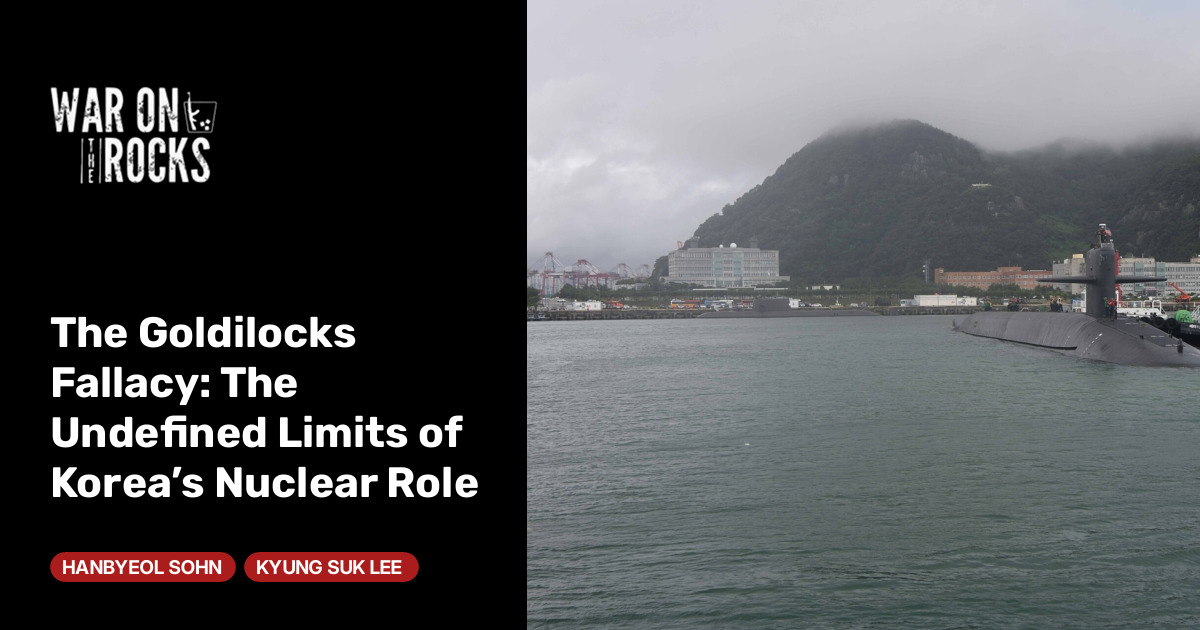
Narang then offered a further Goldilocks choice among the options for strengthening extended deterrence, ruling out the redeployment of ground-based tactical nuclear weapons and NATO-style nuclear sharing. The core argument was that forward-deployed nuclear weapons might not be fully usable from an operational standpoint and could divert resources and attention from conventional missions. He offered a sea-based asset as an alternative: the sea-launched cruise missile, a low-yield nuclear cruise missile fired from U.S. Navy submarines.
Read into what Narang excluded, and the underlying premise becomes apparent: The significance of this preference is that a submarine-launched weapon keeps both the operation and delivery of the nuclear asset exclusively in American hands. . In other words, Narang’s point is that in the Indo-Pacific, Americans — and Americans only — should fire American nuclear weapons, in sharp contrast to Europe, where NATO allies are assigned the wartime mission of delivering U.S. nuclear weapons under established procedures. The deeper question is how far South Korea’s role should extend in operating and delivering American nuclear weapons, but rather than simply debating whether warheads return to the Korean Peninsula, it also asks why Korea’s role differs from Europe’s.
The reason it is urgent to press this question of nuclear role-sharing is that between North Korea’s conventional provocation and America’s strategic nuclear weapons, particularly at the moment North Korea crosses the threshold with a low-yield tactical weapon, a deterrence gap exists that neither South Korea nor the United States alone can fully cover.
The Goldilocks Thermometer
Goldilocks is the main character from a children’s story. Uninvited, a girl enters a home where three bears live. There she finds three bowls of porridge and picks the one that is not too hot, not too cold, but “just right.” She does not set the table. She chooses among bowls someone else has already placed upon it. Logic has a name for the more familiar version of this problem. The “argument to moderation” (argumentum ad temperantiam) is the fallacy of assuming that the midpoint between two extremes is correct, simply because it is the midpoint. Narang’s problem lies in where he set the upper and lower extremes, not in his having chosen the middle.
The metaphor presupposes one more thing: a single ruler. Porridge is ordered by temperature and nothing else. The debate over tactical nuclear redeployment in South Korea has no such ruler, because it consists of three different questions. The first is the question of “designation”: Is that American nuclear weapon designated for the Korean theater? Second, the question of “deployment”: Is that weapon inside or outside of the peninsula? Third, the question of “role”: Does the United States or South Korea fire the weapon during a contingency?
These three questions are distinct, but they are also sequentially related. A South Korean F-35 cannot fire a warhead stored in a vault in the continental United States, so South Korea’s “role” in operating and delivering an American nuclear weapon presupposes the “forward deployment” of that weapon to the peninsula. Because the two allies should decide which assets are intended for a Korean contingency before deciding where to base them, theater designation should precede any decision on forward deployment. In short, the ruler of role rests on the ruler of deployment, and the ruler of deployment rests on the ruler of designation, and never the reverse. A direct South Korean execution role would require access to a weapon deployed where South Korean forces could operate it. Designation requires no deployment at all.
Stacking the three rulers does not make them one question. The problem arises when the Goldilocks frame lumps these three stacked rulers together into a single scale. At that moment, South Korea’s nuclear role becomes an appendage of forward deployment, never treated as an independent question. Once the United States decides not to forward-deploy nuclear weapons to South Korea, the question of South Korea’s role disappears before it even needs to be asked. In the end, the real fallacy of the Goldilocks metaphor lies not in Narang choosing the middle, but in his cramming of three originally different rulers onto one scale and simplifying them.
Europe’s Goldilocks, and Korea’s
Should these three rulers be stacked into one? The best evidence for a “no” answer is Narang’s own writing, including his 2025 article in Foreign Affairs, co-authored with Pranay Vaddi, “How to Survive the New Nuclear Age,” where Narang keeps these three apart — at least where Europe is concerned — and discusses designation, deployment, and role individually. The two authors diagnose that Russia possesses up to 2,000 low-yield battlefield nuclear weapons “unconstrained by any existing arms control,” and posit that there is an opportunity for Europe to build resilience in the nuclear mission by using the F-35 program that allies operate jointly. They go further, placing even ground-based options on the table for consideration to replace the B61-12 gravity bomb. This concern is not that of the two authors alone. Linde Desmaele and Austin Cooper likewise begin from the diagnosis that there is an empty rung on Europe’s escalation ladder and propose filling that gap with high-yield conventional precision strikes. In Europe, the debate over what to fill that gap with is underway.
Narang and Vaddi further diagnosed that the theater nuclear gap in the Indo-Pacific is more serious than that of Europe. For the Indo-Pacific, they described that “the regional nuclear cupboard is even more bare,” and that while B-2s and B-52s from the continental United States can deploy gravity bombs and long-range air-launched cruise missiles, the “tyranny of distance” degrades the bombers’ effectiveness. In that sense, Narang is by no means a nuclear reductionist. He is an advocate of expansion, arguing that for the first time in this century, the United States should develop “more, different, and better” nuclear capabilities and deploy them in new ways.
The real asymmetry between Europe and the Indo-Pacific, therefore, has little to do with whether to expand nuclear weapons. The key asymmetry is that Narang recommends different approaches to the theater nuclear gap in Europe and on the Korean Peninsula. For Europe, he prescribes a nuclear mission performed by allies and ground-based options. For the Indo-Pacific, and more narrowly, the Korean Peninsula, he prescribes sea-based assets that only the United States operates. Narang opposes ground-based nuclear deployment on South Korean territory, and South Korea performing the nuclear mission directly. Narang does not oppose tactical nuclear weapons as a category. Yet in Europe he is willing to consider both a greater allied nuclear role and ground-based nuclear options.
Narang justifies this asymmetry based on geography. Europe is a continental theater, so a ground-based posture is natural, whereas the Indo-Pacific is a vast maritime theater, so sea-based assets are reasonable. The point itself is correct. What geography justifies is at most the form of deployment, or “what to put where.” It leaves undetermined the questions of designation and role: “Will the United States designate that asset to the Korean theater?” and “How far will South Korea participate in operating it?” This is because theater designation is conceptually separate from the physical location of an asset. The maritime character of the theater precludes neither designating a sea-launched weapon for Korean contingencies nor involving South Korea in planning and targeting for its potential use. In short, geography can serve as an argument that distinguishes the form of deployment. It cannot serve as an argument for excluding the role.
There is, of course, historical background to the Korean Peninsula’s omission from this prescription. In 1991, with the end of the Cold War, the United States withdrew its tactical nuclear weapons from the Korean Peninsula, and thereafter the character of the threat changed from existential to regional. Jennifer Lind and Daryl G. Press pointed to precisely this transition in their 2026 article in Foreign Affairs, “The Broken Nuclear Umbrella.” Extended deterrence had credibility during the Cold War because Washington regarded a Soviet conquest of Western Europe as an existential matter threatening America’s survival. After the Soviet collapse, as the United States came to face “regional security challenges, rather than near-existential threats,” its incentive to risk nuclear war for an ally also thinned.
Extending this diagnosis, Lind and Press hold that the “America First” line structurally collides with the fundamental commitment of extended deterrence, which puts the American homeland at risk for an ally. Their conclusion is more radical than Robert Peters’. The United States should help its allies build their own means of deterrence, and even if Seoul were to withdraw from the Treaty on the Non-Proliferation of Nuclear Weapons and choose its own nuclear armament, the United States should support this and protect South Korea from the risks of carrying it out. The very fact that such an argument appeared in a mainstream outlet like Foreign Affairs is a signal that excluding tactical nuclear deployment as an extreme option is no longer self-evident.
That is not to say the alliance has been sitting on its hands. The Nuclear Consultative Group between Seoul and Washington, created by the 2023 Washington Declaration as a standing body in which the two countries consult and plan together on American nuclear operations, was a measure that dramatically raised the credibility of extended deterrence. But as Narang himself pointed out, the purpose of the group lay in more forcefully deterring North Korea’s offensive nuclear posture and equally in blocking South Korea’s own nuclear armament. The former is a measure aimed at the adversary’s posture, while the latter is a measure aimed at the ally’s options. What deserves attention, however, is that U.S. extended deterrence has maintained a passive and tailored form, raising its level of response by small increments each time the North Korean threat advances. Precisely because of this passivity, even with the establishment of the Nuclear Consultative Group, if North Korea develops its offensive posture faster than the U.S. response increases, the insecurity felt by the protected state deepens.
What is happening in Washington right now brings this problem of passivity into sharper relief. Speaking at the U.S. Strategic Command Deterrence Symposium on Aug. 5, 2026, Elbridge Colby, the undersecretary of war for policy, who had argued that extended deterrence does not hinge on conventional deterrence by denial alone, confirmed that his office is reviewing nuclear employment guidance. The point, he said, is less the range of the weapons than whether the president has limited options to employ rationally and can manage escalation favorably. The threat Colby named as his greatest concern was not a bolt from the blue but a regional war in which an adversary uses nuclear weapons locally, and escalation spreads outward. In short, the United States seeks to devise a new nuclear strategy aimed at the empty rung that allies, and South Korea in particular, confront.
This change of direction is clearly welcome, and a core question remains. If all that expands is the set of options presented to the U.S. president in a crisis, should South Korea passively await the outcome of that decision? Even as the means of deterrence increase, if South Korea, as an ally, remains relatively excluded compared to European allies from the role of operating American nuclear weapons, the uncertainty of assurance that South Korea feels will not diminish in the slightest. Therefore, at the stage at which the United States devises its new nuclear strategy, it should decide where to put tactical nuclear weapons and, together with that, how to pursue more actively the division of roles in their operation and delivery with Indo-Pacific allies.
South Korea’s Nuclear Role: Support or Execution?
In this context, it is worth examining in three stages South Korea’s nuclear role in operating American tactical nuclear weapons. The first is the stage in which the United States operates alone and South Korea has no role — a stage already passed since the creation of the Nuclear Consultative Group. The second is support, the stage in which South Korean conventional forces underwrite U.S. nuclear operations. Missions such as escort, suppression of enemy air defenses, provision of targeting information, and parallel Korea Massive Punishment and Retaliation belong here. Conventional-nuclear integration, the concept that the group tying South Korea’s conventional forces and America’s nuclear operations into a single operation is developing, is exactly this. The third and final stage is execution, the stage in which South Korean conventional forces directly operate American nuclear weapons. This is securing deterrence through so-called European-style nuclear sharing, through allied dual-capable aircraft certified to deliver American warheads.
South Korea’s nuclear role should now aim at the third stage, execution. The immediate task is to first open the possibility of execution through designation and joint planning, followed by deciding the subsequent role and form of deployment according to the threat environment and the institutional and operational conditions of the alliance. This would not demand bringing warheads onto South Korean territory today or having South Korean pilots deliver them. Europe’s experience shows that allied participation in a nuclear mission can occur while the United States retains custody and release authority and while the alliance maintains that its arrangements are consistent with the Treaty on the Non-Proliferation of Nuclear Weapons.
The Washington Declaration of April 26, 2023, stated that the alliance would cooperate to “enable joint execution and planning for [South Korean] conventional support to U.S. nuclear operations in a contingency,” and declared the introduction of new tabletop exercises to that end. But the reality is that no public document has defined exactly how far “South Korean conventional support” extends. Moreover, the “execution” in the quoted passage means that the two allies jointly execute and plan that conventional support. It carries no sense of South Korea directly operating American nuclear weapons. The nuclear role the Washington Declaration codified for South Korea remains, in effect, at the second stage: support. The text never addresses the third stage: execution. Even that codified support remains an open question as to how far South Korea carries it out.
There is a reason this codified role has remained hollow. The same reason that killed tactical nuclear redeployment — that forward-deploying tactical warheads on South Korean soil would leave them vulnerable, make them an early target in a contingency, and make a crisis harder to control — also extended beyond “deployment” and buried the discussion of “execution” along with it.
One cannot deny these considerations. But it is worth noting that these grounds are, one and all, objections to deployment. One objection to an allied execution role is that it could distract South Korean forces from conventional missions, although European allies have long maintained conventional and nuclear responsibilities simultaneously. In the end, the debate has merely treated South Korean execution as a byproduct that disappears whenever Washington rejects deployment. The alliance never rejected execution after examining it in its own right. If Washington utilizes the danger of deployment to erase the discussion of role itself, then the disagreement is no longer about risk. It is about who may raise the question at all.
The case standing at the opposite pole from this erasure of South Korea’s role is that of the NATO allies. The nuclear role of NATO allies is already at the execution stage. NATO’s dual-capable aircraft arrangement is a structure in which allied pilots operate American warheads. In peacetime, the United States holds absolute custody and control of these warheads. In a contingency, it transfers control after political approval by NATO’s Nuclear Planning Group and authorization by the American president, and dual-key procedures operate. For this to work, the location of the warhead alone does not make execution possible. Peacetime storage infrastructure, dual-key procedures, certification of pilots and units, and the accumulation of repeated exercises are all necessary. In fact, the F-35A received B61-12 delivery certification on Oct. 12, 2023. The Netherlands obtained “initial certification for the deterrence mission” for its own F-35s in Nov. 2023, and on June 1, 2024, became the first in the world to formally assign the F-35A to the nuclear strike mission. All of this is a condition of execution.
South Korea has yet to meet these conditions. NATO’s nuclear sharing stands on multilateral institutions and procedures accumulated over decades, while the institutional accumulation in the U.S.-South Korean alliance runs shallow. Yet NATO’s institutions were not there from the beginning either. The two allies created the Nuclear Consultative Group for precisely the kind of consultation and planning European allies conduct. Shallow accumulation is a reason to begin now, and not a reason to refrain from beginning.
Extending nuclear sharing to a new region also carries a nonproliferation burden. Japan may demand equal treatment, China will read it as a change in the regional nuclear order, and pressure falls on the nonproliferation regime. Even so, the nonproliferation argument cuts both ways. The Nuclear Consultative Group exists for the purpose of forestalling South Korea’s own nuclear armament. South Korean insecurity, produced by an alliance in which nuclear sharing is ruled out, can at any time lead to the very proliferation Washington guards against most. What these two objections share is that they describe conditions the alliance can improve. Neither objection explains why Europe crossed into execution, and South Korea did not.
What, then, lifted Europe to this execution stage, and what holds South Korea at its threshold? There are many factors, and one core determinant separating South Korea from the NATO allies is whether the United States has made a theater designation. Designation does not imply deployment and is possible even when the asset is far away. Whether the sea-launched missile resides in the Indo-Pacific, or ground-based nuclear weapons come to Guam or Japan, designation for the Korean theater should come separately. Designation is a variable independent of an asset’s location. It is not merely an administrative measure marking where an asset sits — it is the precondition that allows South Korean conventional forces to jointly engage in the operation and delivery of American nuclear weapons. Only when there is a designated object can the two sides discuss what to integrate and how, and to what extent to divide the roles. The demand for designation is therefore not a roundabout expression of the redeployment argument.
Washington has strategic reasons for having deferred designation. Tying a particular asset to one theater reduces discretion in a crisis and makes it harder to shift scarce low-yield assets to another theater. That fact in itself tells Beijing and Moscow that Washington now treats the Korean Peninsula as a theater it has committed nuclear weapons to. Yet these three costs may be smaller than commonly assumed. Designation does not amount to automatic use. Theater designation of an American nuclear asset is a planning relationship rather than the physical assignment of the asset. Washington can make the designation quietly, and neither government has to publish the planning documents.
Another point deserving attention is that these costs of theater designation arise in Europe as well. Assets designated to Europe are likewise difficult to shift to another theater, and that designation tells Moscow the same thing, that the United States has committed particular nuclear weapons to a European contingency. Even so, the United States has judged those costs as worth paying. The question to pose, then, is why the costs are bearable in one theater and not in another, not whether the costs can be borne at all.
That said, no one should read theater designation of nuclear assets as “a third compromise, neither redeployment nor neglect.” Designation is not a compromise adopted merely due to its availability. Its purpose is to diversify the options for strengthening deterrence and assurance. Above all, the reason designation is decisive is because it draws those questions into the procedures of allied joint planning, and not because it answers the question of which stage we have reached.
Once the United States designates assets to the Korean theater and the two allies begin running the nuclear targeting cycle, the following questions become substantive outputs rather than subjects of political dispute: what yield each target requires, how far away the asset is and what the response time is, and who takes on what. Joint targeting moves the problem out of a public discourse where taboo operates and into the procedures of technical planning. Put succinctly, designation does not logically guarantee joint targeting. If the United States unilaterally designates the theater and does not share the cycle, designation can end as a symbol. Designation therefore needs a second half. South Korea has to join the targeting cycle.
This demand meets none other than Narang’s own concern. He emphasized that conventional-nuclear integration should be made real, “must not remain an acronym.” Yet if the targeting cycle discussion begins with it already nailed down that South Korea’s role stops at support, this cuts off the range of outputs from the start. What dialogue can produce determines substantive integration. If Washington excludes a particular conclusion beforehand, what remains is consultation in form only. What makes integration an acronym stems from Narang’s own exclusion of the tactical nuclear deployment option.
At this point, some experts say the sea-launched missile is the alternative. This asset can be a channel for prompting the United States to designate it to the Korean theater, and it can also be a route for South Korea to secure a substantive stake by contributing financially to modernization costs. But there is no way for South Korean forces to operate it. An American submarine fires it, and South Korea waits for that decision. Operating American assets with American crews does have advantages in command and control and in operational reliability, and even so, that cannot be a reason to consign South Korea’s nuclear role to support. It circumvents the role problem rather than solving it, and so it stands as a temporary second-best and falls short of an alternative to redeployment. And once policymakers take the second-best for the alternative, they treat the obvious next questions as already answered.
Who Sets the Default?
The moment the demanded designation and joint targeting come about, an unavoidable question follows. Once the alliance designates assets to the Korean theater and begins running the targeting cycle, the question of the scope of roles is bound to surface. When one seriously calculates which target requires which asset, the question of who takes on what, and how quickly, becomes urgent. What matters in the end is whether the alliance answers that question deliberately or evades the answer and accepts as a default the boundary line someone else has drawn on its behalf. Until now, it has been the latter. Designation, deployment, execution — Washington has rejected each of these options without sufficient examination.
Tactical nuclear redeployment is not the only answer, and the concerns surrounding it are valid. The benefit of placing ground-based tactical nuclear weapons on the Korean Peninsula is not as great as commonly hoped. In a contingency, such weapons are likely to become North Korea’s first target, and a nuclear weapon placed on a narrow peninsula could become the flashpoint that escalates a crisis into a great-power confrontation, inviting instability on the order of the Cuban Missile Crisis. Insofar as the Cold War forward-deployment model is vulnerable and cannot be the only correct answer, the distance between this position and Narang is not great. Guarding against the rote repetition of an outdated model and excluding a particular option from the discussion altogether are entirely different matters.
There is a clear gap in South Korea’s deterrence posture. The moment a crisis moves past South Korea’s proportionate conventional response in its early stage, what lies immediately above it is only extended deterrence by American strategic nuclear weapons, and the space in between is empty. The larger problem is that this gap is precisely where North Korea aims. If North Korea detonates a tactical nuclear weapon on an uninhabited island or chooses an extremely limited method such as an electromagnetic pulse, American strategic nuclear retaliation loses credibility because it is not proportionate. Add to this the risk of mutual assured destruction and the possibility of Chinese and Russian intervention, and strategic nuclear weapons become ill-suited as a means of confronting nuclear use at such a low level. In short, even excluding redeployment would not make this gap disappear, and the question of what to fill it with remains.
What is clear is that deterrence does not depend on capability alone. Deterrence works only when the adversary perceives that capability. Strategic strike and missile defense systems become deterrents only when the alliance displays and makes that capability perceptible to the adversary. This means one cannot flatly conclude that “designation of nuclear weapons alone suffices, and the location of the asset is irrelevant.” If visibility is a component of deterrence, then the asset’s location is not an entirely neutral variable. For that reason, the alliance should not rule out ground-based options in advance either. The path therefore runs in steps.
Designation to the Korean theater and participation in the joint targeting cycle come first, lifting South Korea’s role from support onto the trajectory of execution. Designation means stating that an American nuclear asset is for the Korean theater, and joint targeting means the two allies running the same calculation over that asset. And if the security environment on the Korean Peninsula deteriorates sharply, more direct forms of execution, including ground deployment, should remain within the scope of consideration. The two allies should agree upon the conditions for that review now, rather than after the situation arrives. An option first raised inside a crisis always comes late.
South Korea has the standing to ask how far its own share extends in the alliance’s nuclear division of labor. In the alliance’s reorientation, Washington is placing on Seoul the primary responsibility for conventional deterrence against North Korea, and the boundary of that responsibility is the nuclear threshold. Beyond that threshold lies a gap the two allies can only cover together. Who takes on what to cover that gap is a question the alliance should answer jointly. A default is not simply given but set by someone. There is no reason South Korea should be left out of that “someone.”
Hanbyeol Sohn is a professor in the Department of Strategic Studies at Korea National Defense University. He concurrently serves as director of the Center for Nuclear and Weapons of Mass Destruction Affairs and director of research planning at the Research Institute for National Security Affairs, and as a policy adviser to South Korea’s National Security Office.
Kyung Suk Lee is an assistant professor at the Graduate School of International Studies at Yonsei University. His research focuses on nuclear policy, extended deterrence, and the alliance between South Korea and the United States. His work has appeared in leading journals such as International Studies Quarterly, the Washington Quarterly, and Contemporary Security Policy.
The views expressed here are the authors’ own and do not represent the positions of any institution with which they are affiliated.
Image: Michael Chen via Wikimedia Commons