

Sri Lankan Army admits soldiers committed crimes in Haiti as troops return
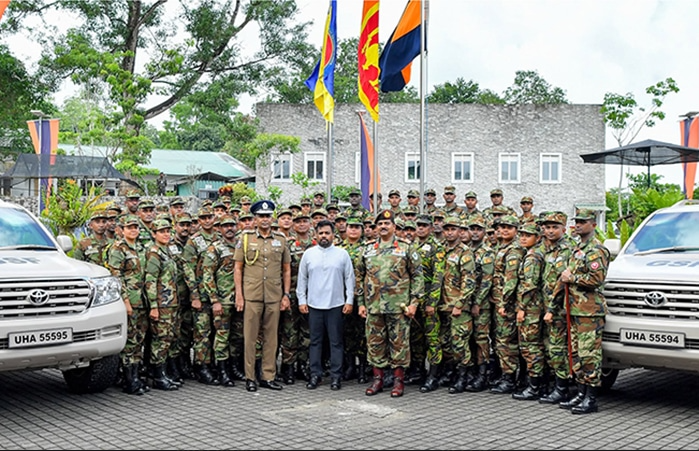
Sri Lankan president Anura Kumara Dissanayake with personnel departing for Haiti, at a ceremony at the Sri Lanka Infantry Regimental Centre in Panagoda in June
The Sri Lanka Army has acknowledged that its soldiers committed crimes against Haitian children during previous peacekeeping deployments, as 1,132 personnel return to the country under a United Nations-backed force.
Asked about the record of earlier contingents, the army spokesman Brigadier Waruna Gamage told the Sunday Times: “Those who were accused of such crimes were tried in the internal military court, and later they were dismissed.”
The admission is significant. Sri Lanka has for nearly two decades avoided publicly conceding what its personnel did in Haiti, and no soldier has ever been criminally prosecuted for it.
What the UN found
A 2007 United Nations investigation found credible allegations implicating at least 134 members of successive Sri Lankan contingents in the sexual exploitation and abuse of Haitian children, some as young as eight. More than 108 personnel were repatriated.
Investigators found an organised pattern in which contact details were passed from one rotation to the next, with one boy abused by more than a hundred soldiers. Children were given food and small sums of money in exchange for sex, in a sex ring that operated for three years. The inquiry concluded that commanders “failed to take appropriate action”.
Those responsible were sent home, not tried in open court. The International Truth and Justice Project found that every contingent commander from those deployments was subsequently promoted. The UN Committee Against Torture has pending questions to the Sri Lankan government on whether any prosecutions were proportionate to the gravity of the crimes, which Colombo has not answered.
Gamage’s account, that those accused were tried internally and dismissed, has not been accompanied by any public record of charges, verdicts or numbers.
Screened by their own army
The acknowledgement came as the army defended the current deployment against criticism that no independent vetting of personnel had taken place.
Gamage said an internal vetting process had been followed and that the names of cleared personnel were shared with the Office of the UN High Commissioner for Human Rights for further screening, and subsequently with the United States, which leads the Gang Suppression Force.
“In the absence of a dedicated vetting mechanism involving the relevant ministries, the Sri Lanka Army carried out its own internal screening process to clear 1,132 personnel who are currently deployed,” the Sunday Times reported.
That confirms the concern raised by the transitional justice expert Yasmin Sooka and the former BBC correspondent Frances Harrison, who wrote last week that screening had been reduced to self-certification by the state whose forces are being assessed.
Since 2016 the Human Rights Commission of Sri Lanka held a special screening role agreed with the UN, but withdrew in June 2024, citing “unwarranted pressure to expedite screening” and “pressure to reconsider its decisions to not clear particular applicants”. No successor mechanism has been established. The commission’s independence had already been questioned, with the ITJP previously calling for the suspension of all Sri Lankan peacekeepers after the UN human rights commissioner’s report noted that the body had been “politicised and its independence undermined”.
Warnings before departure
Human rights organisations including the ITJP, the Sri Lanka Campaign for Peace and Justice and People for Equality and Relief in Lanka called for an urgent halt to the deployment in June, demanding an independent vetting mechanism with meaningful participation from the Office of the High Commissioner for Human Rights.
“No individual should be deployed without an independent assessment of involvement in past violations,” they said, warning that the deployment was proceeding from a country whose security forces “have been repeatedly implicated in serious violation of international humanitarian law, international human rights law, and conflict-related sexual violence, and where accountability for such violations remain largely absent”.
The risk, they said, “is not merely theoretical, it is foreseeable, well documented and is incompatible with the standards that the UN has committed itself to uphold”. They asked that the names and photographs of deploying personnel be published to enable investigation of any allegations, and that a complaints mechanism be established in Haiti.
Amnesty International separately called for answers about the deployment amid what it described as ongoing impunity over the child abuse allegations.
A decision due this month
The contingent, comprising 900 army personnel and 189 Special Task Force officers, including 43 female soldiers, left the island in July in Sri Lanka’s largest ever overseas deployment. The first troops reached Port-au-Prince that month, with a further contingent landing at Gonaïves in August.
Sending them off at Panagoda in June, the Sri Lankan president Anura Kumara Dissanayake told the personnel: “You are demonstrating to the world that we possess an armed force and a Special Task Force that are prepared to stand for the protection, democracy and human rights of oppressed people wherever they may be in the world.”
More than 16,000 Sri Lankan military personnel served in Haiti between 2004 and 2015. The UN moved to redeploy them earlier this year despite the record.
The UN Security Council is due to decide by 30 September whether to renew the mandate of the Gang Suppression Force. UNICEF estimates that up to half the members of Haiti’s armed groups are children.
Sri Lankan security forces have never been held accountable for atrocities committed against Tamils, and have been deployed on UN missions including in South Sudan and Mali despite those concerns. At the UN Human Rights Council this month, the Deputy High Commissioner for Human Rights said personnel suspected of serious violations continue to serve within the military and police, and that close screening of security forces personnel was needed, including for peacekeeping and other international operations.