

South Korea weighs Strait of Hormuz deployment amid Iran war risks
While there are similarities between the 2003 deployment and any such move now, the stakes are higher for the current government.
Korea’s controversial 2003 decision under the former Roh Moo-hyun administration to send troops to Iraq is back in the spotlight as the incumbent Lee Jae Myung administration considers deploying military assets to the Strait of Hormuz 23 years later.
The two situations share similarities in that both involve Democratic Party (DP) administrations facing pressure from the United States, but a different set of political and security variables has made the decision over a potential deployment considerably more complicated this time.
One difference is that winning National Assembly approval may not be straightforward despite the ruling DP’s commanding majority.
The Roh administration decided in 2003 to send troops to Iraq despite widespread antiwar sentiment and opposition among its supporters. Because the then-majority conservative Grand National Party, the predecessor of the current People Power Party (PPP), controlled more seats in parliament at the time, cooperation from the opposition was crucial. Still, the conservative opposition backed the deployment relatively actively because it prioritized the Korea-U.S. alliance.
Today, the DP holds enough seats that meeting the constitutional requirement for approving a troop deployment — attendance by a majority of all lawmakers and approval by a majority of those present — would not be difficult on numbers alone.
But opposition to involvement in the Iran war has emerged within the DP. The Rebuilding Korea Party and the Jinbo Party, both broadly aligned with the ruling bloc, have also made their opposition clear. The government would therefore first have to persuade some of its own core political supporters.
Another difference is that the government may have a weaker justification to present to the National Assembly.
In 2003, the George W. Bush administration cited Saddam Hussein’s alleged development of weapons of mass destruction and violations of United Nations resolutions as grounds for war. For months, Washington raised the issue of Iraq’s weapons programs at the UN Security Council and in the broader international community. The Bush administration also secured authorization from the U.S. Congress to use military force.
Even then, Washington failed to obtain a UN Security Council resolution authorizing the invasion. Major allies including France and Germany opposed the war, leading the United States to form a “coalition of the willing” centered on allies including Britain and Australia.
The Iran war has an even weaker basis under international law. Iran’s development of nuclear weapons may not meet the requirement of an “instant” and “imminent” threat that could justify a preemptive strike under international law. Criticism has also continued in the United States over waging war without congressional authorization. Unlike in 2003, major U.S. allies have consequently been reluctant to commit forces.
The substantially greater nuclear threat from North Korea is another consideration.
A North Korean nuclear crisis was already underway in 2003 when Pyongyang withdrew from the Nuclear Non-Proliferation Treaty, but North Korea had not yet demonstrated possession of nuclear weapons.
Since then, North Korea has conducted multiple nuclear tests and effectively established itself as a nuclear-armed state. Its long-range missile capabilities have also advanced, while its increasingly close ties with China and Russia have heightened tensions surrounding the Korean Peninsula.
A deployment to the Strait of Hormuz could therefore be more sensitive than the Iraq deployment because of its potential effect on military resources needed for a contingency on the Korean Peninsula.
The biggest difference may be the very nature of the deployment itself.
In 2003, Korean troops were sent to Iraq after Saddam Hussein’s government had already collapsed. The Zaytun Division was deployed primarily for peacekeeping and reconstruction operations.
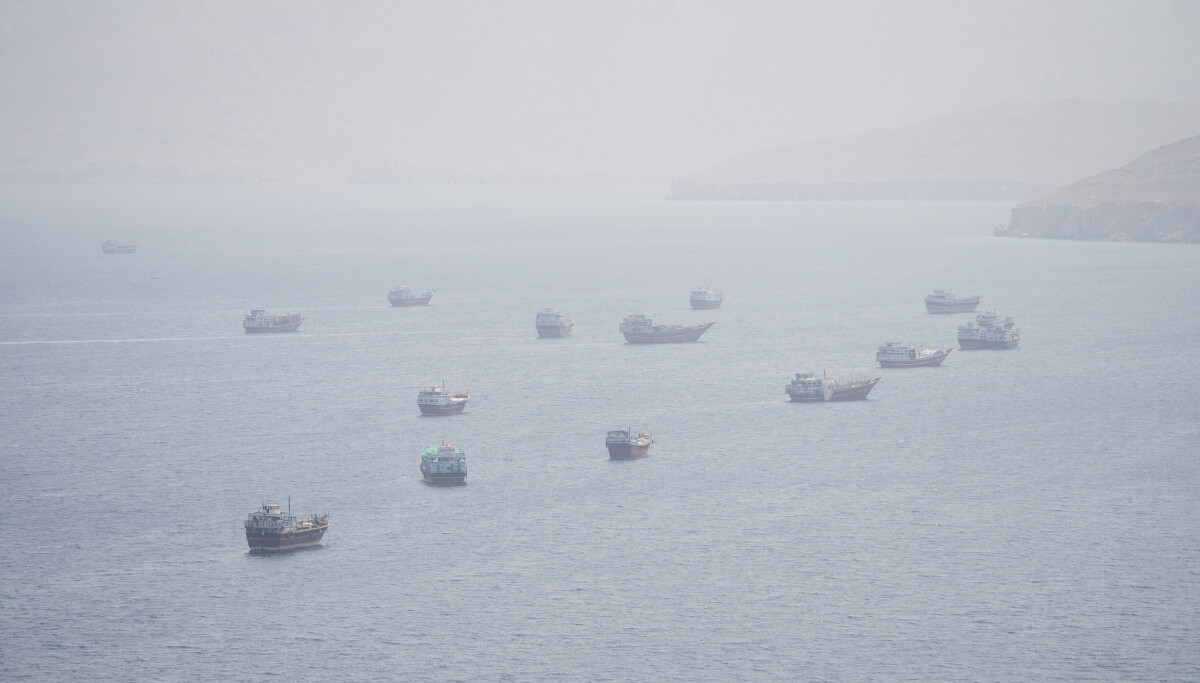
In 2026, however, the Strait of Hormuz lies within the sphere of influence of Iran. Even if Korea sends maritime patrol aircraft and a logistics support vessel rather than combat troops, Iran could regard the deployment as military support for its adversary.
Korea also relies heavily on crude oil imports from the Middle East that pass through the strait, adding an economic dimension to the risks of becoming involved.
On Friday, a senior Iranian political official warned that Iran would consider any Korean involvement against Iran in the Strait of Hormuz as military participation, according to Iran’s state-run Fars News Agency.
BY KIM KI-HWAN [yoon.soyeon@joongang.co.kr]