

Somalia Formally Joins AfCFTA as 50th Member, Opening Access to 1.4 Billion Consumer Market
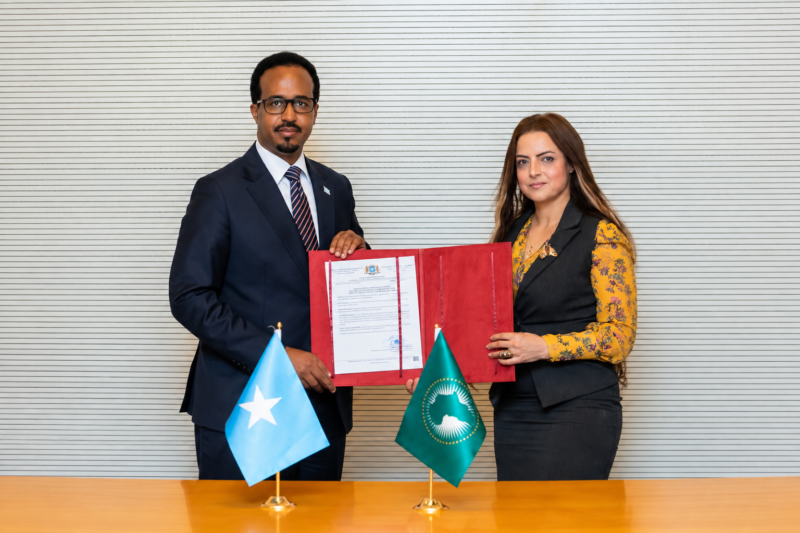
ADDIS ABABA — Somalia has formally become the 50th nation to ratify the African Continental Free Trade Area (AfCFTA) agreement, with the Federal Government depositing its instrument of ratification at the African Union headquarters in Addis Ababa.
The instrument was submitted by the Minister of Commerce and Industry, Ambassador Gamal Mohamed Hassan, on September 4, 2026, following approval by the Federal Parliament and presidential assent from President Hassan Sheikh Mohamud. The ratification completes Somalia’s domestic legal process and opens the door to a continental market of more than 1.4 billion consumers.
“Today, Somalia has become the 50th country to officially join the AfCFTA. Our task now is to prepare customs and tax procedures, support Somali businesses in meeting long-term trade requirements, and move toward exporting our first consignment under the agreement. This ratification leads to wider markets, stronger trade, and more job creation,” said Minister Gamal.
Implementation Begins
Joining the AfCFTA opens opportunities for Somali businesses to access continental markets, attract foreign investment, increase production and exports, and participate in regional value chains to support the country’s economic development. AfCFTA Secretary-General Wamkele Mene visited Mogadishu in August 2026 to discuss the transition from ratification to implementation, including technical requirements such as tariff schedules, rules of origin, and customs modernization.
Somalia has been actively engaged in continental trade forums, including the Intra-African Trade Fair (IATF 2025) in Algiers and the second AfCFTA Business Forum in Marrakech, where Somali officials held high-level discussions on expanding trade and investment cooperation.
The Ministry of Commerce and Industry has established a National Coordination Office (NCO) to oversee implementation and coordinate with federal institutions, federal member states, businesses, and other stakeholders to align Somali trade laws and procedures with AfCFTA obligations.
Beyond Market Access
While the agreement provides tariff-free access to much of the African market, analysts caution that Somalia’s biggest challenge is not access to markets but its limited production capacity. Somalia recently chaired the first-ever meeting of Horn of Africa trade ministers, where it pushed for a single shared economic space and a five-year action plan to simplify cross-border trade.
Somalia has also been strengthening its engagement with regional organizations, pledging to boost trade and investment ties with Tanzania and deepening its integration into the East African Community. The country’s population of 17 million has boosted the EAC’s market to more than 300 million people as the bloc seeks to expand free trade across the region.
Somalia has also been actively participating in global trade negotiations, with Minister Gamal representing the country at the 14th World Trade Organization (WTO) Ministerial Conference in Yaoundé, Cameroon, where he held productive talks with his Turkish counterpart on strengthening bilateral trade.
Critical Note
Somalia’s ratification of the AfCFTA represents a significant diplomatic achievement and a vote of confidence in the country’s economic future. Joining the world’s largest free trade area by participating countries opens new opportunities for Somali businesses to access continental markets, attract investment, and diversify exports.
However, the real test will be in implementation rather than ratification. For decades, Somalia’s economy has been defined by imports rather than exports, with a trade deficit exceeding $2.6 billion. The country’s productive capacity remains limited, its infrastructure is fragile, and its institutions are still being rebuilt. Without sustained investment in production capacity, trade-related infrastructure, and regulatory modernization, the benefits of AfCFTA membership will remain largely theoretical.
The government’s commitment to establishing a National Coordination Office and aligning trade policies with AfCFTA obligations is a positive step. But for Somali businesses to compete in a continental market of 1.4 billion people, the country must address its underlying structural constraints. The international community, while supporting trade reforms, must continue to invest in Somalia’s productive capacity and institutional development to ensure that the country can fully benefit from regional integration.
Recommended Reading On ftlsomalia.com
Credit: Source link