

Overcrowded Ebola treatment centers are fueling transmission in the Democratic Republic of the Congo
The current reemergence of Ebola virus disease due to Bundibugyo ebolavirus in the eastern Democratic Republic of the Congo is once again demonstrating significant weaknesses in outbreak response1,2. Although early case detection, efficient contact tracing, early isolation and infection prevention and control (IPC) are still the mainstay of Ebola containment, the most recent national situation report (SitRep No. 080, published 2 August 2026) suggests that these measures are challenged even more by a lack of sufficient treatment capacity1,3. The epidemic has grown to more than 3,800 confirmed cases and more than 1,700 deaths, with Ebola treatment centers (ETCs) and transit centers both running well above capacity, potentially setting the stage for ongoing transmission despite continued response efforts1.
The operational indicators show that isolation sites are extremely overwhelmed. In North Kivu, ETC bed occupancy is at 131.9% (186 patients admitted for 141 official bed capacity) while there has been no change in reporting on functional bed capacity for the seventh straight surveillance bulletin, which makes it difficult to maintain situational awareness and to mobilize resources. In Ituri — the province with around 87% of all cumulative confirmed cases — multiple centers have stretched beyond ‘safe operating limits,’ such as the Nizi ETC (278%), Higher Institute of Medical Techniques (ISTM Nyakunde, 123%), Evangelical Medical Center (CME Bunia, 104%), and Lita and Fataki (100%). The capacity of suspect-case holding areas is equally stretched thin, with the Fataki transit center at 200%1. These conditions greatly diminish the capability of the health care system to quickly and safely isolate patients who are infectious3,4.
In addition to posing a logistical challenge, the overcrowding of Ebola isolation units could become a direct contributor to the continuing epidemic. Overcrowding at ETCs has the potential to compromise infection prevention and control by reducing patient separation, increasing workload and leading to shortages of trained staff and protective materials, and it can result in nosocomial spread among patients and health care workers3,5. At the same time, the maximum availability of admission spaces delays the referral and isolation of suspect cases, which extends infectious periods in homes and communities. These delays contribute to the large proportion of community deaths reported in the current outbreak and undermine confidence in the health system, discouraging prompt care-seeking2,6. Additionally, chaotic treatment centers strain surveillance teams, hinder effective contact tracing, disrupt rapid secondary case identification and reinforce sustained community transmission7,8.
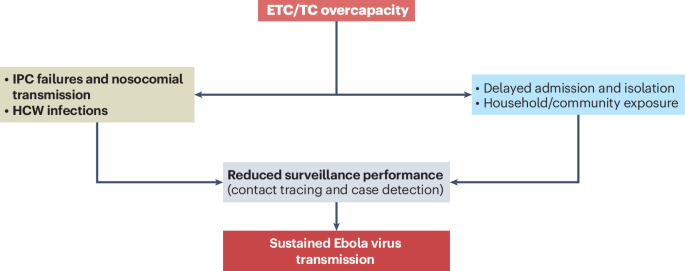
We propose that overcrowding undermines containment through two pathways: IPC failures due to reduced patient separation, staff shortages and personal protective equipment gaps, which increase nosocomial risk; and delayed isolation of suspected cases, which prolongs community exposure, drives community deaths and weakens contact tracing (Fig. 1).
Overcapacity of ETCs and transit centers (TCs) simultaneously promotes two interconnected pathways that sustain Ebola virus disease transmission. First, overcrowding increases the risk of IPC failures, leading to nosocomial amplification and increased health care worker (HCW) infections. Second, limited admission and isolation capacity delays the management of suspected cases, which prolongs household and community exposure, increases community deaths and weakens contact tracing performance. Together, these mechanisms create a self-reinforcing cycle that may perpetuate epidemic transmission despite ongoing response interventions.
These observations imply that treatment capacity should be considered not simply a clinical resource but an integral element of epidemic control. It is therefore crucial to prevent structural saturation of ETCs to preserve IPC standards, maintain public confidence, guarantee prompt isolation and to keep up surveillance performance throughout the response2,3.
Short-term actions should include rapid deployment of modular isolation units in the districts that are most affected, scale-up of decentralized triage and point-of-care diagnosis, re-establishment of transparent daily reporting on usable bed availability, and augmentation of IPC supplies and staffing to shield frontline health care workers and maintain quality of care. Amplifying these operational capabilities may also diminish secondary transmission and increase the robustness of the overall Ebola response3,4.
We argue that treatment capacity is an epidemiological intervention. Without addressing saturation, overcrowding will sustain transmission despite other response efforts.
Credit: Source link