

Polluted waterways and water shortages complicate the fight against Ebola in the DRC

- Safe access to water is scarce across parts of Ituri province, which is the epicenter of the Ebola outbreak in the Democratic Republic of the Congo.
- The Ebola virus is transmitted through direct contact with bodily fluids like blood, saliva and urine of an infected person. It is, therefore, crucial, in order to prevent the spread of the disease, to be able to wash regularly. Response teams also need access to water to clean equipment and areas used by patients.
- People sometimes use taps and showers installed at Ebola treatment centers to collect water, potentially increasing contact between healthy and infected people.
- Artisanal and small-scale mining in the region also put pressure on local water resources, by turning some waterbodies muddy.
In Ndrele, a commercial center in Ituri with nearly 40,000 inhabitants, there is virtually no access to safe drinking water. Children leave home at 5:30 a.m. to fetch water for their families and often spend hours doing this activity. They usually don’t return before 11 a.m. or noon. “It’s a serious problem, and it’s the same everywhere,” Jacques Pithua, deputy coordinator of civil society group “Forces vives des Djukoth,” told Mongabay by phone.
Pithua lives near Ndrele, in Mahagi, in Ituri province bordering Lake Albert in eastern Democratic Republic of the Congo (DRC). In May 2026, the DRC declared its 17th Ebola outbreak in the province. To prevent Ebola transmission, health authorities recommend frequent handwashing, among other measures, but in many parts of Ituri, clean water remains scarce.
The current Ebola outbreak is the largest in terms of case numbers for the DRC, and it is also the fastest spreading. The rising number of cases, over 5,000 recorded as of Aug 17 and more than 2,400 deaths in three months, has prompted health agencies including the Africa CDC to adapt its strategy. A joint response plan also calls for an assessment and strengthening of water, sanitation and hygiene services in health facilities within communities and provides training.
Oxfam, a confederation of NGOs, which is also involved in the response to the outbreak, warned in a statement that “most health facilities in the areas hardest hit by Ebola still lack access to safe water and adequate sanitation facilities.”
Ebola is not a waterborne disease. But where safe and clean water is scarce, it can make it harder to maintain hygiene essential to curbing disease spread. The Ebola virus is transmitted through direct contact with the bodily fluids like blood, saliva and urine of an infected person. It is, therefore, crucial, in order to prevent the spread of the disease, to be able to wash regularly.
On the ground, this lack of access to water has two consequences, Baptiste Filloux, advocacy officer for international solidarity at Oxfam, told Mongabay by phone.
“Hygiene is an important barrier against the disease, so this lack of infrastructure works against us,” he explained. “There is a major challenge when it comes to information about the outbreak. Some people do not take it seriously enough and use the infrastructure put in place by the response teams, showers, taps and so on, to get water.” Since these facilities are often located in Ebola treatment and care centers, it creates a risk of transmission between sick and healthy people, according to Filloux.
The response to Ebola is also characterized by the appearance of gleaming vehicles and job opportunities that pay much more than what ordinary Congolese make. In previous epidemics, this led to abuses and financial malpractice. Minister for Public Health, Hygiene and Social Welfare, Samuel Roger Kamba said in a press briefing on August 18 that bad actors are also profiting financially from funds coming in for Ebola response. Suspicions about profiteering, which are sometimes referred to as “Ebola business” also hamper response creating distrust about information about the disease.”
Eastern Ituri lies on the shores of one of Africa’s great lakes, Lake Albert, which covers an area of 2,046 square miles (5,300 square kilometers), roughly twice the size of Luxembourg. The lake is fed by several major rivers in the Great Lakes region. The Semuliki River, as well as the Ituri and Kibali rivers, are among the region’s main waterways. All of these rivers have numerous tributaries, creating an extensive network of waterways across the region.
Explaining the lack of water access
“Here, it is not necessarily the lack of water itself that is the problem, but the lack of safe access to water,” Filloux explained.
“There is a lack of wastewater treatment infrastructure, boreholes and filters. It is a question of money and political decisions,” he said, adding that the Ebola response is severely lacking the funding it needs to organize the response as it would like.
In addition to these infrastructure issues, there are also security concerns. Ituri is a province plagued by armed conflict. Simply looking for water can put one at risk of physical violence, robbery, rape or even death. Therefore, for some people, having access to water from a tap, without violence and long distance, despite the risk of contamination, is appealing.
For Dieudonné Kasonia, permanent secretary of the Congolese NGO Cadre de Concertation sur les Ressources Naturelles (CdC/RN), the causes of the problem are more complex. The first Ebola cases in this outbreak were detected in the Mongbwalu area in Ituri, which is a mining region. “Ituri has a lot of mines, a lot of gold is extracted there. Where mining is industrial, it is regulated and there are sanitation facilities. The problem comes from artisanal and small mines [semi-industrial mining],” he said.
In gold mining using artisanal or semi-artisanal methods, the extracted earth is washed to separate heavier ore-rich sediments. Various chemicals, such as mercury, are then added to this water, they bind with gold particles making them easier to detect. As artisanal and semi-industrial practices are often unregulated the muddy slurry and water contaminated by chemicals are discharged after extraction into the environment.
“The pollution is terrible. With artisanal mining, it is really awful. And currently, we do not even know whether we are dealing with artisanal mining, small mines or industrial mining because the equipment used is practically the same everywhere,” Kasonia said. “There are excavators, dredges, all kinds of machinery and also chemicals, particularly cyanide. Before, only industrial operators used them, but now everyone does.”
He added that people involved in artisanal mining are not necessarily trained in the “safe” use of this equipment, often leaving behind a devastated landscape.
“These machines divert rivers to find gold. By diverting the rivers, we destroy the entire ecosystem that existed in those rivers. The color of the water changes. Many streams and rivers that used to have a more or less normal color, somewhat clear and somewhat green, have turned a yellowish-brown color. They have become mud,” Kasonia said.
He explained that these water sources, which were once used by local communities, are no longer usable, forcing people to search farther and farther for water or put themselves in dangerous situations to obtain it.
Kasonia is based in Bunia, the capital of Ituri province, but his organization, which works on governance issues related to the DRC’s natural resources, also has offices in Haut-Uele province. Haut-Uele has also been affected by the outbreak, although to a lesser extent than Ituri. There, he observes similar problems.
To address this problem, the WHO, the Africa CDC, the U.N. and NGOs such as Oxfam are installing taps to make it easier for the local population to access water, Filloux said.
In some instances, this kind of emergency response has led to benefits for the broader community.
In response to another outbreak in the DRC in September 2025, the WHO along with local and national partners set up a water supply system that channeled water from a nearby stream for Ebola response in Bulape, Kasai province. The system supplied not just chlorinated water for clinical use but also provided households with water to meet their everyday needs, saving community members long treks to fulfill a basic need.
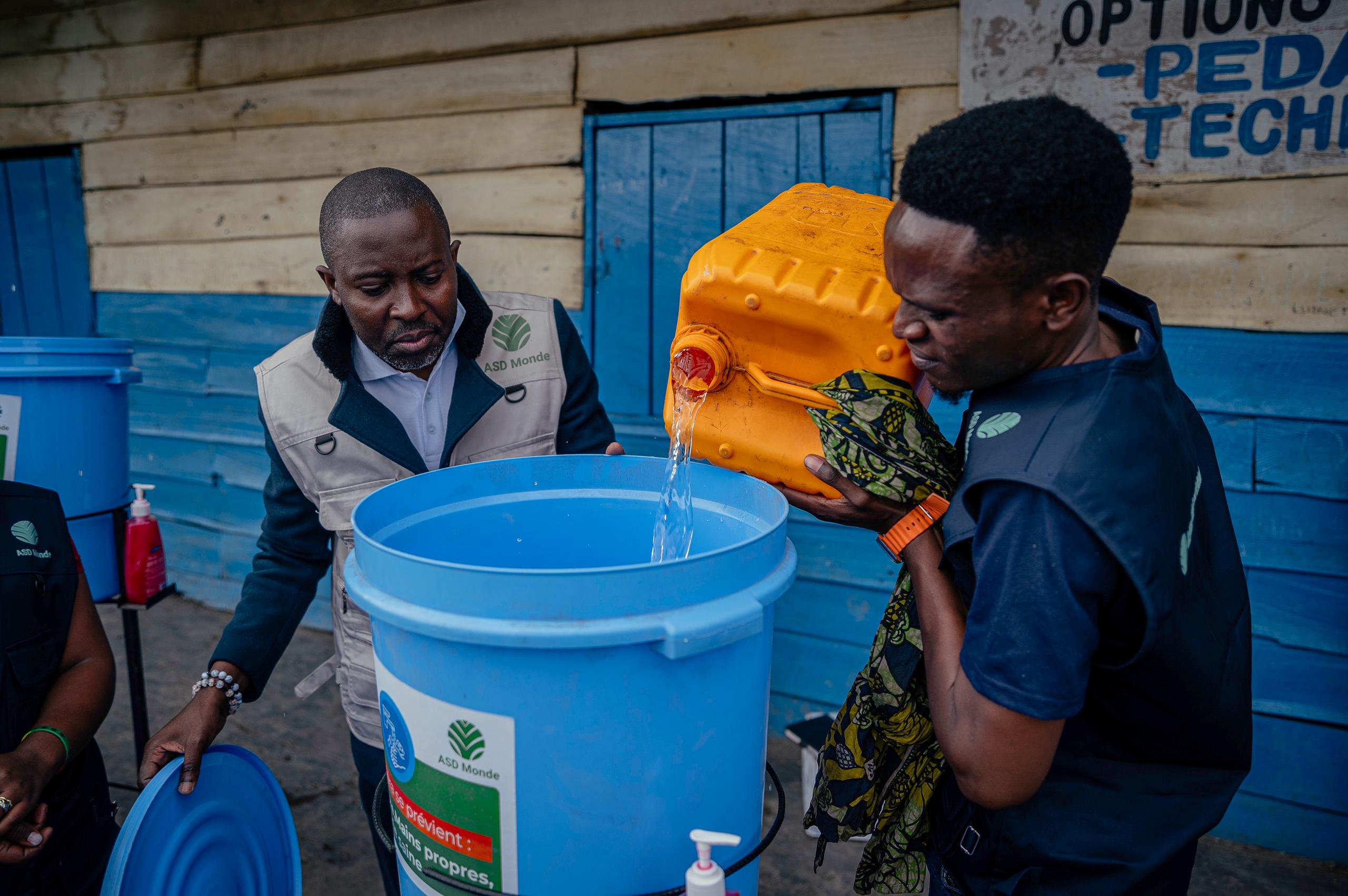
Image captions: A team from the nonprofit ASD Monde responding to the Ebola outbreak in the DRC. Image courtesy of ASD Monde.
Cite this article
Elodie Toto (2026). Polluted waterways and water shortages complicate the fight against Ebola in the DRC. Mongabay Conservation news. DOI: https://doi.org/10.66709/news-326929

Credit: Source link