

DRC Ebola outbreak update: 57 health zones in 6 provinces
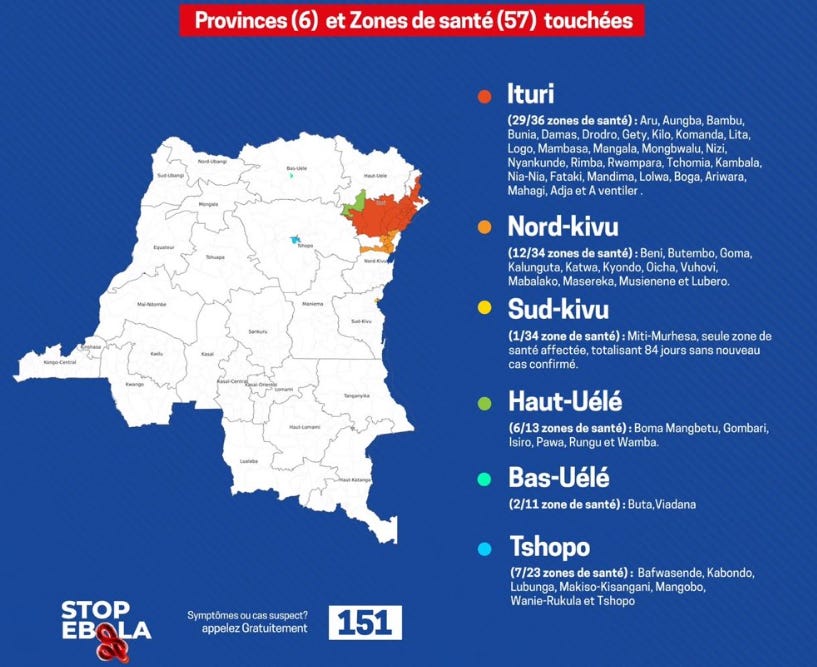
One hundred days ago, the Government of the DRC declared the country’s 17th Ebola outbreak following confirmation of the Bundibugyo virus. WHO subsequently declared a Public Health Emergency of International Concern, followed by Africa CDC’s declaration of a Public Health Emergency of Continental Security.
Over the past 24 hours, 70 new confirmed cases of Ebola Virus Disease (EVD)—including 16 community deaths—were reported in the provinces of Ituri (48 cases), North Kivu (14), and Haut-Uélé (8), according to the Democratic Republic of the Congo (DRC) Ministry of Health (MOH).
During the same period, 15 patients were declared recovered after testing negative for EVD twice (13 in Ituri and 2 in Haut-Uélé). Additionally, 22 deaths occurred within Ebola Treatment Centers (ETCs): 17 in Ituri and 5 in Haut-Uélé.
Antibiotics, antimicrobial resistance and the Revenge of the Microbes
From the start of the outbreak through August 23, 2026, a total of 5,584 confirmed cases and 2,680 deaths have been reported in the DRC, representing a case fatality rate of 48.0%. Ituri remains the epicenter of the outbreak, accounting for 83.4% of cumulative confirmed cases and 68.6% of new cases reported in the last 24 hours.
Largest Outbreaks and Modern Era
The 2013–2016 West Africa epidemic (primarily Guinea, Liberia, and Sierra Leone, with limited spread elsewhere) was by far the largest on record. Caused by EBOV, it produced nearly 29,000 total cases (over 15,000 laboratory-confirmed) and more than 11,000 deaths (overall CFR around 40%). It was the first major outbreak with significant urban transmission and international spread, prompting a Public Health Emergency of International Concern (PHEIC) declaration.
The second-largest overall prior to the current outbreak was the 2018–2020 outbreak in eastern DRC (Ituri, North Kivu, South Kivu provinces), also EBOV, with about 3,470 cases and 2,280 deaths. It was complicated by armed conflict, population displacement, and attacks on responders, and briefly spread to Uganda.
Other notable events include smaller EBOV outbreaks in the DRC (multiple times since 2014, including 2017, 2018, 2020, 2021, and 2022), SUDV outbreaks in Uganda (e.g., 2022 and one ending in 2025), and occasional resurgences linked to persistent infection or delayed transmission rather than new animal spillover.
Credit: Source link