

Ngafuan Challenges Liberians to Turn Patriotism Into Service, Integrity | News
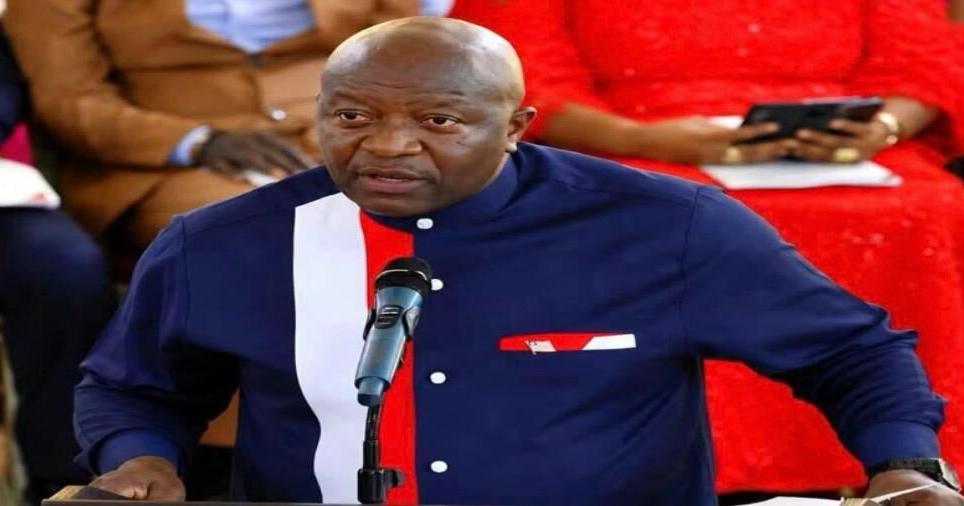
Finance and Development Planning Minister Augustine Kpehe Ngafuan has challenged Liberians to move beyond symbolic displays of patriotism and demonstrate their love for the country through integrity, service and responsible citizenship.
Delivering the keynote address Monday at the 179th anniversary of Liberia’s National Flag Day, Ngafuan said the nation’s red, white and blue flag should serve not merely as a symbol of national identity but as a daily reminder of every citizen’s responsibility to Liberia.
Speaking under the theme “From Heritage to Hope: The Flag That Unites Us,” Ngafuan urged Liberians to transform national pride into concrete actions that contribute to the country’s development.
“It is easy to dress in national colors, easy to sing the national anthem, and easy to wave the flag. The harder task is to live by what the flag demands of us,” he said.
Ngafuan said true patriotism is reflected in how citizens conduct themselves at work, in their communities and in their dealings with the state.
“Patriotism is not only what we say about Liberia. Patriotism is what we do for Liberia,” he declared.
The Finance Minister described Liberia as “a common enterprise in which every citizen is a shareholder,” stressing that no Liberian owns the country more than another.
He said public office does not give political leaders greater ownership of Liberia, but instead places greater responsibility on them to serve the nation.
“Public office does not increase one’s ownership of Liberia. It increases one’s responsibility to Liberia,” Ngafuan said.
He noted that regardless of social or political status, every Liberian has an equal stake in the country’s future.
On election day, he said, “the President in the Executive Mansion or a fisherman in West Point” each casts a single vote.
Ngafuan therefore urged public officials to recognize that their positions are a mandate to serve rather than an opportunity for personal enrichment.
The minister broadened the concept of national leadership, saying leadership is not limited to elected officials or government employees.
He identified pastors, imams, teachers, journalists, business owners, union leaders and social media influencers as leaders whose words and actions can influence society.
“Influence creates responsibility,” he said, warning that every platform—from a pulpit and classroom to a microphone and political stage—comes with an obligation to promote the public good.
Ngafuan also cautioned Liberians against what he described as a “tragedy of the commons” mentality, in which citizens demand accountability from government officials while excusing wrongdoing when committed by members of their own political, ethnic or religious groups.
He called for citizens to judge people based on their individual conduct rather than their political affiliation, ethnicity, religion or association with government.
Reflecting on Liberia’s 179-year history, Ngafuan said the national flag has witnessed both the country’s triumphs and tragedies.
The flag, he noted, has been present during presidential inaugurations and national mourning, war and peace, and the country’s post-war reconstruction.
He said the promise represented by the flag must be available to every Liberian child regardless of where or into what circumstances they are born.
“The circumstances of my birth do not determine the boundaries of my possibilities,” Ngafuan said, arguing that such an opportunity should be a birthright rather than a privilege reserved for a few.
The minister drew on his own childhood experience, recalling marching as a first-grade student in Bolahun, Lofa County, in 1978 to salute the Liberian flag.
He said the memory reinforced his belief that every Liberian child should have the opportunity to develop a sense of hope and possibility regardless of background.
Ngafuan also used the occasion to appeal for stronger national unity, urging Liberians to place national identity above political, ethnic and regional affiliations.
He compared the Flag Day parade, where students from different schools marched in different uniforms but saluted the same flag, to Liberia’s broader society.
He called on Liberians to move away from “county-centricity” and “party-centricity” toward “country-centricity.”
According to him, political differences should not prevent citizens from recognizing their shared responsibility to Liberia.
He also urged Liberians to reject the tendency to automatically assume that someone is good or bad based on whether that person belongs to the government, a political party, ethnic group or religious community.
Ngafuan provided several examples of what practical patriotism should look like in everyday life.
He said a public official “raises the flag” by protecting state resources; a teacher does so by preparing properly for lessons; and a health worker demonstrates patriotism by faithfully caring for patients.
He also cited security officers who refuse bribes, business owners who pay legitimate taxes, journalists who practice responsible journalism and young people who choose education and entrepreneurship over despair.
He said these everyday acts represent a deeper form of patriotism than simply displaying national colors.
Ngafuan connected his message to the government’s ARREST Agenda for Inclusive Development, citing ongoing efforts to improve public infrastructure and social services.
He referenced plans to rehabilitate or construct more than 100 schools as an example of translating national aspirations into tangible development.
He also pointed to what he described as a historic fiscal milestone, saying Liberia’s national budget is projected to cross the US$1 billion threshold for the first time, with the government expecting to reach that mark in September.
He presented the projected milestone as part of the broader effort to expand Liberia’s fiscal space and finance national development through stronger domestic resource mobilization.
Concluding his address, Ngafuan called for what he described as a “Patriotic Covenant”—a shared set of national values centered on integrity, the rule of law, accountability, anti-corruption and peaceful political competition.
He said such values should transcend political parties and changes in government.
Ngafuan urged Liberians to “raise the flag” not only by displaying the national colors but by raising their personal standards, strengthening their integrity and raising children with knowledge, discipline and hope.
Credit: Source link