

More Starlink satellites and two big launches for China
Here’s what’s launching 8/17-8/23: SpaceX plows ahead with three Starlink launches; China opens and closes the week with a reusable booster test flight and a robotic moonshot.
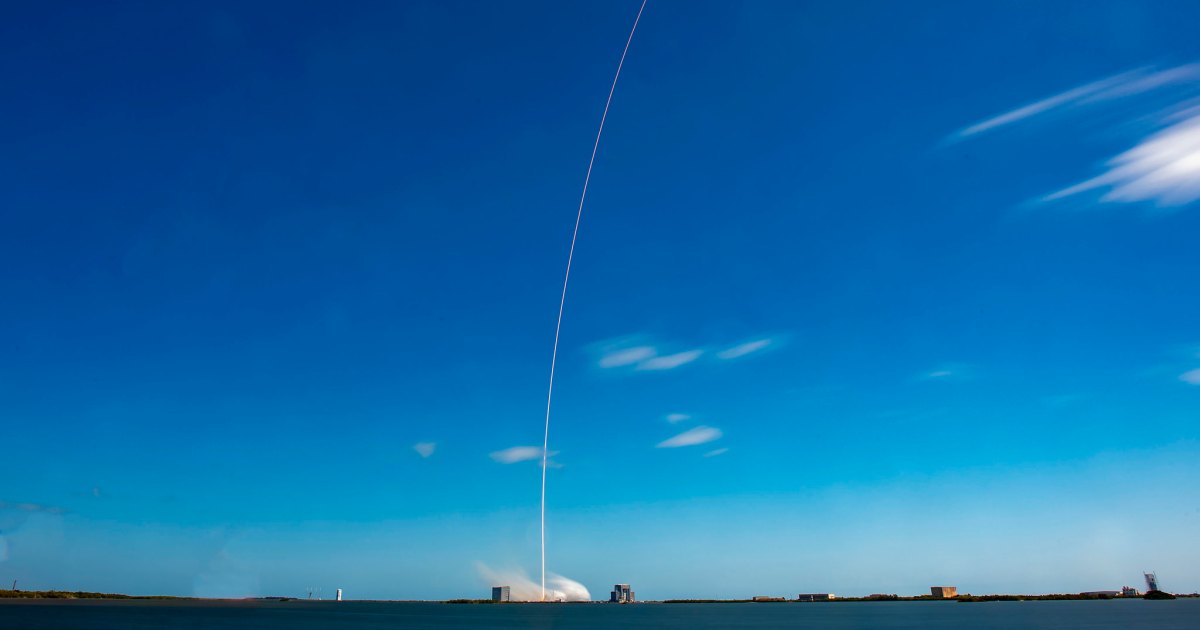
A Falcon 9 rocket lifts off from Florida’s Cape Canaveral Space Force Station carrying 56 Starlink satellites on March 24, 2023. SpaceX has launched over 12,000 Starlink satellites across more than 200 missions since 2019, with three more scheduled this week. Credit: SpaceX, via Flickr, CC BY-NC 2.0
Rocket launches this week
On Tuesday, Aug. 18, Chinese aerospace firm LandSpace is targeting 7:35 p.m. EDT for the second flight of its Zhuque-3 rocket from the Jiuquan Satellite Launch Center in China, according to tracking from Next Spaceflight. The launch was scrubbed last week after a Long March 7A rocket exploded hours before Zhuque-3’s targeted launch. Zhuque-3 is LandSpace’s methane-fueled rocket, comparable to Falcon 9 in payload and designed for first-stage recovery. During Zhuque-3’s first test flight in December 2025, the rocket performed as expected during launch, but the booster was lost due to a combustion anomaly, resulting in the first stage breaking apart near the landing zone during reentry.
Later on Tuesday, Aug. 18, SpaceX is scheduled to launch the Starlink Group 17-50 mission from California’s Vandenberg Space Force Base at 10:00 p.m. EDT. The Falcon 9 booster is expected to land on the droneship Of Course I Still Love You. Watch it here.
On Thursday, Aug. 20, SpaceX heads to Florida for the Starlink Group 10-39 mission, lifting off from Cape Canaveral Space Force Station at 11:19 a.m. EDT. The booster will target a landing on the droneship A Shortfall of Gravitas. Watch it here.
On Saturday, Aug. 22, SpaceX is back at Vandenberg for the Starlink Group 15-20 mission at 3:25 a.m. EDT, with the booster set to land on Of Course I Still Love You. Watch it here.
Closing out the week on Sunday, Aug. 23, the China Aerospace Science and Technology Corporation (CASC) is targeting 8:00 p.m. EDT for the launch of Chang’e 7 aboard a Long March 5 rocket from the Wenchang Space Launch Site, according to tracking from Next Spaceflight. The mission represents the next phase of China’s lunar exploration program, sending an orbiter, lander, rover, and hopping probe toward a landing at the Moon’s south pole to hunt for water ice in permanently shadowed craters. Chang’e 7 will help to lay the groundwork for the International Lunar Research Station — China’s answer to the Artemis program and to NASA’s long-term goal of a crewed lunar landing in the 2030s.
Rocket launches last week
A Long March 7A carrying a Chinese communication satellite failed during first-stage flight from Wenchang Space Launch Site on the South China Sea’s Hainan Island on Aug. 10 — prompting LandSpace to stand down from its own Zhuque-3 attempt hours later.
Japan had better luck the same day, launching Michibiki 7 — the final satellite completing its regional navigation constellation — aboard an H3-22S from Tanegashima, an island in Japan’s Kagoshima Prefecture.
SpaceX flew four Falcon 9 missions across the week: Starlink Group 10-19 from Cape Canaveral on Aug. 11, with the booster landing on A Shortfall of Gravitas; Starlink Group 17-49 from Vandenberg on Aug. 12, landing on Of Course I Still Love You; the classified USSF-366 national security launch from Vandenberg on Aug. 15, also landing on Of Course I Still Love You; and Globalstar’s 2-R Mission 1 from Cape Canaveral on Aug. 15, carrying new satellites for the telecommunications company, with the booster returning to Landing Zone 40.
China closed the week with two more launches on Aug. 16: a Long March 12 carrying a group of communication satellites for the SatNet LEO internet constellation from Wenchang, and a Long March 2C launching an Earth observation satellite from Taiyuan Satellite Launch Center in northeastern China.
Looking ahead
On Aug. 25, SpaceX has two Starlink launches on the books: Group 10-49 from Cape Canaveral and Group 15-22 from Vandenberg. On Aug. 27, French company Arianespace is targeting the launch of the MTG-I2 weather satellite aboard an Ariane 62 rocket from the Guiana Space Centre in French Guiana.
NASA is currently targeting no earlier than Aug. 30 for the launch of the Nancy Grace Roman Space Telescope aboard a Falcon Heavy from Kennedy Space Center. Roman has already completed final assembly and integration, and once launched, will offer a field of view more than 100 times larger than Hubble’s. Astronomers hope the next-generation space telescope will help pin down the nature of dark energy and open a new window on exoplanets.
Brooks Mendenhall is a staff writer for Astronomy and is based in Chattanooga, Tennessee.