

Libya does not need a new agreement, but a change in the rules of the game.
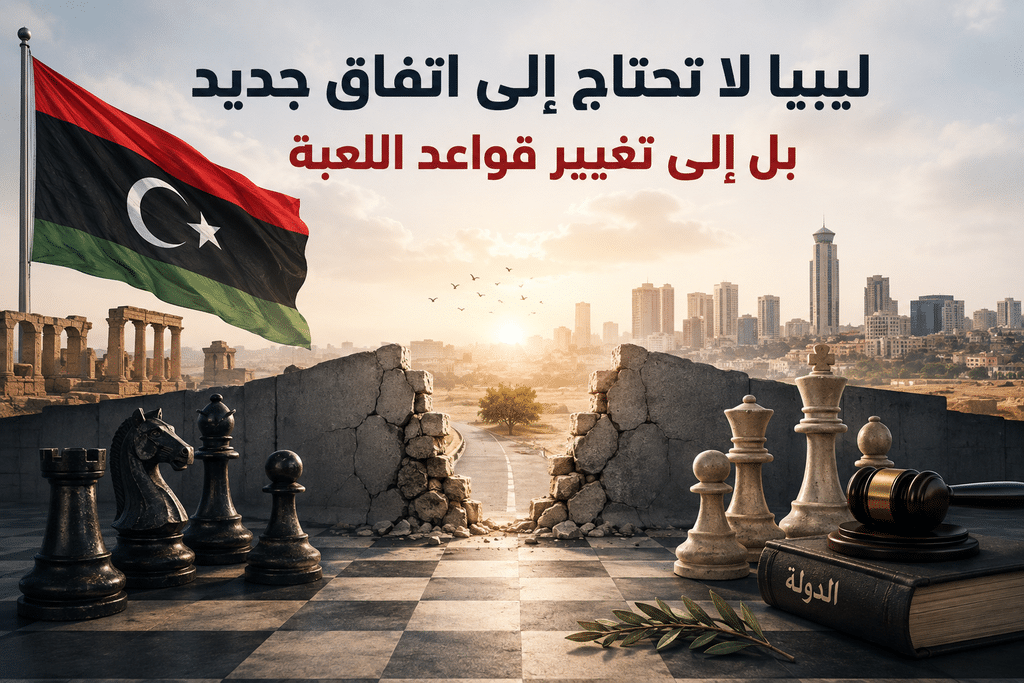
The Libyan crisis no longer needs more agreements in the traditional sense used over recent years. The problem was never that Libyans did not sit at the negotiating table or that rival parties failed to sign enough political documents. The deeper problem has always been that every new agreement dealt more with the consequences of the crisis than with its causes. Governments changed, initiatives multiplied, alliances shifted—and Libya remained largely in the same place: a state with all the trappings of a modern country that still has not found a stable formula to make its institutions stronger than centers of power, to make the law prevail over power balances, and to make authority a means of governing rather than an end in itself.
Today’s Libyan scene requires a completely different reading than one that reduces the crisis to the existence of two governments, a split parliament, disputes over elections, or a struggle for positions. These are all symptoms of a deeper crisis tied to the nature of the political system that emerged after 2011 and to the unwritten rules that now govern the relationship between authority, arms, money, institutions, regions, and local and international actors. Addressing the crisis through reshuffling posts, forming a new government, or creating another political body will not be enough if the rules that produced the crisis remain in place.
It has become clear that Libya has been trapped for years in a perpetual political transition without reaching the stable state that a transition should lead to. Each transitional phase opened the door to another transition, every interim authority found reasons to extend its stay, and political disputes gradually turned into fights over institutions, resources, and influence. Over time the temporary became permanent, exception became the rule, and Libyans found themselves living in a state with multiple official institutions but lacking a single political center capable of making and implementing decisions across the whole country.
This is precisely where the need to change the rules of the game arises.
What is required is not another agreement among the same elites so much as a redefinition of the entire political game. It must be clear that the state is not a party to the political struggle but the framework that should contain that struggle and set its limits and rules. Political disagreement is natural and can indicate a healthy society when it takes place within institutions and laws, but it becomes an existential threat when the institutions themselves become part of the struggle, when weapons are used as negotiation tools, when public money becomes a means to buy loyalties, and when national resources become bargaining chips used by competing parties to strengthen their positions.
Libya needs to end that equation, not rearrange it.
The core of the Libyan problem lies not only in the people currently in power but in an unstable system that allows individuals to remain in authority long after the reasons that brought them there have expired. Changing names is not a real change if the framework that allows the same cycle to repeat remains intact. Officials may leave and be replaced, governments may change, but the new administrations remain captive to the same system; alliances shift but the rules of influence persist, and eventually the scene returns to where it began.
Libya needs a state in which no political actor has to possess the state in order to protect its interests. This is fundamental to understanding the crisis: the continuation of division is largely driven by mutual fear among forces and regions that unifying authority will enable one party to dominate the others. Building a state cannot rest on the victory of one side over another; it must be based on institutions that guarantee everyone that the state will not become an instrument of revenge or exclusion.
That is the real test for any future political project.
Can it convince Libyans that the state will belong to everyone, not just one faction?
Can it establish clear rules for the peaceful transfer of power so that leaving office is not treated as an existential threat by those who leave?
Can it ensure a fair distribution of resources without turning them into political or geographical spoils?
Can it place military and security institutions under state authority and remove them from political rivalries?
Can it transform oil from a tool of conflict into the foundation for stability and development?
These are the questions that must be at the heart of domestic and international debates about Libya’s future.
Libyan oil is not just a source of revenue; it is one of the state’s most strategic assets and a core interest for the national economy, regional stability, and energy markets in the Mediterranean and Europe. As long as oil remains tied to political conflict, Libya’s economy will be vulnerable to shocks and economic institutions will be part of the power equation. Protecting oil production, stabilizing exports, and ensuring that revenue is managed transparently and fairly should be integral to any serious plan for rebuilding the state, not a separate technical issue apart from politics and security.
Economics cannot be separated from politics in Libya because, over recent years, the economy has itself become a tool for managing the conflict. The swelling of state institutions, the multiplicity of decision-making centers, and the intertwining of political, security, and economic interests have made many citizens feel that the state exists more on paper than in their daily lives. Despite Libya’s abundant natural resources, vital geographic position, and human capital capable of reconstruction, large segments of society still suffer from poor services, eroding trust in institutions, and a closed political horizon.
This contradiction is one of the most worrying features of Libya’s condition.
A rich country suffering a state crisis.
A country with a strategic location but weak national decision-making.
A country with vast oil wealth that has failed to turn it into a sustainable development project.
A country with multiple official institutions but lacking a single state capable of holding sovereign decision-making.
Continuing to talk about a political solution without discussing state rebuilding will keep the crisis trapped in a vicious cycle.
Elections are undoubtedly an essential part of any sustainable solution, and lasting political legitimacy cannot be built without returning to popular will. But elections must not become a magic word used to gloss over other problems. Successful elections require clear rules, unified institutions, security guarantees, acceptance of results, and constitutional mechanisms that define the powers of different authorities. Holding elections in a politically and security-divided environment without addressing the roots of the conflict may produce a new crisis instead of ending the current one.
The goal is not to hold elections at any cost, but to hold elections that can be the start of genuine political stability.
Here again the rules of the game must change.
Election disputes must be resolved politically and institutionally, not by a return to arms.
Power transitions must result from the ballot box and the law, not from shifts in force balances.
Public office should be temporary by design, not a permanent privilege.
State institutions must be able to function regardless of who holds the top positions.
This is the kind of state Libya needs.
On the security front, any attempt to ignore or indefinitely postpone the weapons issue will keep any political settlement fragile and prone to collapse at the first crisis. You cannot build a modern state with multiple centers of security and military decision-making, nor can political life stabilize when the balance of power outside institutions can at any moment affect political outcomes. The solution is not to handle security by exclusion or dominance but through a gradual national project to reorganize and unify institutions and subject them to civilian and legal authority so as to protect Libyans and prevent the use of force in political competition.
That requires political courage at least equal to the courage needed to reach a political agreement.
The international community also faces a real test in Libya. The past years have shown that many international initiatives do not automatically lead to success and that managing the crisis from abroad can sometimes prolong it, especially when local actors become more interested in securing foreign backing for their positions than in reaching a national settlement. Therefore, the most effective international role should not be to create a new political class or micromanage the distribution of power, but to help Libyans build stable state foundations, support unified institutions, and back any serious national process that enjoys Libyan acceptance.
The international community should not choose Libya’s rulers for Libyans; it should help them build a system in which no party can impose itself on others by force, money, or external backing.
This brings us to a more sensitive point about national sovereignty.
In recent years Libya has become a theater where multiple international and regional interests intersect because of its geography, oil wealth, proximity to Europe, and links to migration, security, and energy issues. This cannot be ignored or addressed with slogans alone. States act according to their interests, and Libya must do the same. The aim is not confrontation with the international community or regional powers but to build a Libyan foreign policy that manages those interests in a balanced way so that Libya’s geographic and economic importance becomes a source of national strength rather than an additional cause of division.
Sovereignty does not mean isolation; it means that the state has the capacity to define its interests, negotiate them, and defend its national decisions.
Changing the rules of the game in Libya therefore means not only changing the form of power but changing the political culture that has governed the country in recent years. We need to move from the logic of winners and losers to the logic of state and institutions; from a quota mentality to citizenship; from patronage to competence; and from protecting personal or factional influence to protecting the state.
This transformation will not be easy because interests have formed over years of division, forces have adapted to and benefited from the existing reality, and some people have tied their influence to weak, fragmented institutions. Any serious project to change the rules of the game will face resistance from those who view a unified state as a threat to their positions and interests.
But the question everyone must ask is: how long can this situation continue?
How long can Libya remain in an open-ended transitional phase?
How long will public spending continue to serve an inflated political system instead of being invested in people, infrastructure, education, health, and development?
How long will citizens be asked to be patient while the same crises recur and only the names of officials change?
It is time for Libya’s debate to be bigger than an elite struggle for power.
What is needed is a state-building project.
A project that restores trust between citizens and institutions, redefines legitimacy, sets clear rules for the transfer of power, protects the national wealth, unifies institutions, ensures fair resource distribution, builds a military and security apparatus under state authority, preserves the independence of sovereign institutions, and puts the country on a path to development and stability.
Libyan forces may disagree over the shape of the political system, the timing of elections, or the nature of the next government—and those are negotiable issues—but there should be no dispute over the fundamental principles on which the state must rest.
One state.
One set of institutions.
One sovereign decision.
An army and security agencies under state authority.
National wealth for all Libyans.
Peaceful transfer of power.
Elections with clear rules.
The law above everyone.
These are not partisan demands; they are essential conditions for any country that wants to emerge from division.
It is wrong to think that changing the rules of the game means excluding any actor from the national scene. On the contrary, the success of any political project in Libya requires including everyone within the rule of law while rejecting the use of weapons, public money, or institutional influence to impose political will. There is a vast difference between exclusion and holding everyone to a single set of rules. The state does not exclude its citizens but prevents anyone from converting their position, arms, or influence into a permanent right to control the fate of the country.
Herein may lie Libya’s real opportunity.
To turn the crisis from a perpetual burden into a moment of comprehensive national reassessment, and for political actors to realize that the current situation grants no one a true victory. It may give some actors extra time or temporary influence, but ultimately it destroys the state, weakens the economy, increases social tension, and complicates the future.
Libya does not need another agreement that reproduces the old equation, nor a settlement based on swapping positions among elites, nor another endless transitional phase.
Libya needs a change in the rules of the game.
It needs agreement on the state before agreement on the government.
It needs institution-building before distributing posts.
It needs unified decision-making before seeking new legitimacy.
It needs to protect oil and public funds before they are used in conflict.
It needs to place weapons under state authority before elections can deliver real stability.
And above all, it needs the political will to recognize that Libya will not be saved by a deal among rivals for power but by a national project that makes the state the sole winner.
Perhaps now is the moment to change the question from who will rule Libya to how Libya will be governed; from who will occupy a post to what the limits of that post will be; from who holds power to how power becomes subject to law; from who controls resources to how resources become the property of all Libyans.
When those questions change, the nature of the solution changes.
When the rules of the game change, it will not matter only who reaches power, because the state itself will be stronger than individuals, more lasting than governments, and bigger than parties, regions, and movements.
This is the real struggle facing Libya today.
It is not a battle between east and west, between one city and another, or between one political current and another. It is a battle between those who want the status quo to continue and those who want to build a state of institutions.
In my view, Libya has reached a stage where recycling the crisis is no longer a safe option as it once was, because the cost of delay has become greater than the cost of change. Every day that passes without addressing the roots of division adds a new layer of interests and complexities and makes state-building harder.
Therefore any forthcoming political initiative should be measured by its ability to change the rules of the game, not by how many parties sign it or how many positions it allocates.
A true agreement is not one that makes rivals share power; it is one that enables the state to end the causes of conflict.
A genuine settlement is not one that gives everyone a position; it is one that gives everyone the guarantee that the state will be for all.
The Libya we want is one where a Libyan does not need a tribe, city, group, or political faction to feel secure and enjoy rights.
A Libya where the law guarantees protection, institutions are the reference, and citizenship is the foundation of the relationship between the individual and the state.
When we reach that point, we can say Libya has truly begun to emerge from its crisis.
Until then, changing governments, councils, and faces will remain mere scenery while the same game continues.
Libya does not just need another agreement.
Libya needs a change in the rules of the game.
It needs the state—this time—to be the party no one can bypass.
Credit: Source link