

LibLaw Unveils ‘CJ Lewis’ | News
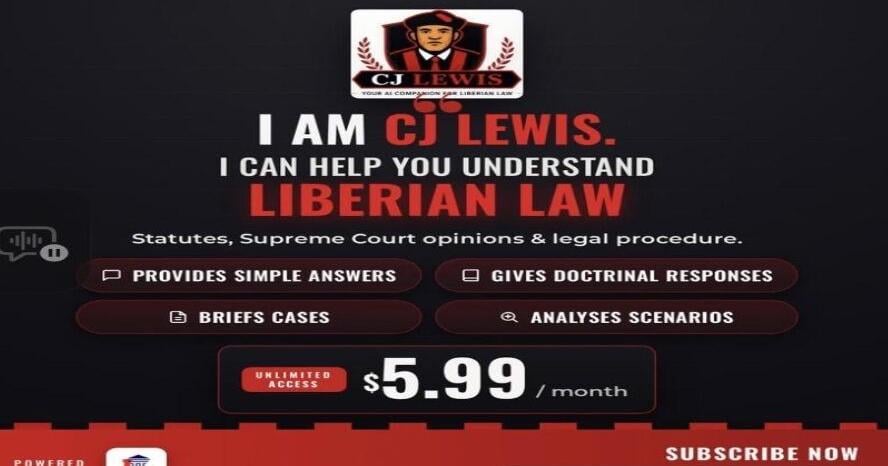
LibLaw, a legal research tech-based firm, has launched “CJ Lewis,” an artificial intelligence tool to offer legal advice and tutorials to users.
With prompts, the payment-based tool provides inquiry responses on Liberia’s Supreme Court status, court opinions, and legal procedures as a legal companion.
The platform is designed to break down long-standing barriers to legal literacy by providing real-time, understandable answers to legal questions for ordinary Liberian citizens, legal professionals, and students.
The tool, built directly into the Liblaw framework, draws from an extensive repository of Liberian legal records, including Supreme Court opinions spanning from 1861 to 2026, alongside national statutes, regulations, and legal analytics.
Founded in 2021, LIBLAW is Liberia’s premier legal tech firm, the ultimate in legal and social science research in Liberia, and an aspiring thought leader in West Africa. The goal of LIBLAW is to produce cutting-edge products through a combination of technology, world-class analysis, and local context.
Speaking at a press briefing to publicly announce the launch, Cllr. Kim A. Harris, Managing Director of Liblaw, emphasized that the tool marks a turning point in making Liberian law universally accessible.
“For generations, our law has been locked away—in heavy volumes, in scattered court records, and in language that ordinary citizens could not easily follow,” Cllr. Harris said. “CJ Lewis changes that… Access is no longer limited by geography or by cost; the law now travels to the people, anytime and anywhere.”
Accessible via mobile phones and computers, CJ Lewis acts as a digital companion capable of simplifying everyday legal matters, briefing complex court cases, and analyzing real-life legal scenarios. By converting dense legal jargon into plain language, the tool aims to empower marginalized groups, rural dwellers, and the general public to better understand their statutory rights.
According to Liblaw, the technology was built to bridge the historic gap between citizens and the judicial framework that governs them.
“When citizens understand the law, they understand their rights,” Cllr. Harris noted during the conference. “A young person can learn what protections the Constitution affords them; a woman can learn the redress available to her; a community can learn the human rights standards their leaders are bound to uphold. To know your rights is the first step to defending them, and to know the law is the first step to justice.”
The launch was made possible through key institutional backing. Liblaw expressed gratitude to the Office of the United Nations High Commissioner for Human Rights (OHCHR) in Liberia, whose partnership and support were central to developing the tool and placing human rights at the forefront of the platform.
Cllr. Harris expressed optimism that CJ Lewis would not only serve everyday citizens, but also act as a vital resource for young advocates, law students, and the broader legal community as they work to strengthen the rule of law.
“We are confident that this technology will strengthen the rule of law, deepen human rights literacy, and equip our youth—the next generation of lawyers, advocates, and active citizens—with the tools to build a fairer Liberia,” Harris concluded. “Together, we are building a Liberia where justice is not a privilege, but a right—accessible to every citizen, regardless of where they live or what they earn.”
Cllr. Harris said the tool removes the two barriers that have kept legal information out of the hands of ordinary people. “Access is no longer limited by geography or cost; the law now travels to the people, anytime and anywhere,” she said.
She framed the platform as a route to legal literacy rather than a research shortcut for lawyers and beneficiaries. “A young person can learn what protections the Constitution affords them; a woman can learn the redress available to her; a community can learn the human rights standards their leaders are bound to uphold,” Cllr. Harris noted.
Liberians nationwide can now interact with the AI assistant and explore the digital legal repository by visiting www.liblaw.org.
Credit: Source link