

India’s All-Women Peacekeepers Leave Enduring Legacy | News
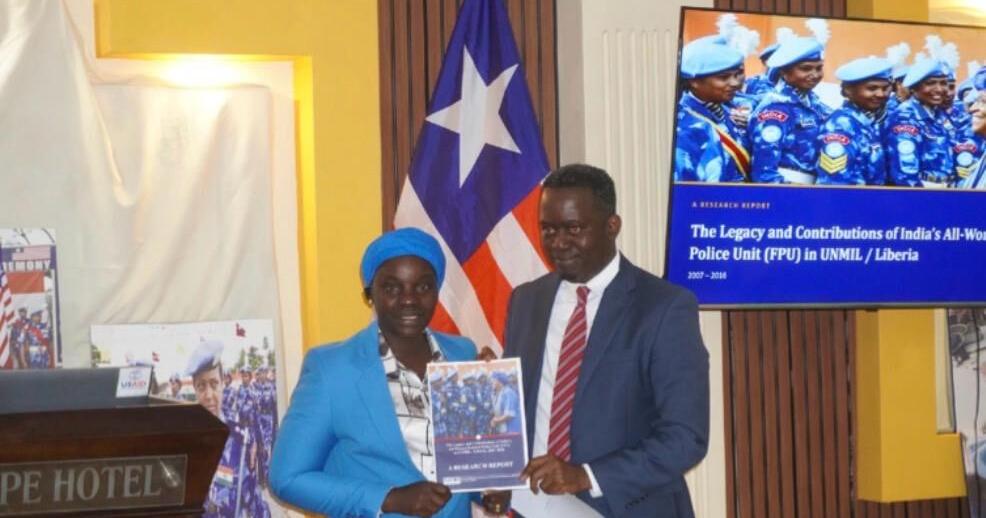
A decade after India’s historic all-women Formed Police Unit (FPU) completed its final rotation in Liberia, the Indian Embassy and the Ducor Institute for Social and Economic Research have launched a new report documenting the unit’s contribution to Liberia’s post-war recovery.
The report, “The Legacy and Contributions of India’s All-Women Formed Police Unit (FPU) in UNMIL/Liberia, 2007–2016,” was launched at the Cape Hotel in Monrovia by Brigadier General Geraldine Janet George (Ret.), Liberia’s Minister of National Defense, who served as Chief Launcher. The event drew government officials, diplomats, security-sector representatives, researchers and civil society actors to reflect on one of the most significant chapters in Liberia’s post-conflict peacebuilding history.
In January 2007, India deployed the first contingent of its all-women FPU to Liberia under the United Nations Mission in Liberia (UNMIL), the first-ever all-women FPU in UN peacekeeping history. For nearly a decade, rotations of women officers from India’s Central Reserve Police Force served alongside Liberian security institutions and other international peacekeepers.
Ambassador Verma called the deployment more than a routine mission, saying the officers “were not merely deployed as peacekeepers” but “were making history.” Many came from small towns and villages across India, and their presence became a visible example of women in roles traditionally dominated by men.
The unit arrived as Liberia worked to rebuild institutions and transform its security sector after years of civil conflict. According to research presented by Dr. Aaron Weah, of the Ducor Institute, the FPU carried out patrols, static security, riot control, public-order operations, mentoring, training, medical assistance and community engagement, demonstrating that women peacekeepers could operate effectively under demanding conditions.
Minister George said the deployment’s significance went beyond routine duties: “It demonstrated the vital role women can play in maintaining peace, protecting communities, strengthening public confidence and supporting post-conflict recovery.”
Perhaps the unit’s most enduring impact was on Liberian women and girls, who saw women conducting patrols and professional policing duties that challenged assumptions about who could serve in security roles. This coincided with efforts under President Ellen Johnson Sirleaf to expand women’s participation in national institutions, tying the FPU’s presence to the broader Women, Peace and Security agenda and UN Security Council Resolution 1325.
Ambassador Verma called the FPU one of the strongest symbols of India-Liberia friendship, noting the seminar’s timing between India’s 80th Independence Day (August 15) and Liberia’s (July 26). The two nations, he said, have built ties on democratic values, South-South cooperation and collaboration in education, healthcare, trade and human-resource development, with the FPU representing a deeply human dimension of that relationship.
Ambassador Verma noted India has contributed more than 300,000 peacekeepers to over 50 UN missions since the 1950s. Indian women medical officers served in the Congo as early as the 1960s, and today India continues deploying women peacekeepers to the DRC, South Sudan, Lebanon, the Golan Heights, Western Sahara and Abyei.
Ms. Seema Dhundia, who led the all-women FPU in Liberia, has since become Inspector General of Police and head of the Rapid Action Force of India’s Central Reserve Police Force, a career that reflects the deployment’s lasting influence on women in India’s security institutions.
The Ducor Institute’s research identifies gaps in personnel records, unit rotations and community testimonies. Dr. Weah said documenting these experiences matters for future policy, not just history. The study recommends preserving archival records, documenting oral histories in Liberia and India, incorporating the FPU’s experience into training, strengthening women’s advancement in security institutions, and establishing public memorials.
Ambassador Verma highlighted the US$1 million IBSA Fund project, “Women Legislators in Liberia: Promoting Voice, Leadership and Gender-Responsive Governance.” Notably, members of Liberia’s Women Legislative Caucus were in India for a related peer-learning mission at the time of the seminar, linking the FPU’s legacy to present-day cooperation.
Minister George called on researchers and policymakers to use the report to shape future programs on women, peace and security. She commended India, the UN and the Ducor Institute for preserving the record.
The launch also featured a photo exhibition documenting the FPU’s years of service.
Nearly two decades after the first Indian women peacekeepers arrived in Monrovia, their legacy endures, a reminder that sustainable peace is strongest when women and men work together as equal partners.
Credit: Source link