

Morocco Is a Bridge to Europe, not a Border Wall (Part II)
In the first part of this series, I examined the growing distance between Morocco’s visible economic progress and the reality experienced by many young Moroccans who feel excluded from it.
That loss of confidence helps explain why some eventually look across the Mediterranean for the dignity and opportunity they cannot find at home. But their departure is only one part of a much larger and more complicated relationship between Morocco, Europe and Africa. European officials generally view migration through the language of border security, smuggling, deportation and pressure on public services.
Morocco sees the issue differently. Its officials argue that migration is a shared European African responsibility and that Morocco cannot be reduced to Europe’s permanent border guard merely because geography placed it at Africa’s closest door to Europe. That geography is both a burden and an opportunity.
Morocco has become a route for sub-Saharan migrants hoping to reach Europe, even as it struggles to accommodate those who remain. Yet the same location could make Morocco Europe’s commercial gateway to Africa and a liaison between the two continents. European companies, tourists and retirees are already moving south while Moroccan and African migrants move north.
The real question, therefore, is whether Morocco will be treated as Europe’s wall against Africa—or developed as the bridge through which both continents can prosper. Geography Made Morocco the Bridge to Europe Morocco lies just fourteen kilometers from mainland Spain.
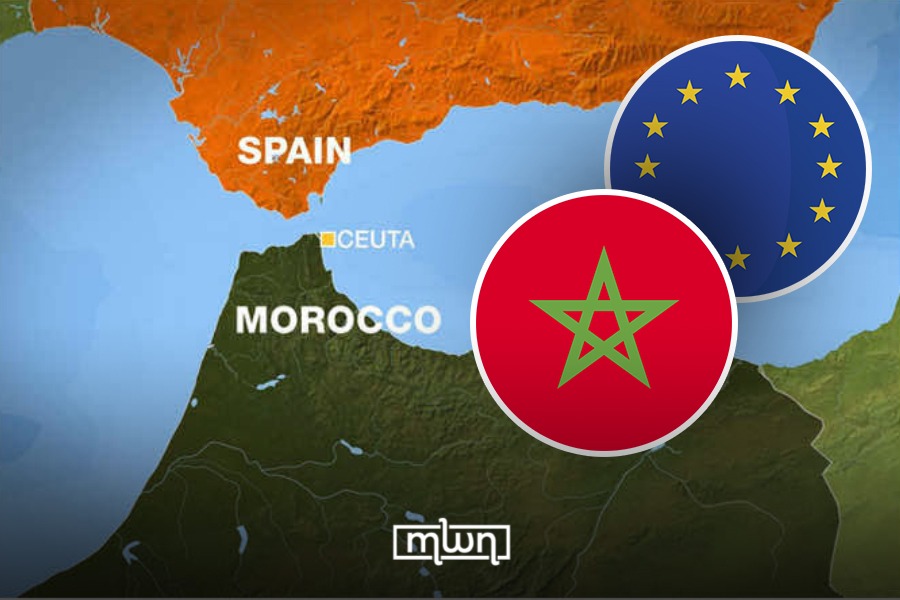
The Spanish enclaves of Ceuta and Melilla place European-controlled territory directly on Morocco’s Mediterranean coast. With major ports on both the Atlantic and Mediterranean and strong ties to West Africa, Morocco is naturally positioned as a bridge between Europe and Africa. For many sub-Saharan African migrants, Morocco is the last stop before attempting to enter Europe.
As a result, European governments demand Moroccan cooperation in safeguarding their southern border. However, Morocco should not be held responsible for the wars, poverty, political instability and inequality driving migration north simply because it is the final transit country.
Many of these conditions were shaped or intensified by colonial legacies, foreign interventions and postcolonial political and economic arrangements involving the same European countries that now complain about the resulting migration. While its location explains Europe’s need for cooperation, it does not justify placing the burden of managing migration for an entire continent on Morocco.
Morocco as Europe’s Commercial Gateway to Africa The same geography that makes Morocco a migration route also gives it the potential to become Europe’s commercial gateway to Africa. Its proximity to Europe, political stability, modern ports and expanding transportation networks make it an attractive base for European companies seeking access to African markets.
Tangier Med, now one of the Mediterranean’s most important port, connects Morocco to shipping routes serving Europe, West Africa and the wider Atlantic economy.
The same will go for Hador port and soon to be finished Dakhla port. Morocco can offer more than infrastructure. Its multilingual workforce, cultural familiarity with both regions and growing commercial presence across Africa allow it to serve as a liaison between European businesses and African governments, consumers and local partners.
European companies can further use Morocco as a center for manufacturing, logistics, banking, telecommunications and professional services while remaining only a short distance from their home markets. Europe should therefore see Morocco as more than a checkpoint tasked with stopping migrants. Properly developed, it can become the economic bridge through which European investment reaches Africa, creates employment and helps address some of the pressures that drive migration in the first place.
If Europe helps Morocco create meaningful employment for its young population and strengthen its capacity to manage migration, the effort to control irregular African migration could begin at Morocco’s southern frontier rather than end in crisis at Europe’s southern border.
Europeans Are Also Moving South Movement between Morocco and Europe does not occur in only one direction. While European governments debate how to limit African migration northward, millions of European tourists travel south to Morocco every year. European retirees are also choosing to spend part or all of their retirement there, attracted by the warmer climate, lower cost of living, cultural richness and proximity to Europe. Others arrive as investors, business owners, remote workers or buyers of Moroccan property.
Morocco is investing heavily in the infrastructure that supports this movement. Airports are being expanded, airline connections increased, high-speed rail extended and new hotels, resorts, restaurants and coastal developments built to accommodate foreign visitors and residents.
Their arrival is generally presented as an economic opportunity. The language itself reveals a double standard. Europeans who settle in Morocco are commonly described as expatriates, retirees or investors. Migration scholar Hein de Haas highlights this imbalance: “Europeans enjoy largely unrestricted access to Morocco, while Moroccans face restrictive barriers when attempting to travel, work or settle in Europe”.
Moroccans who settle in Europe are more readily described simply as immigrants, often with the suggestion that they represent a social burden. Movement south is celebrated as tourism and investment, while movement north is increasingly portrayed as a crisis.
Europe Relies on Moroccan Workers but Remains Wary of Migration Europe’s increasingly restrictive immigration debate often ignores a basic economic reality: many European countries need foreign workers. Falling birth rates and aging populations are shrinking the labor force while increasing demand for healthcare, elder care and other essential services. These demographic pressures are particularly acute in Spain, France, Italy and Germany.
Moroccan migrants already perform essential work in agriculture, construction, hospitality, transportation, domestic services and healthcare. European employers also recruit Moroccan doctors, nurses, engineers, technicians and university graduates when they cannot find enough qualified workers at home. These migrants help sustain businesses, public services and pension systems that increasingly depend on foreign labor.
Yet the same Moroccan who is considered indispensable at work may be viewed with suspicion as an immigrant. Europe welcomes his labor and expertise in all aspects of its economies, while remaining uneasy about his permanent presence, the family he may bring and the community he may help build.
This contradiction allows governments to recruit the workers their economies need while political parties promise voters that immigration will be sharply reduced. Europe does not merely receive Morocco’s most desperate migrants; it also attracts many of its most highly trained citizens.
OECD data showed that approximately 425,000 university-educated Moroccan emigrants were living in member countries in 2010–2011—more than twice the number recorded a decade earlier. They included approximately 7,000 doctors and 7,300 nurses, meaning that one-quarter of Moroccan doctors and one-fifth of Moroccan nurses were living in OECD countries.
France and Spain alone hosted approximately 240,000 highly educated Moroccan emigrants. Although these figures are now dated—and some of these professionals received their education abroad—they demonstrate the longstanding scale of Morocco’s loss.
This brain drain deprives Morocco of many of the professionals it needs to improve its economic sectors. Their departure weakens the institutions and opportunities available to those who remain, reinforcing the very conditions that encourage further emigration.
A damaging cycle emerges: Europe fills its labor shortages with Moroccan talent, while the resulting loss of talent makes it harder for Morocco to develop sufficiently to reduce future migration. The Far Right and the Fear of a More Muslim Europe European resistance to Moroccan migration is not driven solely by concerns about employment, border control or public services. Because most Moroccan migrants are Muslim, the debate is also shaped by anxiety about Islam’s growing visibility in European society.
Far-right movements portray mosques, minarets, headscarves, halal food and Islamic schools not simply as expressions of religious freedom, but as signs of a permanent cultural and demographic transformation. In this narrative, the Moroccan migrant is more than a foreign worker; he is presented as the carrier of a religion and civilization that supposedly threaten Europe’s Christian heritage or secular identity.
These fears have influenced legislation as well as campaign rhetoric. France prohibited conspicuous religious symbols in public schools in 2004 and banned face concealment in public in 2010. Although these laws are written in religiously neutral language, the public controversies surrounding them focused heavily on Muslim headscarves, niqabs and burqas. France’s 2021 law “strengthening respect for the principles of the Republic,” originally debated as a response to separatism, expanded government oversight of religious associations, foreign funding and homeschooling.
Switzerland went further in 2009 by amending its constitution to prohibit the construction of new minarets, explicitly restricting an Islamic religious symbol. It later adopted a national prohibition on covering the face in public, which took effect in 2025.
The Netherlands has similarly prohibited face-covering clothing on public transportation and in government, healthcare and educational buildings since 2019.
These laws have different purposes, and their supporters cite secularism, security, communication, women’s equality and opposition to extremism.
Not everyone who supports them is necessarily hostile toward Muslims. Nevertheless, their cumulative effect demonstrates that Europe’s immigration debate is also a struggle over whether Islam will be accepted as a permanent part of European identity. Europe’s far right therefore promises more than a reduction in immigration. It promises to prevent Europe from becoming more visibly Muslim. Under that standard, even a Moroccan who works, pays taxes, obeys the law and integrates economically may still be treated as a cultural threat if he retains his religious identity.
Morocco Faces Its Own Immigration Dilemma Morocco is no longer simply a country whose citizens emigrate. Its location has made it a transit country for sub-Saharan Africans hoping to reach Europe. Once they start that journey, they either choose to stay in Morocco waiting for the right moment to migrate to Europe or simply find employment in Morocco.
Currently, Morocco confronts many of the same questions that dominate European politics: How many migrants can the country accommodate? Should undocumented migrants be allowed to work legally? What services should be available to them? How should the government balance border enforcement with human dignity? Morocco launched regularization campaigns in 2014 and 2016, granting legal status to tens of thousands of migrants. Many others continue to face insecure employment, inadequate housing, racial discrimination, and exploitation by smugglers.
This experience complicates Morocco’s criticism of Europe. Morocco rightly objects to being treated as a holding area for migrants Europe does not want, but it must also ensure that sub-Saharan Africans are not subjected inside Morocco to the same exclusion and suspicion that Moroccans condemn abroad.
Seeing Morocco as a Bridge, not a Barrier Europe and Morocco need a partnership that goes beyond border patrols and payments for border security.
Europe could offer more legal and circular migration options and work with Morocco to train workers for real labor shortages. In return, Morocco should look after its citizens abroad, handle irregular migration responsibly, and treat sub-Saharan migrants within its borders with care. Geography has made Morocco the gateway between Europe and Africa, but a gateway is not merely a barrier built to stop people. It is also a place of movement, commerce and exchange.
Europe cannot welcome Morocco’s products, recruit its professionals, retire along its coasts and use it to reach African markets while viewing Moroccan and African migrants primarily as threats. Morocco must also confront its own contradictions. It cannot benefit from remittances while ignoring the loss of its young talent and skilled labor. It must measure progress not only by the size of its infrastructure but also by whether ordinary citizens can participate in its economy.
Credit: Source link