

How Stable is Mali’s Junta?
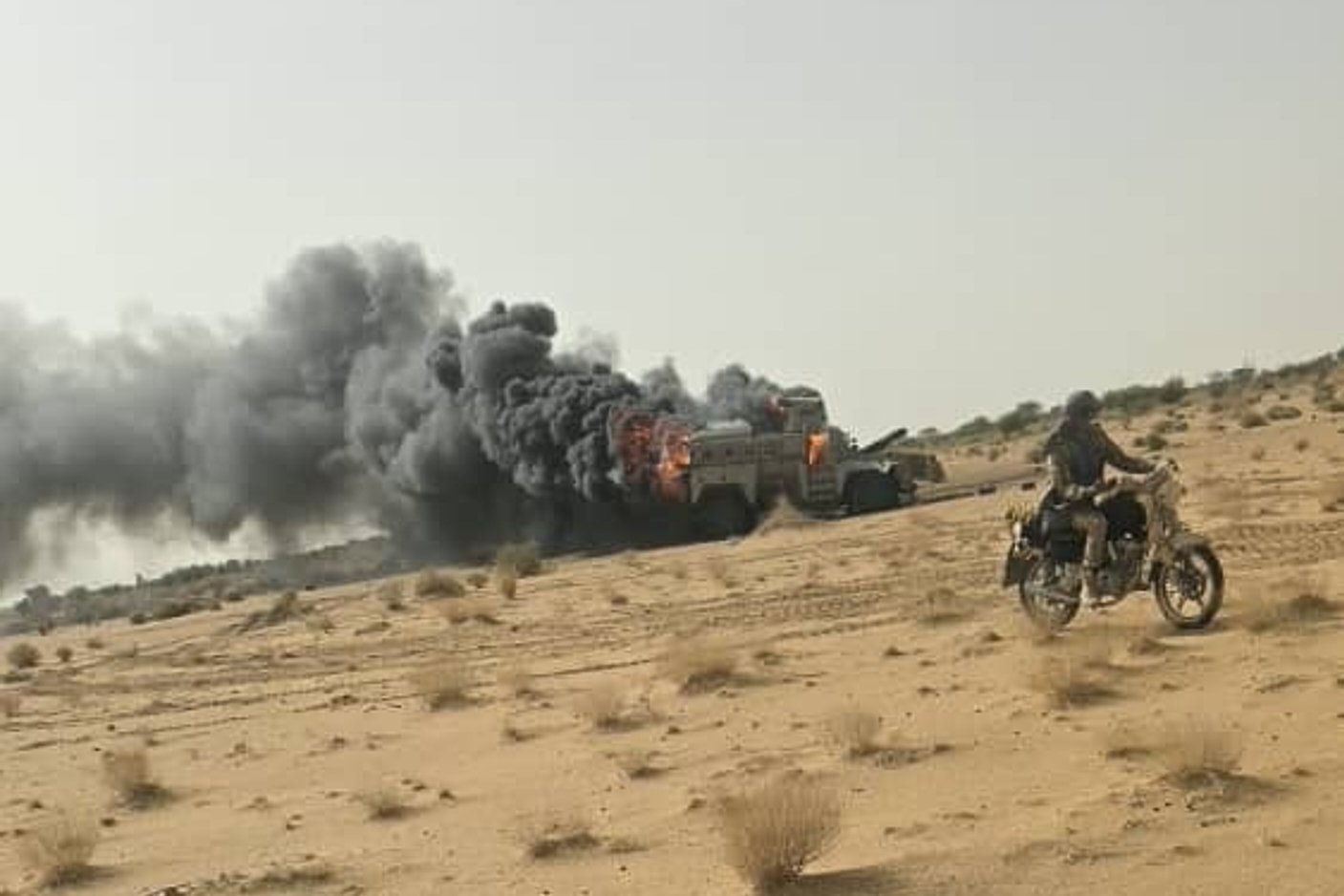
(Frente de Liberación de Azawad vía AP)
Bottom Line Up Front
- Recent successes in hostage diplomacy in the Sahel, such as the release of Kevin Rideout, stand in stark contrast to the grim reality of Mali’s current security landscape.
- Mali’s junta is deeply embattled, even as gold exports and Russian mercenaries continue to prop it up.
- JNIM has established itself as one of Africa’s most successful insurgencies, raking in significant revenue streams, maintaining and governing territory, and launching terrorist attacks with impunity.
- ISSP continues to expand its operational footprint and launch attacks at both security forces and civilian targets.
Last week, the Tuareg-led rebel group Front de libération de l’Azawad (FLA) released 82 Malian Armed Forces soldiers whom it had held captive. Many of the soldiers had been taken on April 25, 2026, when the group and its ally Jama’at Nusrat al-Islam wal-Muslimin (JNIM), al-Qaeda’s affiliate in the Sahel, launched their spectacular joint offensive across Mali, leading to the recapture of the city of Kidal and further ratcheting up the pressure on Bamako. An additional 60 civilians taken hostage by JNIM were also liberated in Mali last week, an apparent sign of goodwill towards the villages from which they were taken. That same day, the Malian junta, following mediation efforts by Morocco, released the French intelligence agent it had held since August 2025. Islamic State Sahel Province (ISSP), which has been at war with JNIM since 2019 and is nestled in the tri-border area and the eastern Ménaka and Gao regions of Mali, released a U.S. citizen, Kevin Rideout, one of a handful of Western hostages it was holding. Analysts have emphasized that these outcomes stem from distinct negotiation paths with different parties involved, including Libyan strongman Khalifa Haftar, who reportedly played a central role behind the scenes, allegedly paying $12 million in ransom. These recent instances of successful hostage diplomacy in the Sahel stand in stark contrast to the grim reality of Mali’s current security landscape, which remains marked by major upheaval and violence.
The fuel blockade, launched in September 2025 by JNIM, is approaching its one-year anniversary. JNIM continues to demonstrate its strength by capturing and holding territory, while launching new attacks targeting the regime. Human rights abuses by all parties, including Mali’s junta and Russia’s Africa Corps, show the devastating extent of the civilian toll. And ISSP profits from diminished state capacity, counting roughly 2,000 fighters and growing operational capabilities.
Economically, Mali’s junta remains heavily reliant on gold, the country’s main export, which is primarily sourced from the South and West, where Africa’s third-largest gold deposit is located. But even this important, lucrative economic pillar is increasingly destabilized by JNIM, which also relies on extortion around the gold industry as an economic motor. Rather than directly controlling gold mines, the group uses the routes gold takes to extort and tax, earning illicit proceeds from nearly every stage of the value chain. JNIM also engages in economic warfare and, during the April offensive, regained control over Intahaka, with the largest artisanal gold mine in northern Mali. While the junta remains in control of the industrial mines and continues to collect revenue from them, it must also pay major expenses to survive, including costly blockade workarounds such as army-escorted supply convoys and heavy monthly bills for the dubious help of Russian mercenaries. JNIM also benefits from ransom paid for hostages. Most notably, the UAE paid the group $50 million for the release of its citizens in 2025, which significantly helped fund its offensive.
Relatedly, the junta’s supply chains remain under immediate and dire threat, weakening the regime, with Mali’s near-total reliance on road imports of oil from Senegal and Côte d’Ivoire continuing to be strategically leveraged by JNIM and FLA. The regime’s military logistics have likewise degraded because of JNIM’s many checkpoints, ambushes, and landmines around the capital, prompting costly workarounds and permanent use of armed escorted convoys to allow some supplies to flow into the capital. Russia continues to supply Bamako with security logistics, but a recent shipment of military vehicles dropped off at the port in Togo and then transported overland to Mali suggests that supply chains continue to shift and evolve in response to security and sanctions concerns. In addition, a C4ADS investigation shows how extensively Russia uses aviation logistics networks in the Sahel, as land routes have become too treacherous.
The effectiveness of the Malian junta’s reliance on foreign partners is equally dubious after the April offensive. Nonetheless, the Russia partnership remains intact, and the junta has resuscitated its relations with Algeria through Moscow’s mediation — suggesting that Moscow is still perceived as a lifeline even after the humiliation of the April offensive. Russia’s presence in the country through Africa Corps stands at 2,000 to 2,500 men and, according to defense blogs reporting in May, now has a consolidated aviation group stationed in Bamako–though Africa Corps has operated Su-24M bombers since at least April 2025.
Meanwhile, the dicey relationship between Bamako and Algiers has seemingly been mended through Russian efforts. Algiers had been an important mediator in the exit of the Malian Armed Forces and the Africa Corps from Kidal during the offensive, helping the Armed Forces that undoubtedly feared a repeat of the 2024 Tinzaouaten massacre. Nonetheless, key differences remain between Algiers and Bamako, with Mali endorsing Morocco’s Western Sahara plan in April, a thorn in the side of Algiers. Mali’s membership in the Alliance des États du Sahel (AES) similarly yields some protection for the weakened regime: rather than a mere paper tiger, it has recently announced an expansion of its joint forces. Türkiye, China, and Iran also remain important to the survival, militarily and economically, of the regime.
The junta’s fraying narrative power further proves its weakened posture — even after it has effectively monopolized the official information domain, expelling free media and detaining opposition voices. Insurgent groups have attempted to conduct counter-messaging campaigns, and JNIM’s Az-Zallaqa Foundation continues a strategy of both incitement to rise up against the junta — as done during the April offensive — and the projection of political legitimacy through broadcasting Qadi rulings. Additionally, al-Qaeda’s official and supporter ecosystem often further propagates its content, battles, and claims. Almost half a million people are internally displaced, and rampant poverty and food insecurity persist, further hollowing out the credibility of the government. Additionally, the junta’s own human rights abuses, especially targeting Tuareg and Fulani communities, further undermine its credibility.
Territorially, the junta controls most of Mali’s major cities, with the notable exception of Kidal, and, through armed escorts, intermittently has access to the arteries between them, amid frequent JNIM ambushes and blockades. The regime’s internal lack of cohesion also points to one of its most glaring vulnerabilities: the Junta has seen periodic purges since 2025. In August 2025, some soldiers were arrested over an alleged coup attempt. In late 2025, the regime removed other senior officers, including the former domestic intelligence chief. After the April 2026 offensive, purges also took place, with soldiers suspected of complicity with JNIM and FLA.
All these factors point to a regime at its weakest since the 2020 coup. Flashpoints that will determine what happens next are not only related to the regime — the cadence of convoy entries into Bamako, the status of major cities, and the health and presence of the regime leaders — but also to the strength of the insurgents.
JNIM’s war spoils and ability to seize and govern territory make it one of the continent’s most successful insurgencies. The latest UN Monitoring Team report estimates that a ransom payment in November 2025 was used and redistributed to finance the April offensive. It also continues to use road taxation, cattle rustling, zakat taxation, and kidnapping for ransom to fill its war chest. Its manpower similarly reflects its stature, with between 7,000 and 8,000 fighters across the Sahel, half of whom are active in Mali. Its offensive also reflected a high degree of sophistication, a pattern that has continued in subsequent coordinated, smaller attacks. Its ‘fratricide’ with ISSP, as fragile truces between the groups continue to falter, weakens the group. The UN Monitoring Team notes an evolution toward “open competition” between the ISSP and JNIM, which has triggered fears of outbidding between the rivals, a phenomenon that could result in more high-profile terrorist attacks in the future, including external operations.
Meanwhile, ISSP remains one of Islamic State’s fastest-growing affiliates in terms of operational reach and has, in Mali, consolidated its control of the Ménaka region, encircling Ménaka city. As Wassim Nasr highlights in his report, “The Islamic State’s Growing Footprint in the Sahel,” ISSP has shown an ability to execute more complex operations, with growing operational links to Islamic State West Africa Province. Notably, ISSP seems to benefit from the broader collapse of state authority without incurring the same costs as JNIM and FLA, staying out of the campaign against the junta in Bamako and opportunistically filling the voids left by JNIM’s offensive. Its own operations against the security forces in the Sahel and JNIM continue apace, and the incoming cash flow from hostage deals will surely be a boon for the organization.
Credit: Source link