

How Iran built Iraq’s powerful network of militias — and why it matters now
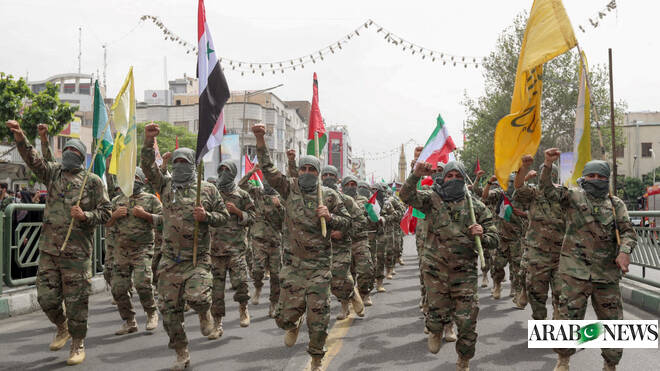
LONDON: Joint US-Saudi strikes on Iran-backed groups in Iraq on Wednesday exposed the depth of Tehran’s military network inside the country, where militias have evolved from insurgent movements into some of the most powerful political and security actors in the Iraqi state.
The operation, which followed more than 30 drone attacks over three days targeting Saudi Arabia’s petroleum infrastructure and US military sites in the region, has reignited debate over whether Baghdad can prevent its territory becoming a launchpad for wider regional conflict.
The coalition of pro-Iran paramilitaries known as the Popular Mobilization Forces, or Al-Hashd Al-Sha’abi, said the US-Saudi strikes hit its headquarters and facilities in Baghdad, Ninevah, Basra, Wasit, Karbala, Kirkuk, Salahuddin and Diyala provinces.
The PMF said at least 20 fighters were killed and 32 wounded. “These attacks resulted in the martyrdom of a number of personnel and injuries to others, as well as material damage to several buildings and properties,” the group said.
The scale of the strikes highlighted how extensively Iran-backed factions have become embedded across Iraq’s security landscape.
Most of the hardline groups now operate under the umbrella of the Islamic Resistance in Iraq, a loose coalition of about 10 factions that security officials estimate commands about 50,000 fighters alongside large stockpiles of drones, long-range missiles and anti-aircraft weapons.
Since the Gaza war began in 2023, the coalition has claimed responsibility for dozens of drone and missile attacks against Israel and US forces in the region, making Iraq an increasingly important front in Iran’s regional confrontation with its adversaries.
The armed groups targeted in Wednesday’s operation emerged after the 2003 US-led invasion of Iraq, when Tehran steadily expanded its influence inside Iraq’s fractured political and security institutions.
With extensive Iranian funding, training and weapons, many evolved from insurgent organizations into powerful military forces capable of rivaling Iraq’s regular armed forces.
Over two decades they have also built extensive business interests, secured seats in parliament and become deeply embedded in ministries and state institutions, blurring the distinction between official security forces and Iran-aligned armed groups.
The most powerful of these factions is Kata’ib Hezbollah, widely regarded as Tehran’s closest military partner in Iraq and the dominant force within the Islamic Resistance.
Founded in the mid-2000s by Abu Mahdi Al-Muhandis, who was killed alongside Iranian Quds Force commander Qassem Soleimani in a 2020 US airstrike near Baghdad airport, the group developed a reputation for rocket, mortar, sniper and roadside bomb attacks against US forces.
US intelligence estimates it commands as many as 10,000 fighters and possesses one of the region’s largest militia arsenals, including drones, rockets and short-range ballistic missiles.
The group also fought alongside Iranian-backed forces during Syria’s civil war and has repeatedly ignored Iraqi government calls to halt attacks on US troops.
Another central faction is Asaib Ahl Al-Haq, formed in 2006 after splitting from Muqtada Al-Sadr’s Mahdi Army and led by Qais Al-Khazali.
Al-Khazali was detained by US forces in 2007 over his alleged role in an attack that killed five American soldiers before being released three years later.
The group later became one of the most prominent militias fighting Daesh and has increasingly sought political influence through its Al-Sadiqoun parliamentary bloc.
Although Al-Khazali has attempted in recent years to project a more moderate political image, he continues to oppose the US military presence in Iraq and remains one of Tehran’s most influential allies inside the country.
The Badr Organization, meanwhile, is the oldest and most institutionalized of Iraq’s Iran-backed factions.
Originally established in Iran in 1982 during the Iran-Iraq War as the armed wing of the Supreme Council for the Islamic Revolution in Iraq, it has become deeply integrated into Iraq’s political system and security establishment while maintaining close ties to Tehran.
Other important members of Iran’s network include Harakat Hezbollah Al-Nujaba, established in 2013 by Akram Al-Kaabi after breaking away from Asaib Ahl Al-Haq, and Kata’ib Sayyid Al-Shuhada, another militia created the same year that fought in Syria.
There is also Kata’ib Al-Imam Ali, founded in June 2014 as the military wing of Harakat Al-Iraq Al-Islamiyah, and Saraya Al-Khorasani, whose current formation dates to 2013.
Together, these organizations illustrate how Iraq’s security landscape has become intertwined with Iran’s wider regional strategy, combining formal state recognition with independent chains of command, ideological allegiance to Tehran and military capabilities that extend beyond Iraq.
The latest escalation has prompted renewed calls from prominent Iraqi leaders for the state to reassert control over armed groups operating outside government authority.
Former Prime Minister Mustafa Al-Kadhimi warned that Iraq can no longer afford to become the battleground for conflicts driven by outside powers.
“It is no longer possible to tolerate the actions of non-state actors, whose conduct can only be described as a deliberate assault on the interests of Iraq and the Iraqi people,” he wrote on X.
“Resolving the issue of weapons outside state control and confronting non-state actors has become a sovereign imperative that can no longer be postponed.
“Iraq must not be made to pay the price for the conflicts of others, nor should the interests of its people be held hostage to foreign agendas or impulses that may appear ideological on the surface but are, in reality, driven by interests and influence.”
Al-Sadr, whose Mahdi Army was disbanded in 2008 and then semi-revived in 2014 as Saraya Al-Salam, likewise appealed for restraint, warning that Iraq should not become another battlefield in the confrontation between Iran and its rivals.
He urged “rogue militias” not to provide a pretext for further attacks on Iraq, adding: “Iraq and its people are in need of peace; we have had enough of war.”