

Gov’t Bets on STEM to Build Workforce of the Future | News
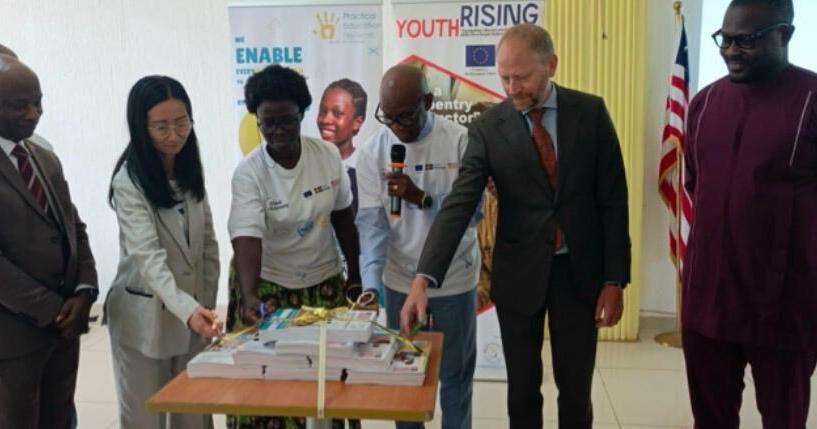
The government has unveiled an ambitious initiative to reshape the way science and mathematics are taught in classrooms, launching a new generation of practical Science, Technology, Engineering and Mathematics (STEM) manuals designed to move students beyond memorization and prepare them for the demands of a modern, technology-driven economy.
The manuals, launched on Wednesday, August 5, were developed under the Youth Rising Project, implemented by the United Nations Industrial Development Organization (UNIDO) in partnership with the Practical Education Network (PEN), with financial support from the European Union (EU) and the Government of Sweden.
More than the introduction of new teaching materials, education experts say the initiative represents an important shift in Liberia’s education philosophy—from teaching students what to think to teaching them how to think.
As Liberia seeks to diversify its economy, expand industrialization, and create employment opportunities for its rapidly growing youth population, stakeholders argue that strengthening STEM education is no longer optional but essential for national development.
For decades, science and mathematics instruction in many Liberian classrooms has relied heavily on lectures, note-taking and rote memorization.
Students often learn scientific formulas and mathematical concepts theoretically but have limited opportunities to test, observe or apply them in practical settings.
The result, education specialists say, is a disconnect between classroom learning and real-world problem-solving.
The newly launched manuals seek to bridge that gap.
Rather than relying exclusively on textbooks and lectures, they encourage experimentation, inquiry-based learning and classroom activities using materials that are readily available within local communities.
Speaking during the launch, Chief of Fair Production, Sustainability and Trade Division, UNIDO, Madam Virpi Stucki, described the initiative as a transformational investment in Liberia’s future.
“If I had to describe today’s event in three words, this would be curiosity, opportunity and transformation,” she said.
According to Stucki, curiosity drives scientific discovery, opportunity allows knowledge to transform lives, and meaningful transformation occurs when teachers have the right tools to inspire practical learning.
“Quality science, technology, engineering and mathematics education opens doors for new careers, new industries and brighter futures for Liberia’s young people,” she added.
Why STEM Matters for Liberia
Globally, STEM education has become one of the strongest predictors of economic competitiveness.
Countries that have invested heavily in science, engineering, innovation and technology have generally been better positioned to industrialize, improve agricultural productivity, strengthen healthcare systems and compete in the digital economy.
For Liberia, the importance may be even greater.
The country continues to pursue economic diversification beyond its traditional dependence on natural resources such as rubber, iron ore and agriculture.
Achieving that objective will require engineers to build infrastructure, scientists to improve agricultural production, technicians to maintain industrial equipment, programmers to develop digital solutions, and innovators capable of creating businesses that generate employment.
Without stronger STEM education, experts warn, Liberia risks remaining dependent on imported technology and foreign technical expertise.
The manuals therefore represent an investment not simply in education but in the country’s long-term economic competitiveness.
Representing the Minister of Education, Deputy Minister for Instruction Amos Armah Fully described the initiative as a major departure from traditional teaching methods.
“For too long, our science and mathematics classrooms have been the chalk and we talk,” he said.
“Everything is done by the teachers. Students memorize formulas. They do not even understand what the teacher is saying.”
According to the Deputy Minister, the new manuals are designed to place students at the center of learning by encouraging participation, experimentation and discovery.
“When you involve the students into practical work, they will do their best. They will be involved in everything. But when you take the time to just talk and talk, some of them will sleep,” he observed.
His comments reflect a growing consensus among education specialists that active learning produces stronger academic outcomes than passive instruction.
Research increasingly shows that students retain knowledge more effectively when they conduct experiments, solve practical problems and collaborate in classroom activities.
One of the initiative’s distinguishing features is its emphasis on locally available materials.
According to Practical Education Network Chief Executive Officer Dr. Heather Been, the manuals were developed specifically to fit Liberia’s educational realities rather than assuming schools possess expensive laboratories.
“These eight manuals that we’re launching today cover science and math from elementary through high school, and they capture one activity for every single topic in the national curriculum,” she explained.
Importantly, the activities rely largely on materials already available within communities.
“The locally available materials have been emphasized throughout the content, proving that it is possible to teach in a hands-on practical way in the Liberian context,” Dr. Been said.
That approach addresses one of Liberia’s longstanding educational challenges: limited laboratory facilities, particularly in rural schools.
Instead of waiting for expensive equipment, teachers can begin implementing practical science immediately.
Stakeholders emphasized that the manuals alone will not transform education.
Implementation will depend heavily upon teacher preparation.
UNIDO disclosed that the next phase of the project includes training 300 teachers across eight counties through a network of 10 master trainers.
The project will also organize national STEM fairs where students will have opportunities to demonstrate scientific innovations and practical projects.
Madam Stucki described the launch as the beginning—not the conclusion—of the reform process.
“Today’s launch is not the end of the journey. It is the beginning of the next phase.”
Preparing Students for the 21st Century
The European Union, one of the initiative’s principal supporters, framed STEM education as preparation for future employment rather than merely improved examination performance.
EU Education Project Officer Lorpu Faith Scott argued that modern economies increasingly reward creativity, innovation and analytical thinking.
“Through STEM education, we empower young people not only to acquire knowledge but also to develop critical thinking, creativity, problem-solving and innovation skills needed to thrive in this 21st century,” she said.
She urged stakeholders to focus not simply on launching the manuals but on ensuring they reach classrooms nationwide.
The project also seeks to address gender disparities in science education.
Swedish Ambassador Karl Backéus praised the initiative’s emphasis on increasing girls’ participation in STEM fields.
International research consistently demonstrates that expanding female participation in science and engineering contributes to stronger innovation, greater economic productivity and more inclusive development.
For Liberia, where women remain underrepresented in many technical professions, encouraging girls to pursue STEM careers could significantly broaden the country’s future workforce.
According to PEN Country Director Joseph Quaye Amoo, the manuals were developed after Liberian teachers repeatedly requested resources aligned specifically with the national curriculum.
“One key demand that kept coming from teachers was: when are you working on the Liberian manuals? The Ghana manuals are good, but we need one that is very much aligned to the Liberian curriculum,” he explained.
Following classroom testing, technical reviews and stakeholder validation, the manuals were revised to reflect Liberia’s educational environment.
For Amoo, the ultimate objective extends beyond improved classroom instruction.
“Students can learn with their hands, students can build critical thinking, students can solve local problems, and students can transform Liberia,” he concluded.
The launch comes at a time when Liberia continues to prioritize education as a driver of economic transformation under its broader national development agenda.
Analysts note that successful economies increasingly depend on innovation rather than natural resources alone.
Investments in STEM education therefore produce long-term dividends by strengthening human capital, encouraging entrepreneurship, improving industrial productivity and reducing dependence on imported technical expertise.
If effectively implemented, the new manuals could help cultivate a generation of scientists, engineers, technicians, innovators and entrepreneurs capable of addressing Liberia’s own development challenges—from agricultural modernization and renewable energy to healthcare, infrastructure and digital technology.
For thousands of Liberian students, the manuals offer something more immediate: the opportunity to discover science not as a collection of formulas on a chalkboard, but as a practical tool for understanding the world and shaping the country’s future.
As the government works toward building a more diversified and knowledge-driven economy, stakeholders believe the country’s next great investment may not lie beneath its soil, but within the curiosity, creativity and potential of its young people.
Credit: Source link