

From ballots to reform: the EU’s election work in Lesotho
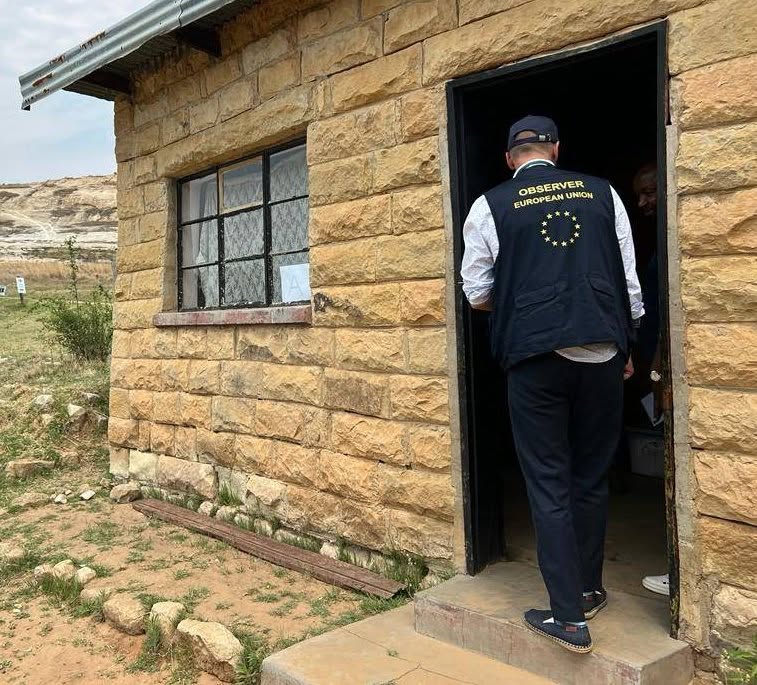
From the EU’s first-ever Election Observation Mission in Lesotho in 2022 to a Follow-Up Mission in 2025, the partnership has tracked progress, sharpened reform priorities and supported a more inclusive electoral process.
Lesotho’s electoral journey over the past three years has been marked not only by ballots cast and reports written, but by a steady, practical effort to strengthen the democratic tenets that underpins them. Since 2022, the European Union’s engagement has moved from watching the vote to following up on what came next, helping Lesotho assess progress, address gaps and strengthen the institutions that sustain credible elections.
The journey began in 2022, when the European Union (EU) announced that it would deploy an Exploratory Mission (ExM) to Lesotho to assess whether a full election observation mission should follow. That decision led to the signing of Administrative Arrangements in July 2022 between the Government of Lesotho, the Independent Electoral Commission (IEC) and the EU, clearing the way for the first-ever EU Election Observation Mission to the country to observe the National Assembly elections scheduled for 7 October 2022.
What began in 2022 as the European Union’s first-ever Election Observation Mission to the Kingdom has developed into a broader reform partnership, with one mission assessing the vote, another checking progress, and a new programme helping to turn recommendations into lasting change.
The 2022 EU Election Observation Mission was led by Ignazio Corrao, appointed Chief Observer by the EU’s High Representative at the time, Josep Borrell. The mission’s core team comprised nine election experts, joined by 22 long-term observers and later reinforced by 30 short-term observers, making for a substantial field presence across the country. Its work culminated in a final report that set out 21 recommendations for strengthening electoral administration, transparency, participation and the broader democratic governance environment in Lesotho.
Those recommendations did not sit on a shelf. In the years that followed, they helped shape a wider reform conversation in Lesotho, including the launch of Inclusive Lesotho, a €4 million initiative running from 2025 to 2029 and designed to support electoral reform, civic education, inclusive participation, electoral administration, and transparency in political finance. The programme is part of the EU’s wider support to democratic governance in the country and reflects a long-term commitment to turning observation into institution-building.
In November 2025, the EU returned to Lesotho with a Follow-Up Mission to assess how far those recommendations had been implemented. Led by Chief of Mission Andreas Schieder, Member of the European Parliament, the Electoral Follow-up Mission engaged national leaders and key electoral stakeholders, including Prime Minister Sam Matekane, the Parliament, the Senate, the Independent Electoral Commission (IEC), political parties, the media and other stakeholders, to examine the political and legislative environment shaping future elections, while also assessing progress against the 21 recommendations contained in the Final Report of the EU Election Observation Mission.
The Final Report was formally shared with the Honourable Minister of Foreign Affairs at the time, Lejone Mpotjoane, as well as the National Assembly, the IEC and other national stakeholders in electoral governance. The report provides a comprehensive evaluation of progress achieved since 2022, and offers recommendations grounded in international best practice and a consolidated EU methodology.
Its press materials made clear that the follow-up was not a verdict, but a measure of progress, a way of mapping what had changed, what still needed attention ahead of future elections and where momentum needed to be sustained.
By March 2026, the EU Follow-Up mission’s final report had been publicly released, offering an updated assessment of implementation and a roadmap for the next stage of reform. Together, the 2022 mission, the follow-up mission and Inclusive Lesotho tell a story of steady democratic engagement, one that has moved from election-day observation towards more durable institutional support.
The story that emerges is one of continuity rather than spectacle. Lesotho’s electoral governance reforms have advanced through patient work involving dialogue, technical support, institutional engagement, and an increasingly clear sense that credible elections depend on more than election day itself. This approach reflects a partnership that now spans half a century, rooted in mutual trust and shared democratic values.
The EU’s first mission helped identify the reform agenda, the follow-up mission assessed delivery, and Inclusive Lesotho has added a practical, programme-based engine for the next phase.
Yet this is not merely a sequence of interventions. It is the latest chapter in a 50-year relationship where the EU has stood as a consistent ally.
For Lesotho, the significance goes beyond external observation. It speaks to a broader democratic resilience, the willingness to examine institutions, welcome recommendations, and keep improving the rules of the game. For the EU, it reflects a partnership grounded in long-term cooperation rather than one-off intervention, with support stretching from observation to reform implementation. In an era where global alliances often prioritise short-term gains, this half-century of collaboration stands as a testament to what can be achieved when partners invest in shared progress.
This page brings together all reports, publications, and media to tell the complete story clearly. Visit the EU Election Missions database here.
Credit: Source link