

France’s Transport Minister Calls Morocco a Continental ‘Mobility Hub’
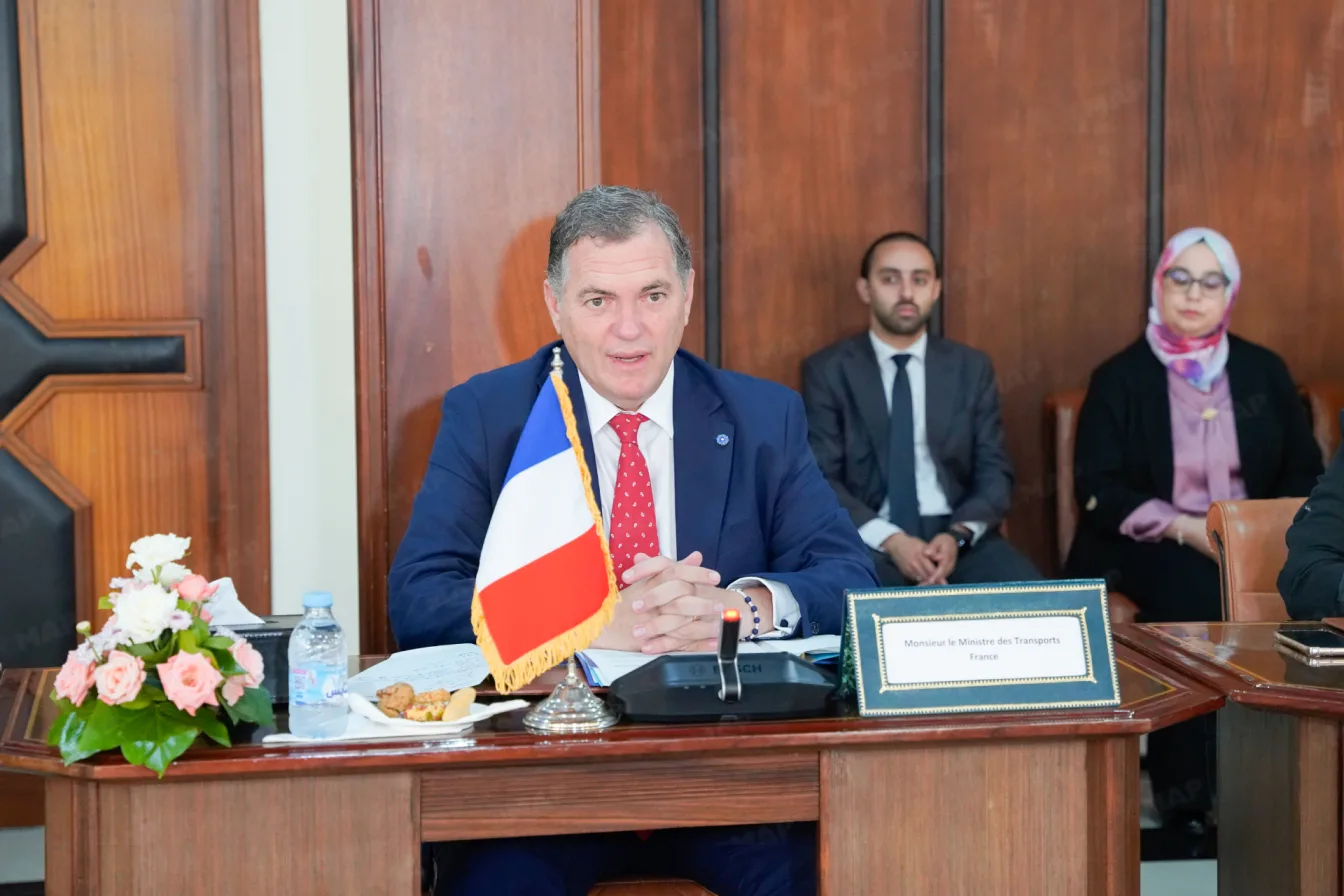
Marrakech – Morocco is positioning itself as a continental “mobility hub” on the strength of its infrastructure advances, particularly in rail, French Transport Minister Philippe Tabarot declared Thursday during the 15th Morocco-France High-Level Meeting.
Tabarot made the comments to reporters after a working session with his Moroccan counterpart, Abdessamad Kayouh, describing the country’s high-speed rail project as “remarkable at every level” – from rolling stock and engineering to infrastructure.
The French minister called the Morocco-France TGV partnership “an immense mark of confidence,” pointing to the large number of French companies involved and the innovative financing mechanisms developed jointly by both countries.
The remarks came as Rabat hosted the most significant round of bilateral talks between the two countries in years. The 15th High-Level Meeting, co-chaired by Moroccan Head of Government Aziz Akhannouch and French Prime Minister Sébastien Lecornu, had not convened since 2019.
Lecornu arrived Wednesday evening with a delegation of twelve ministers, including Foreign Minister Jean-Noël Barrot and Interior Minister Laurent Nunez.
The visit represents the latest chapter in a diplomatic warming that began when French President Emmanuel Macron recognized Moroccan sovereignty over the Western Sahara in the summer of 2024. A state visit to Rabat that October produced a batch of contracts and a “reinforced partnership of exception.”
Lecornu on Thursday referred to the prospect of a future “extraordinary friendship treaty” with Morocco, though no date has been fixed for a potential royal visit to Paris.
On transport specifically, the two ministers covered a wide range of cooperation areas. Kayouh told reporters the talks addressed road transport, with a planned increase in the quota of bilateral and transit transport authorizations.
The two sides also discussed facilitating mobility for Moroccan professional drivers operating in international road haulage – a step intended to support growing trade volumes between the countries.
Maritime cooperation featured prominently as well. Kayouh pointed to opportunities in merchant marine development, including expertise exchanges, capacity building, and modernization of Morocco’s maritime sector.
The ministers also reviewed airport cooperation, with both sides flagging the renewal of a protocol under the 2015 comprehensive cooperation agreement between Morocco’s airports office (ONDA) and France’s Aéroports de Paris (ADP).
Tabarot, for his part, urged investment in training – specifically in engineering schools and future-oriented programs – to sustain infrastructure development over the long term, particularly in railway engineering.
Both ministers committed to deepening bilateral transport and logistics cooperation through joint projects, intensified expertise exchanges, and stronger coordination between relevant entities on both sides.
A ‘pivotal moment’ for French-Moroccan cooperation
The transport discussions fed into a broader session that produced several signed agreements spanning infrastructure, water, culture, research, education, defense, and institutional cooperation.
Among the transport-related deals: a three-year action plan (2026-2028) for civil aviation cooperation signed by Kayouh and Tabarot; a partnership convention between France’s National Maritime Academy (ENSM) and Morocco’s Higher Institute of Maritime Studies (ISEM); and a French Development Agency (AFD) loan convention for a planned RER commuter rail network in Rabat.
A framework agreement between France’s Center for Studies and Expertise on Risks, the Environment, Mobility, and Urban Planning (CEREMA) and Morocco’s Public Laboratory for Testing and Studies (LPEE) covering soil engineering and port and maritime infrastructure expertise was also concluded.
Other notable agreements included a memorandum confirming financing for the Kenitra-Marrakech high-speed rail line, a declaration on teaching Arabic language and history-geography in French schools in Morocco, a defense industry bilateral committee, and an arrangement on military archives.
Lecornu framed the gathering as a “pivotal moment,” calling for a shift in scale in the bilateral relationship – particularly on security, counterterrorism, and shared interests on the African continent. Akhannouch, for his part, pushed to “accelerate implementation” of the commitments made under the 2024 partnership and to “prepare the next steps.”
Credit: Source link
Comments are closed.