

‘Everyone is scared’: flood-hit Porto Alegre braces for another El Niño | El Niño southern oscillation
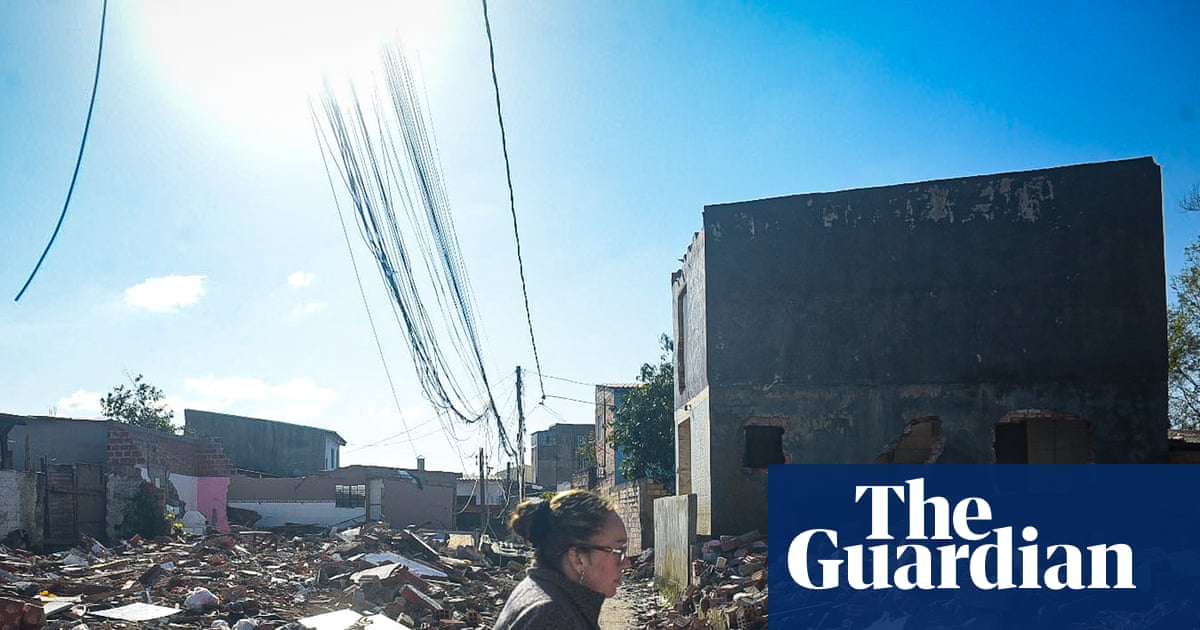
In the backstreets of Porto Alegre, a state capital in southern Brazil, you can still see signs of the devastating flood that swept through the city two years ago: scattered debris, waterlogged homes and destroyed businesses.
In May 2024, flooding killed 183 people in the state of Rio Grande do Sul and displaced more than 600,000. The neighbourhood of Sarandi was one of the hardest-hit parts of Porto Alegre, with water levels reaching up to 5 metres above normal, completely submerging many of its streets.
“Most people are still suffering the mental health consequences of the flood,” says Luís Rogério “Jamaika” Machado, a community leader in Sarandi.
“They lost absolutely everything. Unable to rebuild their houses, most have become deeply depressed.”
Last month, meteorologists announced the imminent return of El Niño, the naturally occurring phenomenon caused by rising sea-surface temperatures in the equatorial Pacific but the effects of which are greatly aggravated by the climate crisis. El Niño, which disrupts weather patterns across the globe, is likely to cause extreme rainfall and flooding in southern Brazil.
Jamaika lives in an urban quilombo, a Brazilian settlement founded by escaped enslaved people or their descendants. Quilombo dos Machado is one of 11 such territories in Porto Alegre and served as a centre of solidarity for the entire Sarandi area during the flood, distributing food, clothing and medical assistance to thousands of families.
Now Porto Alegre’s flood-hit communities, though still recovering from one of Brazil’s deadliest climate disasters, face renewed threats from this year’s developing El Niño as incomplete flood defences and government relocation schemes fuel fears of displacement and deepen a climate justice crisis.
Sarandi, along with other poorer areas of the city, is one such example. Despite being among those who are the least responsible for the emissions that cause climate breakdown, people there experienced the worst effects of the 2024 flood.
This imbalance has led the Porto Alegre research group at the Metropolis Observatory, part of Brazil’s National Institutes of Science and Technology (INCT), to call the flood a climate justice crisis.
Now, these same people are bracing for yet another climate-induced disaster.
The first storms caused by the latest El Niño arrived in Rio Grande do Sul last month, with rain and strong winds disrupting the region. Rising river levels affected at least 200 municipalities, leaving 1,800 people homeless and many more outraged by the government’s inaction over the past two years.
“El Niño peaks in December, January and February,” says Wilfran Moufouma-Okia, chief of climate prediction at World Meteorological Organization. “So we are just at the beginning.”
For people in Porto Alegre, the headlines bring renewed fears.
“Our house was completely submerged. We lost everything,” says Suelen Telles, a pre-school teacher who lives in Sarandi. “We’ve since returned to our house, and we’re terrified of losing everything again. Everyone on our street is scared.”
After losing her house in 2024, Solange Rodrigues Correa moved in with her grandson in Ilha Grande dos Marinheiros, an archipelago on the margins of the city. News reports have caused her to worry about the flood waters returning, and Correa, who suffered a stroke due to the stress of the 2024 floods, has not slept for several nights in a row.
“Once again, what will become of us?” she says.
Rudimar Dal Asta, a priest in Ilha Grande dos Marinheiros and one of the community leaders who helped in rescue missions during the previous flood, says the government has given assurances that there is an evacuation plan, but they have not seen it yet. “Our escape route is to run to the bridge, just like we did in 2024,” he says.
Over the past few months, Porto Alegre has repaired floodgates, replaced sewer covers, and rebuilt a section of the Sarandi dyke. Mayor Sebastião Melo announced that improvements to pumping stations – which were shut off in 2024 due to the risk of electric shock – would be completed by November.
“We’ve finished many projects,” says Melo. “Others are now under construction, and others have yet to be started. Porto Alegre is now a much more protected city.”
In the south of the city, however, the preparations remain makeshift: sandbags, movable barriers and floating pumps. Certain neighbourhoods, such as Ilha Grande dos Marinheiros, do not have adequate protective infrastructure and people are apprehensive.
“The flood protection systems are still incomplete,” says Leonardo Bauer Maggi of the Movement of People Affected by Dams (MAB), a large grassroots social movement that supports the affected population.
“They installed emergency sirens, but we don’t know where to run if they sound,” he says. “No shelters have been prepared.”
The Porto Alegre administration is now being sued for the failures of the flood protection system in 2024. Last year, the state court of auditors revealed that a lack of investment and a series of other failures combined to weaken flood-protection measures in Porto Alegre.
after newsletter promotion
Auditors held Melo, as well as the former mayor Nelson Marchezan Júnior, responsible for a “serious disregard for the duty of care”. The public prosecutors’ office has since sued the city of Porto Alegre for 50m reais (£7.3m) to reimburse 19 neighbourhoods affected by the flood.
“We want to prepare for El Niño, but we still don’t know how,” says Jamaika. “When the water rises, the only alternative presented by the government is to leave the area in an emergency.”
Last month, the state government launched Prepara RS, an emergency initiative to assist policymakers, organise volunteers and provide public guidance about imminent storms to the people of Rio Grande do Sul. The initiative has transferred 32.3m reais to 138 municipalities across the state.
In a statement praising the quality of its monitoring systems and its flood defences, the state government said: “In recent years, the government has been making progress in a series of structural, operational and strategic improvements to prepare the state to face extreme events, including possible negative effects of El Niño.”
Yet the state government acknowledged that it had failed to predict the recent rise of river levels, which have now flooded cities across the region.
A recent study by the Celso Furtado International Centre for Development Policy and the Climate and Society Institute revealed that the state government had spent less than 0.5% of its climate budget on mitigating future disasters.
Maggi says the people most affected by the floods are working class, who had to borrow money to rebuild their homes. “The water receded, but the flood didn’t pass,” he says.
About two-thirds of people affected in Rio Grande do Sul had a family income at or below 5,000 reais (£730) a month, according to the Brazilian Institute of Geography and Statistics.
Jamaika says nearly 7,000 families in his quilombo were affected by the flood – and 4,500 of them have not yet recovered, which he blames on a lack of government assistance.
In 2024, the federal government distributed 5,100 reais of “reconstruction aid” to about 430,000 affected families, totalling 2.2bn reais, based on government data. But Jamaika says this aid was woefully inadequate for those in his community. “Rebuilding their lives becomes almost impossible. What house can you rebuild with 5,000 reais?”
Many in Porto Alegre accuse the city and state governments of using floods to displace them. Betânia Alfonsin, a law professor and member of the Metropolis Observatory, says houses in flood-risk areas are demolished when people relocate and are often refurbished for wealthier owners who can afford risk mitigation.
The classification of “risk area” is often used selectively, says Alfonsin. “It’s a stamp of expulsion for the poor.”
Most people in these areas are relocated through government programmes such as My Home, My Life, which offers financing for new homes. However, people say the mortgage is burdensome. “They push My Home, My Life as a solution, which we call ‘My Debt’,” jokes Solange Correa. “You had a house – now you get a debt for life.”
Another federal government housing programme, Assisted Purchase, gives 200,000 reais towards a new property. In Porto Alegre, 9,477 people applied, with 5,800 of those approved. After receiving funds, the old homes are demolished, leaving people remaining in rubble in neighbourhoods such as Ilha Grande dos Marinheiros and Sarandi, which resemble war zones.
“This programme is problematic because it negotiates family by family rather than community,” says Alfonsin, who argues that it promotes the dispersal and destruction of communities.
More than 50% of Assisted Purchase recipients bought homes in other cities. For Jamaika, the programme “is yet another expression of gentrification”.