

Egypt’s Diminished Regional Hegemony and the Structural Realities of the Saudi-Egyptian Axis – HORN REVIEW
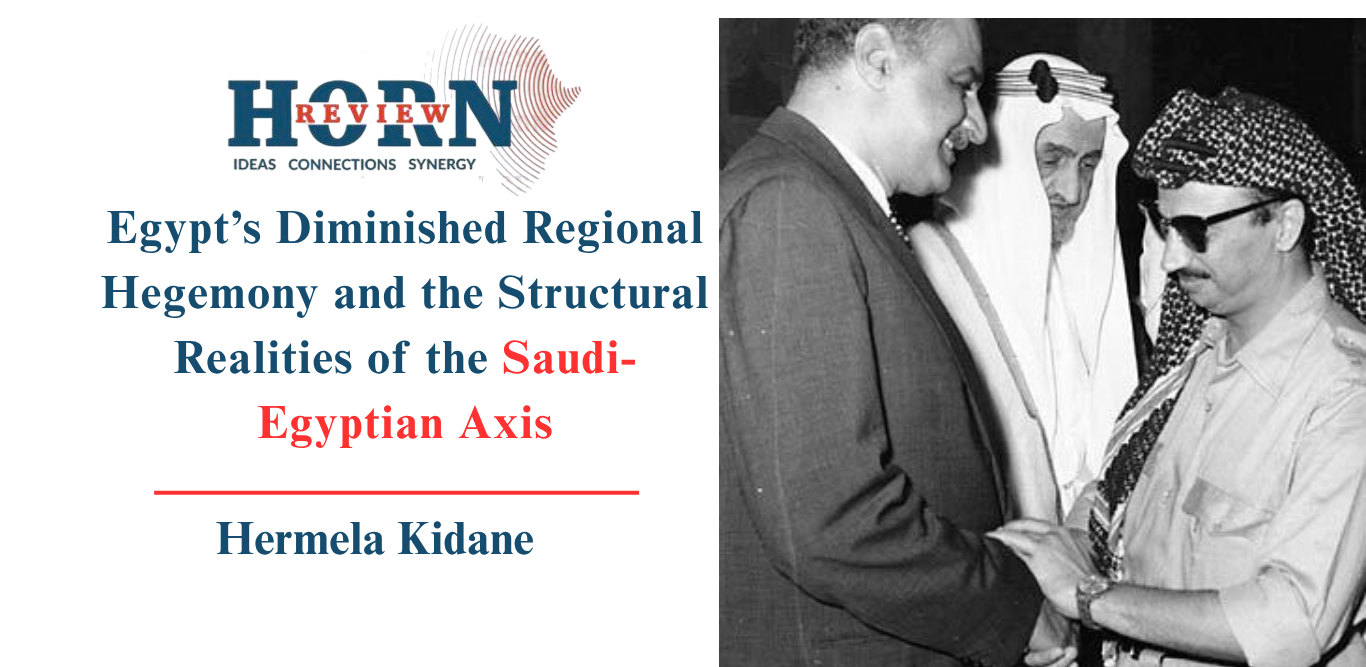
The geopolitics of the modern Middle East is frequently interpreted through the prism of temporary alignments rather than the deeper patterns of historical precedent and structural power. The relationship between the Kingdom of Saudi Arabia and Egypt stands as one of the most influential bilateral relations in the Arab world however it is often misunderstood. Accurate characterization requires setting aside idealized notions of a natural alliance founded on shared identity and instead examining a record defined by power asymmetry, historical memory and pragmatic necessity. While Egypt’s geographic position retains importance its broader structural influence has contracted substantially. Once a regional actor capable of shaping the Arab order Egypt now functions primarily as a junior partner whose value rests more on location than on independent diplomatic or material weight.
The historical foundations of this relationship reveal a protracted period of imbalance rather than partnership. In the nineteenth century the dialectic between the Nile Valley and the Arabian Peninsula was marked by imperial projection and existential challenge. The campaign of 1818 against the First Saudi State culminated in the destruction of Diriyah an episode that remains a foundational trauma in Saudi political memory. It showed that Egyptian power when aligned with external imperial authority could threaten the very existence of the Saudi political project. A related episode involves Imam Faisal bin Turki al Saud who later restored the Second Saudi State.
His departure from captivity in Egypt continues to be the subject of historiographical debate. According to some accounts Egyptian authorities may have permitted or facilitated his return for reasons connected to regional considerations of the period. Whatever the precise motives highlight a time when Egypt possessed the capacity to intervene decisively in Arabian affairs. Saudi Arabia was never just an instrument of Egyptian will yet the historical record leaves little doubt that Egypt once held a clear advantage in power projection.
The post colonial decades appeared to confirm Egyptian primacy. Under Gamal Abdel Nasser Egypt commanded major ideological capital and military prestige enabling it to mediate between Arab and non Arab spheres and to occupy a central place in regional politics. That prominence however rested on a specific international environment and an ideological momentum that proved unsustainable. Economic stagnation, demographic pressures and the gradual erosion of material capabilities produced a structural retreat. The decline of Egypt’s region is therefore not abrupt but cumulative with visible consequences for institutional arrangements in the contemporary Middle East.
When newer security and political structures have taken shape including initiatives associated with Mecca the recalibration of Egypt’s status has become evident. Reports indicated Saudi hesitation regarding Egypt’s inclusion among core initial participants in certain early stage arrangements. Sections of commentary attributed this caution to perceived inconsistencies in Egyptian foreign policy. An assessment points to a rational evaluation of capability. In an order where Gulf states have accumulated substantial capital and independent diplomatic agency Egypt contributes limited economic or military capacity to collective structures. Its principal asset remains geography the Suez Canal and the Red Sea littoral rather than the projection of hard power or the provision of economic stability. Saudi Arabia has developed its own channels of engagement with both Islamic and Western interlocutors and therefore no longer requires Egyptian mediation on the same scale. Egypt’s more limited role in these frameworks reflects a sober appraisal of relative contributions rather than any punitive impulse.
Egypt’s foreign policy path invites critical examination. Successive shifts from Soviet alignment to American patronage from confrontation with Israel to peace and from aspirations of regional leadership to reliance on external financial support have often appeared reactive rather than strategic. Adjustments to the international system are inevitable however the pattern of Egyptian diplomacy has frequently lacked coherence responding primarily to fiscal pressures and internal constraints. This repeated search for external patronage has diminished the credibility necessary for sustained regional leadership. The present alignment with Saudi Arabia must therefore be understood through the lens of economic necessity. Saudi Arabia supplies substantial and ongoing financial liquidity and investment while Egypt offers security cooperation along the Red Sea and demographic weight. The relationship is transactional and asymmetrical an exchange of capital for geographic utility and regional stability.
The Red Sea and the Horn of Africa illustrate the current character of the partnership with particular clarity. This corridor has become a primary arena of geopolitical competition. For Saudi Arabia the security of the waterway is essential for hydrocarbon exports and the economic life of its western provinces. Egypt’s control of the Suez Canal ensures it a place at the table yet does not confer hegemony. Saudi engagement with a wider set of littoral states seeks to construct a collective security framework that prevents any single actor from exercising disproportionate leverage.
This reflects deep seated caution informed by historical experience and a realistic assessment of power. At the same time Saudi Arabia recognizes that a destabilized Egypt would generate a security vacuum along its western approaches that capital alone could not rapidly fill. Support for Egyptian stability therefore constitutes a rational investment in the regional status quo even as Saudi carefully manages the distribution of influence across the maritime domain. Egypt’s geographic value remains real and continues to underwrite the durability of the relationship.
The assertion that Egypt’s regional role has diminished simply records a structural reality. The mid century model of influence dependent on ideological leadership rather than economic resilience proved unsustainable. The Saudi Egyptian relationship has moved from an era of Egyptian power projection, through a period of Egyptian predominance to the present condition of Saudi ascendancy grounded in material capability. Historical memory including the trauma of Diriyah informs a Saudi culture that remains vigilant against overreach while pursuing pragmatic cooperation. The two states are not natural allies in an ideological sense. They are structural partners bound by necessity Egypt requires Gulf financial support to sustain its state institutions while Saudi Arabia requires Egyptian stability to secure its western flank and the Red Sea corridor. The axis endures because it is practical grounded in complementary interests of geography and capital rather than shared ambition. Until Egypt addresses its internal economic contradictions and develops a foreign policy anchored in national capacity rather than external solicitation its regional position will continue to be that of a strategic asset rather than an independent hegemon.
Hermela Kidane, Researcher, Horn Review
Credit: Source link