

Dr Nicola Brown’s journey – Jamaica Observer
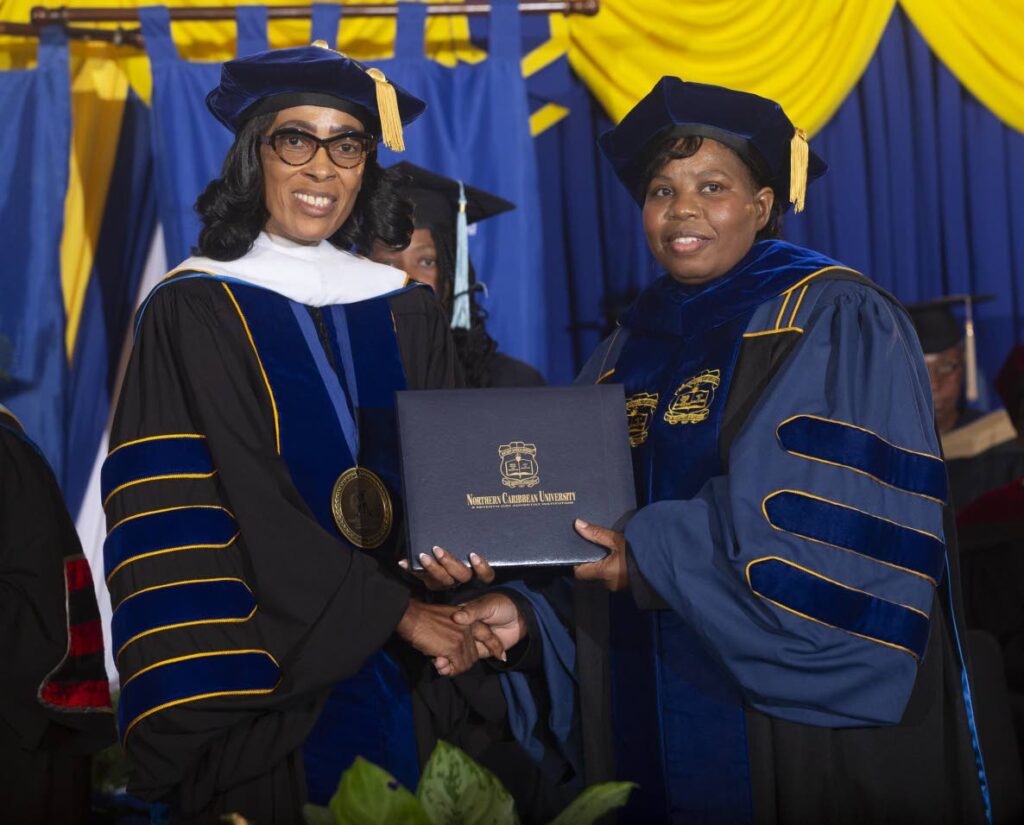
Dr Vivienne Quarrie (left), interim president of Northern Caribbean University, presents the PhD in Education, specialising in leadership, to Dr Nicola Brown, director of nursing services at the National Chest Hospital, during the 103rd Commencement Ceremony held August 9..
WHEN nurse administrator Dr Nicola Brown walked across the stage during Northern Caribbean University’s (NCU) 103rd Commencement, she was not simply celebrating the completion of another academic milestone. She was writing another chapter in her life’s story that began with a missed examination and the inspiration by her mother’s work as a nurse. This has taken her to the leadership of one of Jamaica’s specialised public hospitals.
Today, Brown is director of nursing services at the National Chest Hospital, where she leads a team of approximately 90 nurses. However, her journey to that position has been one of continuous learning, professional growth, and a determination to make a meaningful contribution to nursing. Her decision to pursue doctoral studies at NCU was influenced by a colleague who encouraged her to consider this institution after she had initially applied to a prominent online university.
“A colleague encouraged me to pursue my studies at NCU. I am a director at my job, and it requires me to lead and manage. Currently, I oversee 90 nurses at the National Chest Hospital,” Brown disclosed.
Brown was conferred with a Doctor of Philosophy in Education, with a leadership emphasis, at the August 9 graduation ceremony for 595 graduates. This degree added another dimension to her professional preparation as a nurse administrator.
Her academic journey has included nursing studies at Excelsior Community College and The University of the West Indies, where she pursued preparation in nursing administration. The doctoral qualification now complements years of practical experience in health-care leadership.
Brown said nursing was not the career she initially imagined. She recalls the circumstances which brought her into that career path.
“My mother was a nurse, and I saw her going to the hospital and taking care of her patients. Initially, I wanted to do pharmacology but I missed the chemistry examinations; I mixed up the time. Afterwards I felt it was a sign that, in the end, it did not work out,” Brown recounted.
What initially appeared to be a disappointment ultimately redirected her toward a profession that would become her life’s work. Brown began her career as a junior nurse at the National Chest Hospital. Decades later she now serves the institution in a very different capacity, as its director of nursing services. Her progression reflects not only professional advancement but also the value of remaining committed to learning.
Brown’s academic development also extends to research, particularly in areas affecting public health and the Jamaican population, including:
*Co-author of a 2026 study examining mental health and noncommunicable disease management in Jamaica
*Co-author of research examining the macroeconomic determinants of noncommunicable disease and mental health outcomes in Jamaica, between 1990 and 2025.
*Co-authored of a 2026 publication examining the rising burden of diabetes in Jamaica.
*Research work examining issues such as absentee fatherhood and its psychosocial implications for female children, as well as the influence of social media on the mental health of Jamaicans.
The breadth of these areas reflects a professional interest that extends beyond hospital administration. Brown’s work is increasingly positioned at the intersection of nursing, leadership, public health and social well-being.
That perspective is particularly relevant in her current role at the National Chest Hospital, Jamaica’s specialised public institution for comprehensive care for chest and lung conditions. The hospital receives referrals from across all 14 parishes and provides specialised services that are not widely available elsewhere in the public health system.
Brown said leadership is ultimately about the quality of care patients receive and the professionals responsible for providing it. Her ambition is not simply to manage nurses but to help strengthen the profession itself.
“I really want to impact the nursing profession. Nursing requires compassion and the desire to care for others. I would like nurses to be more accountable and give the best care that they can,” she said.
That call for accountability is rooted in her own experience. Having worked her way from junior nurse to senior administrator, Brown understands the demands placed on nurses at every stage of their careers. She also recognises that health-care leadership requires more than technical competence. It requires communication, empathy, decision-making, and the ability to motivate people.
Her doctoral studies in educational leadership have therefore provided a natural extension of her professional journey, giving her an opportunity to examine leadership from both academic and practical perspectives.