

Ceuta and Melilla: Does Morocco Have a Legitimate Claim?
The first article in this series examined what drove thousands of people toward Ceuta and how conspiracy theories, political accusations, and misinformation obscured the human desperation behind the crisis. The second looked beyond the border to the larger migration relationship between Morocco and Europe: Europe relies on Moroccan workers while fearing immigration, and Morocco depends on remittances while losing many of the professionals it needs for its own development.
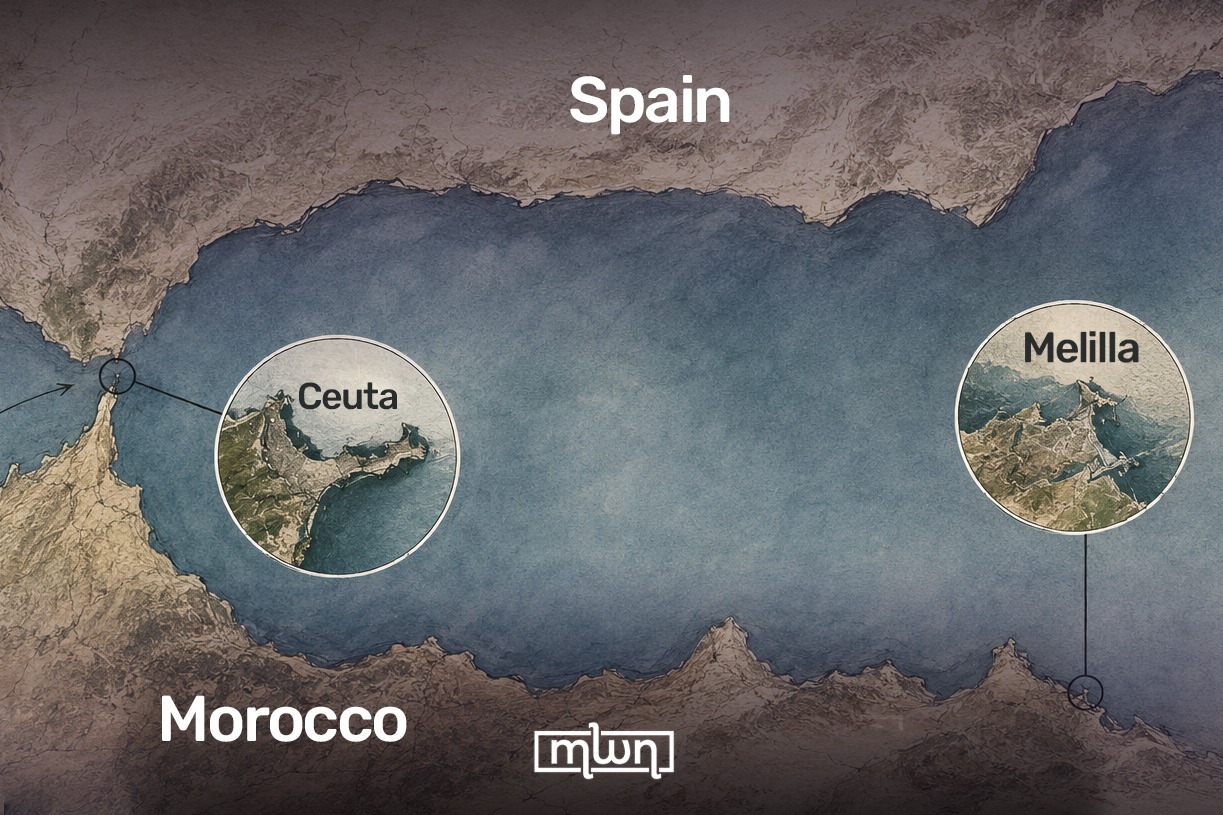
This third article turns to the territorial question the crisis unexpectedly placed before the world. Many viewers were confused by images of people crossing from Morocco into Spain without crossing the Mediterranean. The explanation exposed an uncomfortable reality that Spain has rarely wanted subjected to international scrutiny: Ceuta and Melilla are Spanish-controlled enclaves on Morocco’s northern coast. They are geographically African, politically Spanish and legally connected to Europe, forming the European Union’s only land borders with Africa.
Spain regards the two enclaves as ordinary Spanish cities whose sovereignty is beyond negotiation because its control predates the modern Moroccan state. Morocco considers them remnants of European expansion, and part of its unfinished territorial reunification and the age of a conquest does not make foreign rule legitimate. Morocco is not currently demanding the return of the two cities, but the immigration crisis revived Spanish fears that Rabat may ultimately seek to reclaim them. The crisis therefore raised a larger question: Does Morocco have a legitimate claim to Ceuta and Melilla—and should that claim outweigh centuries of Spanish rule and the wishes of today’s residents?
The history is older and more complicated than the twentieth-century colonization of Africa. Portugal captured Ceuta in 1415; it later became Spanish. Castile captured Melilla in 1497. Spain therefore argues that both cities were Spanish long before Morocco became a modern independent state and that they were not part of the Spanish protectorate returned to Morocco in 1956.
This chronology strengthens Spain’s legal position, but Morocco sees independence as an incomplete process that recovered most, but not all, of the territory placed under European control. Two European cities situated on the African coast, separated from mainland Europe and from each other, naturally raise questions about their historical and political status. The United Nations does not list the cities as territories awaiting decolonization; most governments recognize Spanish administration, and their inhabitants are Spanish citizens. Nevertheless, they remain European-governed territories on the African mainland, surrounded by Morocco and separated from Spain by sea.
The two small cities have approximately 80,000 residents each. Their demographics consist of Christian residents living alongside Muslim communities with Moroccan or Amazigh roots and smaller Jewish communities. Spanish is the official language, while Darija, a Moroccan dialect, is widely spoken in Ceuta, while Tamazight has deep roots in Melilla. Many Muslim residents still have cultural and family connections to Morocco, yet they identify politically as Spanish.
Based on some recent polls, most residents appear to prefer Spanish sovereignty. For them, the issue is not simply a flag: it includes Spanish citizenship and all the benefits that come with it. Morocco cannot ignore those preferences. Today’s demographics were shaped by centuries of Spanish rule; thus, the residents have no benefit to switching to Moroccan sovereignty. The dispute therefore brings two principles into conflict: territorial decolonization or respecting the wishes of the people living there.
Spain has always known that Morocco has not abandoned its claim to Ceuta and Melilla simply because the cities have been under European control for centuries. From the Moroccan perspective, the duration of an occupation does not transform foreign possession into rightful ownership. Spain understood this particularly well after the 1975 Green March, when Hassan II, the former king of Morocco, mobilized 350 thousand Moroccans toward Western Sahara and helped pressure a weakened Spain to withdraw from the territory. The march demonstrated Morocco’s ability to turn a territorial claim into an overwhelming political crisis.
Publicly, Spain continued to present Ceuta and Melilla as ordinary Spanish cities whose sovereignty was beyond discussion. Privately, however, King Juan Carlos appears to have been far less certain that Spain could hold them indefinitely. That contradiction emerged years later through the publication of “The First Ambassador of Democracy: King Juan Carlos and Spain’s International Projection”. In it, the historian Charles Powell cited a confidential U.S. Embassy telegram documenting a remarkable conversation that took place on April 30, 1979, between the king and Edmund Muskie, President Jimmy Carter’s special envoy.
Juan Carlos was speaking with U.S. Senator Muskie in the presence of U.S. Ambassador Terence Todman. According to the telegram, the king believed Melilla could be ceded to Morocco within a relatively short period because only about 10,000 Spanish lived there at the time. He anticipated strong opposition from the Spanish military but reportedly believed the anger would last only a few months and that he could control the situation.
Ceuta presented a greater difficulty because approximately 60,000 Spaniards lived there. Spain could not simply hand such a large population over to Morocco. Instead, Spain considered placing Ceuta under an international arrangement resembling the status Tangier had before Moroccan independence. Most revealingly, he feared that Hassan II might organize another Green March toward the Spanish enclaves.
Contrary to public statements as the head of a state that treated Ceuta and Melilla as indisputably Spanish, the Spanish king understood that Morocco considered the enclaves unfinished territorial business and feared that he might one day be forced to confront that reality directly. This is a powerful political admission: Spain’s king appears to have understood that centuries of control had not erased Morocco’s claim to the African-situated enclaves.
In 1987, King Hassan II applied for Morocco to join the European Communities, the predecessor of the European Union. The request may be understood as more than a serious bid for membership; it also allowed the king to expose a contradiction in Europe’s political geography. If Morocco could not belong to Europe because it was geographically African, then how could Spain claim that Ceuta and Melilla—cities located on African soil—were unquestionably European?
The application turned Spain’s own presence in Africa into a rhetorical argument for Morocco’s place in Europe: if Spain could extend Europe southward across the Mediterranean, Hassan II could ask why Morocco could not extend northward into European institutions. The request was rejected because Morocco was not considered a European country, but the rejection only sharpened the point. Morocco was deemed too African to enter Europe, while territory in Africa could be treated as European simply because it remained under Spanish rule.
Spain calls the enclaves ordinary Spanish cities, but several legal arrangements distinguish them from the mainland. They are autonomous cities rather than full autonomous communities, giving their governments fewer legislative powers than regions such as Catalonia or Andalusia.
Although inside the European Union, Ceuta and Melilla are outside its customs territory and ordinary value-added-tax system. They use a local indirect tax known as IPSI, and goods moving between the enclaves and mainland Spain may face customs procedures. Special rules also apply to excise taxes, trade, agriculture and fisheries.
Their borders with Morocco are external EU borders, yet departures for mainland Spain or other Schengen destinations remain subject to a special system of identity checks. During the crisis, that distinction mattered enormously. Reaching Ceuta did not automatically provide unrestricted access to continental Europe. These exceptions weaken Spain’s claim that Ceuta and Melilla are legally indistinguishable from Madrid or Seville. Geography forces us, along with the American Congress, to know that the two enclaves are not fully Spanish. However, when uniform European rules become impractical, Spain tries to treat the enclaves as exceptions.
NATO adds another complication in that Article 6 defines its geographical scope principally around allied territory in Europe, North America, Turkey, and certain North Atlantic islands. Ceuta and Melilla are African mainland territories that are not expressly named in the article. That does not mean NATO would abandon Spain, but Madrid will have to argue that defending an ally includes its territorial integrity, as per the Article 4 consultation clause, whenever an ally feels threatened. At the 2022 NATO summit, Secretary-General Jens Stoltenberg said the alliance protects all allies, while acknowledging that invoking Article 5 is ultimately a political decision. The treaty was not amended to remove the ambiguity. NATO has therefore offered Spain political reassurance without providing the enclaves the same explicit geographical protection as mainland Spain. NATO’s involvement in this dispute is highly unlikely, but the ambiguity surrounding their protection suggests that even the alliance does not treat the two enclaves as fully equivalent to mainland Spain.
Britain has governed Gibraltar for more than three centuries, and its population overwhelmingly prefers British sovereignty. However, Spain does not accept that time or current public opinion extinguishes its claim. Spain rejects the same two principal arguments that Morocco advances regarding the enclaves. If geography and territorial integrity permit Spain to claim Gibraltar, why should they not permit Morocco to claim enclaves on its coast? Spain still changes principles according to the territory. It emphasizes geography and decolonization when discussing Gibraltar, then historical possession and
residents’ wishes when defending Ceuta and Melilla. The distinction appears to rest less on a consistent principle than on whether that principle serves Spain’s claim.
For the near future, Morocco is not asking for a change of the guards in the two enclaves, but unchanged borders guarantee periodic migration and diplomatic crises. A more constructive approach could begin with economic integration and free movement of people within the two enclaves and Morocco. Joint management of customs, migration, security and infrastructure could follow without immediately resolving sovereignty.
The 2030 World Cup, hosted jointly by Morocco, Spain and Portugal, offers an opportunity to replace some of the symbolism of fences with cooperation. More ambitious arrangements could eventually include special autonomy, shared guarantees or a gradual transfer. But any Moroccan sovereignty plan would need enforceable protections for Spanish or dual citizenship, pensions, property, religious freedom, language, local government and European travel.
A referendum sounds democratic, but Morocco will never agree to it because it raises difficult questions: Who votes, and can a population shaped by centuries of Spanish rule conclusively settle the historical claim? Whatever model emerges, Morocco must show not only that it has a legitimate territorial case, but that residents would remain free, secure and prosperous.
Credit: Source link