

A Day Both Hallowed and Vexed: How Morocco Celebrates the Prophet’s Mawlid
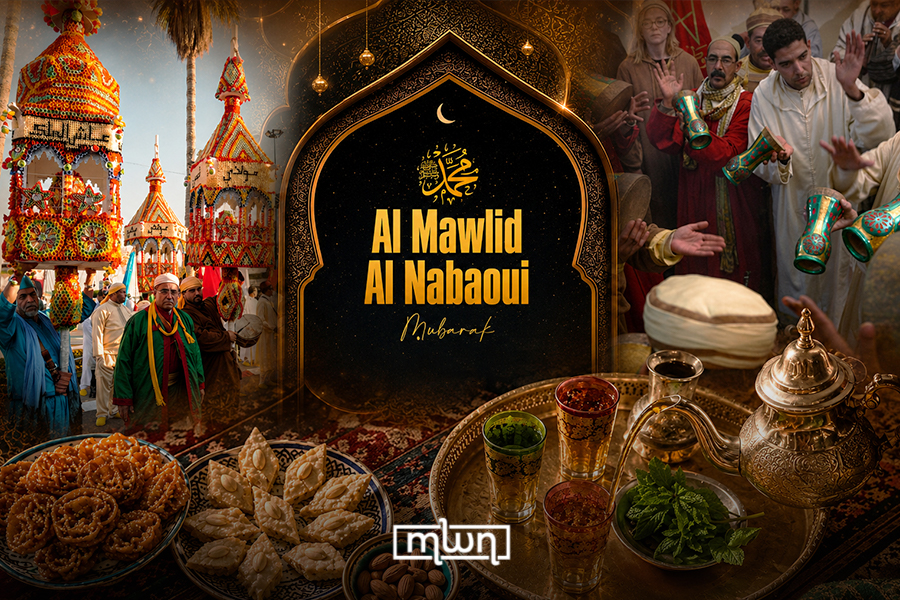
Marrakech – Every year, on the twelfth of Rabi al-Awwal, Muslims across much of the world mark al-Mawlid al-Nabawi, the birth of the Prophet Muhammad. In Morocco, the day carries a weight few other religious dates can match, and in 2026 it falls on Tuesday, August 25, corresponding to 12 Rabi al-Awwal 1448 of the Hijri calendar.
The final date, as always, rests on the sighting of the crescent moon, which the Ministry of Endowments and Islamic Affairs confirms after observers watch the sky on the evening of 29 Safar.
Moroccans have their own name for the anniversary – Eid El-Miloud – and their own way of keeping it, one shaped by nearly eight centuries of history, poetry, Sufi devotion, and royal ceremony. To understand why the day resonates so deeply here, though, it helps to begin with the argument that has trailed it since its earliest days.
A celebration born in dispute
The Mawlid has never enjoyed unanimous approval among Muslim scholars, and the disagreement is as old as the practice itself. At its center sits a straightforward objection: neither the Prophet nor the Rightly Guided Caliphs after him ever observed the day, so a portion of the jurists have long treated it as bid’a, an innovation introduced into the faith after the fact.
From that starting point, critics build a wider historical case. Many Salafi scholars trace the custom’s origins to Fatimid Egypt in the fourth century of the Hijra, under the dynasty they often call the Ubaydids rather than the Fatimids.
They argue that the rulers institutionalized a calendar of commemorative birthdays, including those of Ali, Fatima, Hasan, Husayn, and the Prophet, and gradually normalized the idea of commemorating a sacred birth. From Egypt, on this reading, the practice spread through Arab/Muslim societies over the seventh Hijri century and settled into the religious landscape. Ibn Baz, for example, cites this history while arguing that Mawlid had no precedent among the Prophet, his companions, or the first three generations of Muslims.
The skeptics do not stop at questions of origin. They also point to the patronage the Mawlid received from unlikely quarters, noting that when French forces occupied Egypt at the close of the eighteenth century, they found the festivities in decline for lack of funding and moved to revive them, even taking part in the ceremonies.
For a number of reformist scholars and chroniclers writing in the modern era, this history was reason enough to count the Mawlid among the habits that had dulled the Muslim world rather than strengthened it.
Some Salafi critiques go further, warning that commemorating prophetic birthdays can encourage the kind of religious exaltation they associate with Christianity’s treatment of Jesus. The argument is not that Mawlid itself makes Muhammad divine, but that excessive veneration can, in their view, become a pathway to ghuluw – religious exaggeration in the status of prophets and saints.
Ibn Baz explicitly makes that argument and invokes the hadith, “Whoever introduces into this matter of ours what does not belong to it, it is rejected,” as a principal basis for classifying Mawlid as an innovation. Other Salafi sources also compare the practice with Christian celebrations of Jesus’ birth.
Some critics add another irony: the exact date of Muhammad’s birth is historically disputed, while 12 Rabi al-Awwal is widely reported in the classical tradition as the date of his death. From this perspective, fixing Mawlid on the 12th risks commemorating with celebration a date more securely associated with his death than with his birth.
Yet the case against the day has never carried the field, least of all in Morocco. Those who defend the celebration lean on a well-known prophetic saying that promises reward to anyone who establishes a good practice within Islam, and they insist that the intent behind the Mawlid is what gives it its standing.
By their account, Moroccans never treated the anniversary as a third religious feast set beside Eid al-Fitr and Eid al-Adha. They understood it instead as an occasion to renew love for the Prophet, to revisit his biography, and to reaffirm a shared moral inheritance. Seen through that lens, a ruling that ignores the day’s cultural and social meaning misses the phenomenon entirely.
How Morocco made the day its own
Morocco’s embrace of the Mawlid traces back to the Almohads, who ruled between roughly 500 and 620 of the Hijra and turned the anniversary into a deliberate act of religious policy. Facing a Christian Iberia that celebrated the birth of Christ, the dynasty sought a counterweight that would keep Muslim communities anchored to their own devotion, and out of that effort came a wave of poetry praising the Prophet and exalting his rank.
The impulse found its clearest early expression in the occupied city of Ceuta, where the qadi Abu al-Abbas al-Azafi, who died in 633 of the Hijra, was the first to lay down an ordered set of rituals for the day. He set his reasoning down in a book, al-Durr al-Munazzam fi Mawlid al-Nabi al-Muazzam, presenting the celebration as an educational and cultural alternative for Muslims who were otherwise drawn toward joining their Christian neighbors at Christmas.
From there, the observance moved steadily into the sphere of the state. The historical record places the first formal Moroccan celebration in 1250, under the Almohad caliph al-Murtada, who held a night of commemoration in Marrakech. The Marinids carried the tradition forward when their caliph Yaqub ibn Abd al-Haqq staged a celebration in Fez, and by 1292 his successor had decreed that the Mawlid be observed across the realm as an official holiday.
That status endures. Today the state grants a two-day national holiday spanning the twelfth and thirteenth of Rabi al-Awwal to public employees and schools alike – a generosity that sets Morocco apart from much of the Arab East, where the day passes with far less official weight.
What truly distinguishes the Moroccan Mawlid, though, is how thoroughly it soaked into ordinary life. In the popular memory of many regions, and especially in the Rif, families received the anniversary as though welcoming a newborn into the house.
Women hung flags of fine fabric over the rooftops and prepared the kinds of dishes traditionally offered to a mother who has just given birth, a quiet symbolic nod to the arrival of the greatest of all newborns. Households slaughtered a rooster or set a couscous on the table, and children were dressed in new clothes. The bond ran deep enough to reshape the naming of children: those born during the El Miloud season still carry the names Mouloud, Milouda, and Miloudi.
Rituals of devotion, from the zawiya to the palace
The observance unfolds over the better part of a month. From the first of Rabi al-Awwal, mosques hold nightly lessons after the Maghrib prayer that walk the faithful through the Prophet’s biography, the lives of his companions, and his virtues, all woven together with sung praise and religious chant.
The rhythm builds toward the eve of the anniversary, when each city gathers for a large ceremony in its principal mosque, attended by state representatives, elected officials, scholars, members of the Sufi orders, and the general public. After the Isha prayer, the gathering moves through Quranic recitation and prophetic praise into a short sermon on the Prophet’s life.
The congregation sits through most of it, but at the moment the narration reaches his birth, everyone rises to their feet in a standing tribute, remaining upright as the account of his qualities continues, punctuated by blessings upon him. Dates and milk are passed among the crowd, incense scents the air, and from the rooftops women send up their ululations. A second gathering follows at dawn on the day itself, its praises timed to the hour of the Prophet’s birth.
Alongside the mosque, the celebration lives on in private homes, kept most faithfully by conservative families with ties to scholarship, Sufism, and at times the Makhzen. These evenings open with the Quran and move through sung praise and episodes from the Prophet’s life, often drawing on classic texts such as al-Shifa of Qadi Iyad and the Mawlid compositions of al-Barzanji and al-Kattani.
The table matters as much as the recitation. Depending on the region, guests are served ‘asida, couscous with seven vegetables, or the baghrir and msemmen favored in the Chaouia plains, where the day is also marked by tabrouida, the mounted display of horsemanship.
In Amazigh areas, the morning begins with a spoonful of warm honey and a blessing offered in Tamazight, and honey threads through the dishes that follow. Men and boys put on the jellaba and the belgha, homes are perfumed with incense and oud, and the markets fill with sweets, pastries, dried fruit, and children’s toys.
The Sufi brotherhoods give the season much of its color. The Boudchichiya draw their largest crowds to Madagh, near Oujda, for an annual gathering built around religious litanies and devotional verse. The Issawa converge on Meknes and the shrine of their founder, Sheikh al-Hadi ben Aissa, who died in 1526, pitching their tents near his tomb in the days before the holiday, each participating group under its own banner, before a procession three days long carries them toward the shrine. Across these circles the great devotional poems recur, above all the Burda and the Hamziyya of Imam al-Busiri.
No ritual has traveled farther than the candle procession of Salé, the mawkib al-shumu’. Its story begins in the Saadian era, when Sultan Ahmad al-Mansur watched the Ottomans mark the Mawlid in Istanbul and was taken with the display of candles that formed part of the ceremony. On returning to the throne, he ordered his own version, and elaborately decorated candles were paraded through Marrakech to the royal palace, with the practice soon spreading to Fez and other cities.
In Marrakech and Fez, the tradition faded after his death, but in Salé it survived under the care of Sheikh Abdellah ben Hassoun, a pole of the Jazouliya Chadhiliya order, who gave the candles a distinctly Moroccan form, shaping them like the square minarets of the country’s mosques. His descendants have staged the procession ever since, turning it into an event of international reach.
Preparation begins a month ahead, when the candle frames leave the sheikh’s shrine for the home of a custodian Slawi family; the work moves through cooking the raw wax, pouring it into wooden molds, dyeing the pieces, and fixing them onto tall frames wrapped in white paper. On the day, bearers in traditional dress carry the candles from Bab Sabta through the old city to Bab el-Mrissa, past the official platform at Sahat Chouhada, and on to the house of the Hassouni shurafa, performing the elegant candle dance along the way.
Among them march the Flaykiya and the Tabjiya, a nod to the naval men who once guarded Salé’s coast, and the procession draws support from old religious endowments as well as from the ministries of culture and religious affairs, the city council, and private donors. Lectures, a collective circumcision for the city’s boys, and evenings of Andalusian music round out the program.
Above all of this sits the ceremony of the state. As Commander of the Faithful (Amir al-Mu’minin) and a descendant of the Prophet Muhammad through the Alaouite dynasty, King Mohammed VI presides over a religious vigil at the Royal Palace in Rabat, continuing the practice of his predecessors before an audience of scholars, senior officials, and members of the diplomatic corps. This year, the vigil opens the observance on the eve of Monday, August 24.
The evening honors religious learning through a set of royal prizes – the Mohammed VI Prize for Islamic Thought and Studies, the Mohammed VI Prize for Moroccan Calligraphy, and the Mohammed VI International Prize for the memorization, recitation, and interpretation of the Quran – and the King customarily grants a pardon to a number of prisoners across the kingdom. It is a fitting close to a day that, for centuries, some Moroccan Jewish communities once shared as well, a reminder that El Miloud in Morocco has always been as much about belonging as belief.
Credit: Source link