

Yemen Moves Closer to Full-Scale War
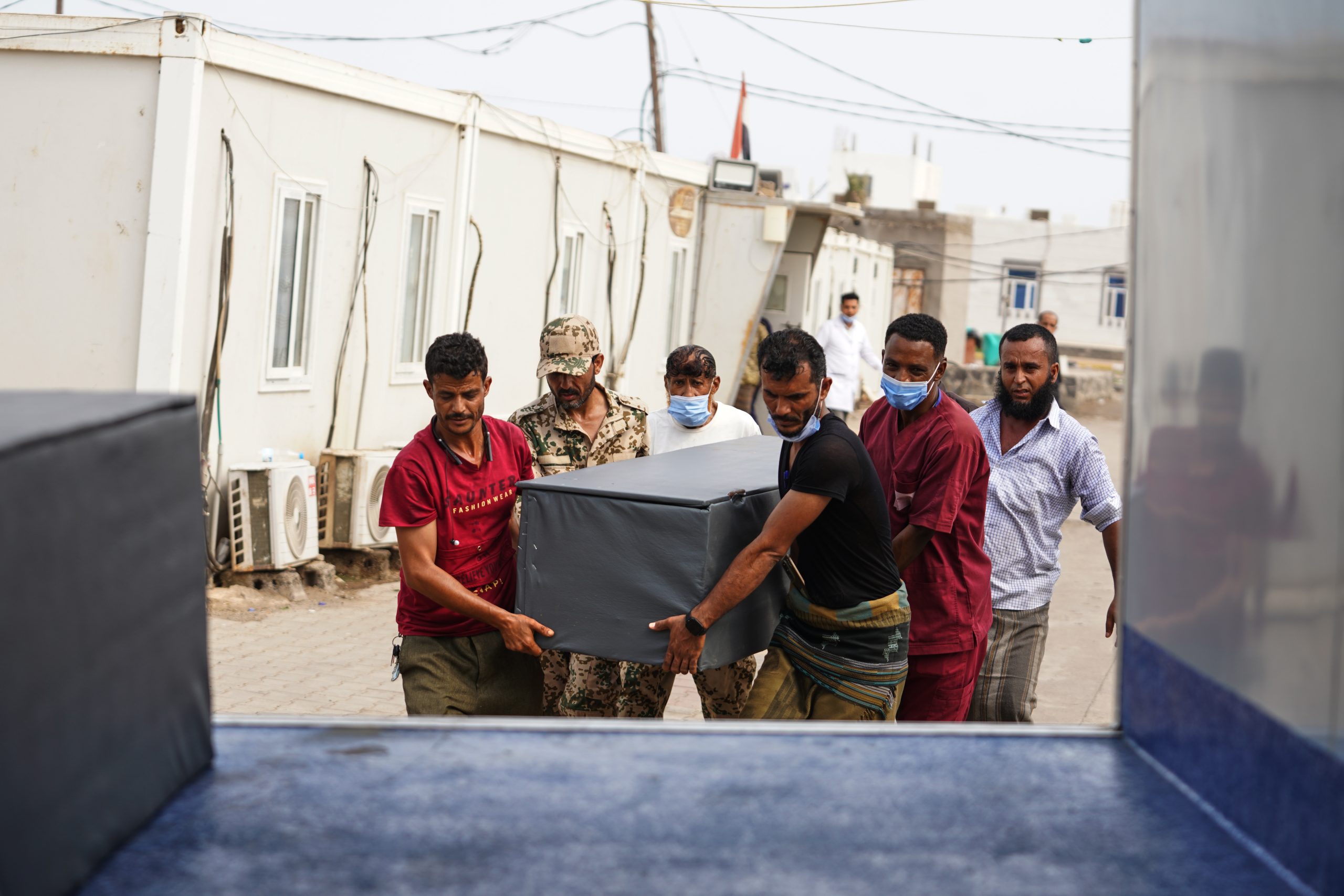
(AP Photo/Abdulnasser Alseddik)
Bottom Line Up Front
- The U.S.-Iran war, as well as unresolved grievances from the 2015-22 Yemen war, have fueled escalating clashes between the Iran-backed Houthi movement and forces of the ousted Yemeni government, increasing fears of renewed full-scale ground war.
- Houthi attacks on Saudi targets and Saudi-backed Yemeni forces represent an effort to break a longstanding Saudi blockade, provide additional strategic leverage for Iran, and disrupt military preparations by anti-Houthi forces.
- A Saudi military mobilization is likely intended to deter Houthi attacks rather than initiate a major ground offensive against the group’s strongholds on the Red Sea coast.
- The escalating clashes in Yemen are showcasing the contribution of advanced drones to asymmetric warfare in and beyond the region.
It was perhaps inevitable that the U.S.-Iran war would reignite the dormant conflict between the Iran-backed Houthi movement and forces of the Saudi-backed ousted government of Yemen. The Yemeni people and the country’s infrastructure still have not recovered from the civil conflict during 2015-2022 that killed tens of thousands of people, uprooted millions, caused a severe cholera outbreak, and drove the country to the brink of famine before an April 2022 truce restored relative calm. The prospect of renewed hostilities between the Houthis and forces of the Saudi-backed Presidential Leadership Council (PLC), sometimes referred to as the Republic of Yemen Government, threatens to set back even the modest recovery of the economic and humanitarian situation since the April 2022 ceasefire.
The slide into renewed war began last month as the Houthis, supported by their ally and backer, Iran, sought to break Saudi Arabia’s control over traffic through Houthi-run ports and airports. To serve their own longstanding interest in breaking the Saudi blockade as well as to help Iran surround Saudi Arabia strategically, Houthi leaders announced their own blockade of Saudi shipping through the Red Sea. The Houthis expanded their targeting to facilities of the Kingdom’s state-backed oil giant Aramco, augmenting Iranian strategy to damage the energy infrastructure in the Arab Gulf states. By early August, tensions had escalated into exchanges of fire between rival forces’ ground units, pointing to a slide back into full-scale warfare. Early this month, Houthi forces launched their deadliest attacks in years, killing 58 PLC troops and several civilians in the oil-rich and contested province of Marib, according to Yemeni sources.
As it braces for possible ground combat, the Kingdom has sought to put diplomatic pressure on the Houthis by shoring up the Kingdom’s regional and global alliances. In response to Houthi attacks on Saudi shipping in the Red Sea, on July 30, Saudi de facto leader Mohammad bin Salman (MBS) assembled a 14-state maritime coalition to protect Red Sea shipping. However, two Gulf states that have differed with the Kingdom on Yemen and some regional issues, Oman and the United Arab Emirates (UAE), did not join the effort. Oman has acted as the primary broker between the Houthis and the international community, and Muscat is attempting to negotiate a compromise mechanism for commercial transits through the Strait of Hormuz. The UAE has backed separatist factions in south Yemen and, in contrast to Saudi Arabia, advocates confronting rather than compromising with both Iran and the Houthis. UAE-backed factions challenged the authority of the PLC in a series of major clashes in the oil-rich Hadramout region last December. On August 7, the Kingdom recruited two large Sunni Muslim-dominated regional powers, Türkiye and Pakistan, with which Saudi Arabia had signed a bilateral defense agreement a year earlier, to join the new “Mecca Joint Defense Agreement.” The pact includes a mutual defense commitment resembling “Article 5” of the NATO charter. However, neither state has, to date, joined Saudi retaliatory attacks against the Houthis or other Iran-backed actors that have attacked the Kingdom.
In addition to its coalition-building, Saudi Arabia is mobilizing militarily, but has yet to commit to support a determined PLC-led ground campaign against the Houthis. Mohamed Qubaty, a former Yemeni tourism minister who is acting chairman of a southern Yemeni group, the Southern Civil Democratic Rally, argues that Saudi Arabia is marshaling its forces to prepare for a variety of contingencies but has not decided to initiate a ground battle to seize Houthi territory. A Saudi-backed push, if MBS decides to initiate it, would most likely focus on the key port of Hodeidah, through which the Houthis import weapons from Iran. However, the port is also the main entry point for much of the international humanitarian aid that flows to Houthi-controlled territory. The potential interruption of aid was the key rationale for the United Nations, aid organizations, and some global leaders to press Saudi Arabia and the UAE to cancel a planned 2018 operation to seize the port.
For their part, the Houthis have sought to disrupt Saudi-Yemeni preparations by striking first, recognizing that the Red Sea coastline, from Bab-el-Mandeb through the ports of Mokha and Hodeidah, to Ras Isa and As-Salif, is of paramount strategic importance. In recent weeks, the Houthis have concentrated drone and artillery fire on a major PLC-led base in Mokha to prevent anti-Houthi forces from assembling. Qubaty noted to journalists: “The Houthis know that eventually the outcome of any major confrontation could be tested there.” Aside from the coast, clashes have occurred in Marib, a PLC stronghold and the center of Yemen’s oil and gas production. The Yemeni forces’ death toll from Houthi strikes there and in neighboring Hadramout in early August totals as many as 60.
A Saudi-backed ground offensive, even if provided with U.S. support, would test the Yemeni forces Riyadh has been trying to reorganize into a cohesive and effective force since January. The anti-Houthi forces are centered on PLC units under the control of the Ministry of Defense, but also include numerous rival militias, such as the Giants Brigades loyal to the UAE. Another semi-autonomous command, the Guardians of the Republic, is a relatively new militia operating in Mokha. In recent weeks, a Saudi senior officer, Maj.-Gen. Falah al-Shahrani, has been tasked with consolidating military decision-making into a single operations center and folding all anti-Houthi units into Yemen’s defense and interior ministries. He also oversees Nation’s Shield and the Emergency Forces, Saudi-created units established in early August. In addition, new army and air force commanders have been appointed. The extensive reorganizations suggest Riyadh is carefully considering entering a sustained, large-scale ground battle against the Houthis, should MBS determine that doing so is vital to Saudi security. Experts are debating whether President Trump, who is having difficulty extricating the U.S. from the Iran war and faces shortages of some precision-guided munitions, would provide substantial and active support to anti-Houthi ground operations in Yemen, were MBS to ask Washington for assistance.
A renewed ground war in Yemen, were it to occur, is likely to follow a trend, exhibited in recent conflicts, in which the combatants rely heavily on armed drones to deter, to defend, to advance, and achieve a full range of other objectives. Close observers of Yemen note that, in the exchanges of fire over the past month, both Houthi and PLC-led forces are utilizing drones to a far greater degree than they did during the 2015-2022 combat. According to Marius Bales, a doctoral researcher at the Bonn International Centre for Conflict Studies: “The government (PLC-led) side is now acquiring a potentially important tactical capability of its own…Reusable, remotely piloted drones may be particularly useful for the day-to-day battle along relatively static front lines, even if they cannot match the Houthis’ strategic strike range.”
On Monday, PLC-led troops reportedly used their advancing drone capabilities, as well as artillery, to kill more than 200 Houthi fighters in a significant intensification of their attacks. The PLC units are focusing on Houthi positions in Marib, al-Jawf, Taiz, Hajjah, al-Dhalea, and other fronts, and have released video footage of several of those operations. Rueben Dass, associate research fellow at the S Rajaratnam School of International Studies in Singapore, told Al Jazeera that the PLC has publicized its use of drone-dropped munitions, which seem to be released from rotary-wing drones. He noted: “These drones may have been modified to carry improvised payloads targeting Houthi positions on the ground, similar to use by state and nonstate actors in several other conflict zones.” However, Bales told Al Jazeera: “I would still regard the Houthis as having the more sophisticated drone capability overall…They have accumulated roughly a decade of operational experience and possess a much broader spectrum of systems…[ranging] from relatively short-range attack drones operated through reusable systems to long-range, one-way unmanned aerial vehicles (UAVs) capable of striking targets far beyond Yemen.” Bales added that the Houthis continue to benefit from Iranian technological assistance, despite U.S., Saudi, and other partner efforts to block Iranian weapons shipments to the group.