

Why Lisk’s exit leaves a hole in Africa’s Web3 funding

On October 31, Lisk, the Swiss-based Web3 infrastructure company, will shut down its blockchain network and move what remains of its products and developers to Celo, a rival network.
A blockchain is the infrastructure that enables digital assets, such as cryptocurrencies and stablecoins, to be transferred between users without relying on a conventional bank or payment processor.
Lisk’s decision marks the end of a blockchain project that began in 2016, first as a foundational blockchain network built from scratch, before later shifting to Ethereum. While the company announced the wind-down in August, the strategic reset began months earlier, when co-founder and chief executive officer Max Kordek returned to the business in December 2025 alongside former chief technology officer Oliver Beddows, who became chief strategy officer. Kordek stepped down as CEO of Lisk in 2024 as the Lisk Foundation expanded its focus beyond blockchain.
Their first move was consolidation. The Onchain Foundation, Lisk’s parent entity formerly known as the Lisk Foundation, discontinued several initiatives, including Onchain, its research arm, and Pass App, its wallet product, to focus resources on Lisk’s pivot away from blockchain infrastructure.
By May, the restructuring had also made several roles redundant, affecting Lisk blockchain’s regional leads and business development teams as the company pulled back from blockchain expansion.
The company said it is now building a financial operations platform for businesses, focused on accounts, payments, and approvals across fiat and stablecoin rails. The shift is more than a product pivot. It closes a decade-long experiment in running a blockchain and, in Africa, removes one of the relatively few ecosystem companies still willing to back early-stage Web3 founders.
Africa’s blockchain companies, including finance, social, gaming, and infrastructure startups, raised $90.1 million across 28 deals in 2025, a 26.6% decline from the previous year, according to a report by venture capital firm Crypto Valley VC (CV VC). Deal volume fell only slightly, from 30 to 28, pointing to a more selective funding market.
Lisk’s African expansion strategy had a commercial intent, but that was not uncommon for blockchain ecosystems. At its core, it wanted to find developers, help them build, give them a reason to use Lisk, fund them, then let their users bring activity and liquidity onto the network.
It sought to attract developers and users to its blockchain, creating the activity and network effects needed to make the chain viable and support LSK, its native token.
Some founders received grants, often worth about $4,000 and paid in LSK, the token currently worth less than $1. Several founders told me they converted their tokens into dollar-backed stablecoins, such as USDT, because they needed cash for their businesses.
Others said the more valuable benefit was the network that came with the money: introductions to investors, technology partners, and other founders, as well as opportunities to travel and build commercial relationships.
Lisk spent to build a market
For a while, the strategy worked.
Lisk began pushing harder into Africa in 2024. According to its year recap, Lisk was co-hosting roadshows in Cape Town, Nairobi, and Lagos, targeting developers. It also created local Telegram communities in Nigeria, Ghana, and Kenya, and partnered with training institutes such as Web3Bridge, AyaHQ, CV Labs, and the accelerator run by CV VC. By the end of 2024, Lisk’s blockchain had about 95,474 accounts and processed over 22 million transactions.
Founders, mostly early-stage builders, received grants and support to integrate Lisk into their products. Azza, a Nigerian WhatsApp-based stablecoin trading platform; Jamit, a blockchain-based creator platform; and Payd, a Kenyan cross-border payments startup, were among those building on Lisk. But getting a founder to deploy on Lisk was not the same as getting a retail market to use it.
Blockchain networks are like banks. For example, a user may prefer one banking partner over another due to certain perks or a sense of relative safety; switching retail customers from their preferred blockchain networks to a new one was always going to be difficult.
Introducing another blockchain network means asking users to learn a new route, acquire the right asset to pay fees, and sometimes move liquidity across chains.
Africa’s crypto market had already divided itself. Retail users on the continent had their preferred blockchain networks, just as people prefer specific banks or payment platforms for moving money.
TRON became a major route for USDT due to its low, predictable transaction costs and deep liquidity, while Ethereum, Solana, and other networks had established their own user bases.
In a 2025 report, Artemis, a US-based stablecoin intelligence firm, cited TRON (TRC-20) and Ethereum (ERC-20) as popular networks for sending and receiving crypto assets across the African markets it studied. Ethereum was the most used network in Nigeria, Kenya, and South Africa, while TRON led in six of the ten countries in its sample, including Egypt and Ghana.
Between 2024 and 2025, stablecoin adoption was also accelerating. In 2024, stablecoins accounted for about 43% of Sub-Saharan Africa’s crypto transaction volume, according to research firm Chainalysis, while Nigeria accounted for roughly 40% of the region’s stablecoin inflows. The International Monetary Fund (IMF) has estimated that Nigeria has accounted for more than 60% of stablecoin inflows to Sub-Saharan Africa since 2019.
Lisk, which at the time was trying to grow stablecoin assets on its network, knew it was sitting on a strong opportunity in greenfield stablecoin adoption markets that were taking off, including Latin America (LATAM), where Ethereum, TRON, and Polygon were the most widely adopted blockchains. For Lisk, the switching costs proved to be one of the toughest challenges to overcome.
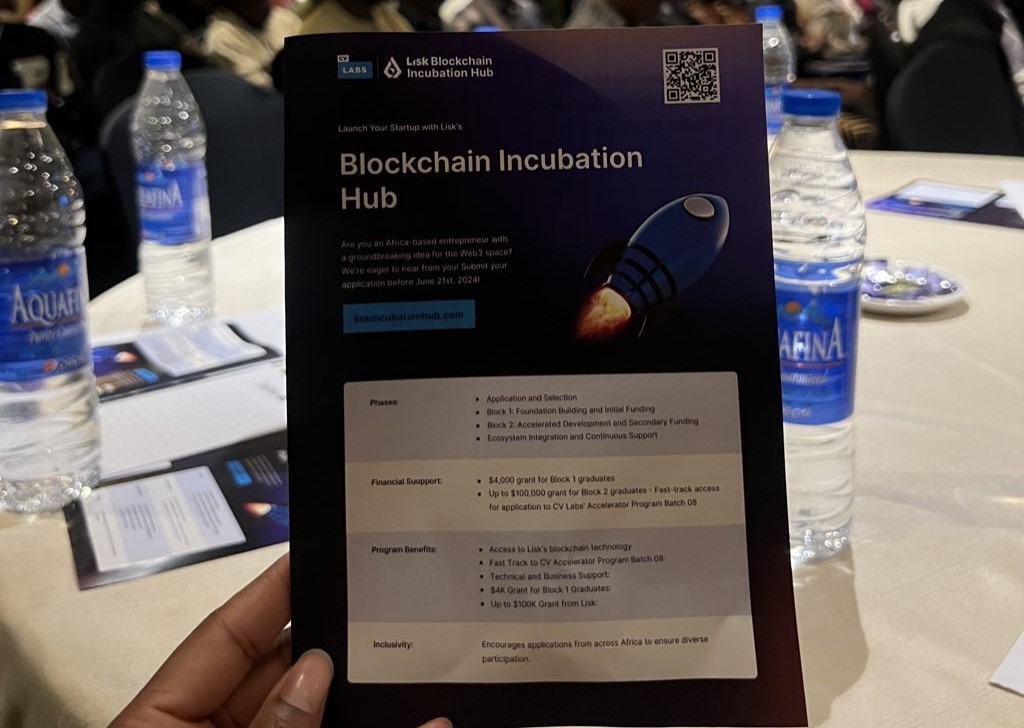
In March 2024, CV Labs partnered with Lisk to launch a six-month Blockchain Incubation Hub for African startups building on Lisk. The programme offered $4,000 for completing its first block, up to $16,000 for the second, and up to $100,000 in additional funding.
Olaf Hannemann, CV VC’s co-founder and head of growth, told me that CV Labs admitted 43 startups across two cohorts, with 11 startups completing the full programme. Lisk supplied the funding, while CV Labs provided the infrastructure, mentorship, and operational support.
AyaHQ became another distribution channel. Across four cohorts, the programme supported more than 35 startups across 25 countries, with 25 ultimately receiving Lisk funding, according to co-founder and chief executive officer Eric Annan. Lisk provided equity-free funding, including grants of up to $20,000 and, in some cases, follow-on commitments of up to $150,000.
Web3Bridge provided another route into Nigeria’s developer community. Its founder, Ayodeji Awosika, told me Lisk backed the organisation with $80,000 to build Web3Bridge Garage, a hub for training developers and supporting founders building on the blockchain.
By August 2025, Lisk told TechCabal that its programmes with CV Labs and AyaHQ had trained more than 30 startups, with 12 graduates receiving grants of up to $20,000.
The economics of expanding blockchain adoption
Building a blockchain is one thing; growing it into the default rail for retail and institutional users to move assets is another. Some networks have managed this through developer incentives, ecosystem funding, and local community-building. Solana, for example, has used all three.
Base, the blockchain built by US crypto firm Coinbase, has taken a similar approach in Africa by supporting developers, targeting creators, and funding local builders. Coinbase also gave Base access to an existing user base and products while subsidising transaction fees, making it cheaper to move assets on its network. Yet Coinbase itself cut 14% of its global workforce in May, and the restructuring affected Base’s regional growth teams.
Lisk did not have Coinbase behind it.
Still, its spending helped boost activity. Between 2024 and 2025, Lisk saw decent traction. Its total value locked (TVL), the total US dollar value of digital assets deposited on the blockchain, peaked at about $20.6 million in July 2025. Stablecoin market capitalisation reached about $3.3 million in June 2025.
Both figures have since collapsed. As of September 24, Lisk had about $143,208 in TVL and $33,780 in stablecoin market capitalisation, according to intelligence platform DeFiLlama.
One founder who built on Lisk told me his startup has started moving liquidity out of the network, leaving limited capital to settle customer transactions. Lisk has also told users to withdraw their assets before October 31. The process can take more than a week because assets must first be unstaked and then bridged back to Ethereum.
While industry speculation has highlighted Lisk’s retreat from Africa, the move was much broader and less targeted at Africa than has been made to seem. The problem was fundamentally with its blockchain’s unit economics; it likely wasn’t profitable.
Lisk’s governance proposal said the project spent roughly two and a half years bootstrapping an ecosystem around the Lisk Chain. The model was a flywheel: more activity would create value for LSK, which could, in turn, fund more ecosystem incentives.
The company ultimately concluded that the blockchain was not generating enough revenue to sustain the loop. It also pointed to selling pressure from incentives paid in LSK and the difficulty of sustaining fragmented operations and ecosystem spending.
The cost of creating a network comes before the revenue. Developers need users; users need applications; applications need liquidity; and liquidity needs incentives. Incentives need money.
A blockchain can spend millions building all four layers and still have little revenue if users do not stay once the incentives disappear.
Lisk’s treasury disclosures also show how much the value of its assets changed over time. The Onchain Foundation’s reports show total assets of about 98.2 million Swiss Francs (CHF), $124 million, in March and May 2024. By March 2025, that had fallen to CHF 52.1 million ($65.7 million), before briefly recovering to roughly CHF 73 million ($92 million) in September. Lisk ended 2025 with about CHF 53 million ($66.8 million) in total assets, the last year reported.
The treasury also became more complex. In 2024, it was largely made up of fiat, Bitcoin, Ether, stablecoins, and LSK. By 2025, it included equities and a broader range of crypto assets, such as AAVE, SOL, SUI, HYPE, ONDO, and EIGEN, as well as substantial staked LSK positions.
These figures cannot be treated as operating losses. But they are snapshots of assets whose value changes with token prices, investments, and asset sales. The reports do not provide the revenue and expenditure lines needed to calculate how much Lisk spent operating the blockchain or whether it made a financial return.
But here’s what we know: Lisk was spending on research and development (R&D), a key part of running any blockchain. In Lisk’s case, this work was funded by the Lisk Foundation (now the Onchain Foundation) but executed by its development studio, Lightcurve.
In 2023, Lisk Foundation accounted for about 27.6% of its total spending*, including bounties and operations. R&D, marketing, and operations incurred expenses totalling CHF 630,265 ($749,000) for the year.
Lisk’s cumulative app revenue reached $981,163 as of September 24, according to DeFiLlama. Its revenue has been climbing slowly. Since the start of 2026, it has increased by just $56,510. Against the cost of running and funding the blockchain, the modest growth helps explain why Lisk ultimately decided to shut it down.
Interactive
Can you buy a blockchain ecosystem?
Lisk spent years trying to create a self-sustaining network in Africa.
Trace the flywheel it built — from funding developers to attracting users
and liquidity — and see where the numbers ended up.
2024
Lisk pushes harder into Africa
2016
Start
2024
Africa push
2025
Peak activity
2026
Pivot
The ecosystem flywheel
Click any stage to see what Lisk was trying to make happen.
Lisk Chain
A network needed enough activity to become economically sustainable.
Funding
Grants and ecosystem spending
Developers
Bring builders onto the network
Applications
Products create reasons to use the chain
Users
Retail activity creates network demand
Liquidity
Assets make transactions possible
Activity
Transactions and network usage
Revenue
Activity must eventually support the network
›
›
›
›
›
›
›
Funding
Money was the first input.
Lisk funded founders, developer communities and ecosystem programmes
to encourage builders to deploy on its network.
What the build produced
Accounts
95,474
Lisk accounts by the end of 2024
Transactions
22m+
Transactions processed by end-2024
Peak TVL
$20.6m
Peak reached in July 2025
App revenue
$981k
Cumulative as of Sept. 24
Then watch the liquidity disappear
The network reached measurable peaks in 2025. By September 24,
those numbers had fallen sharply.
Total value locked
USD
Stablecoin market cap
USD
Follow the money
Lisk used several channels to seed the ecosystem. Tap a programme
to see what it was intended to do.
CV Labs
Up to $100k
A six-month incubation hub launched in 2024.
43 startups were admitted across two cohorts;
11 completed the full programme.
AyaHQ
Up to $150k
More than 35 startups across 25 countries were
supported across four cohorts, with 25 receiving
Lisk funding.
Web3Bridge
$80k
Funding for developer training and ecosystem
work in Nigeria.
The tension at the centre of the story
Lisk succeeded in attracting builders and generating periods of network
activity. But building an ecosystem is not the same as making it
economically self-sustaining. The company concluded that the blockchain
was not generating enough revenue to make the incentive flywheel work.
What happens to the founders?
Depending on which founder or operator you ask, Lisk was different things: a supporter, a believer in early-stage startups, an accelerator funder, and a partner for grassroots talent development.
However, from spending time with people close to the project, I deduced that Lisk may have ultimately left too early. Yet, its exit is a small loss relative to Africa’s broader startup funding market.
However, it played an important role that cannot be overlooked. Lisk was willing to fund founders building blockchain-native products at a time when investors were becoming more selective about the sector.
The funding was modest, but it was critical for builders who needed cash to hire small teams or pay for compliance. Some of the founders supported by these programmes have since received backing from other blockchain ecosystems.
Lisk’s exit does not leave African founders without alternatives. CV Labs, for example, is now running an accelerator with Stellar, a US-based blockchain company, across Europe, the Middle East and Africa. Three of its 10 current participants are African companies.
Africa needs more early-stage backing, but even that capital is selective. While the continent recorded 28 blockchain funding deals in 2025, seed funding accounted for the most deals, while the biggest pools of capital increasingly went to companies with clear commercial models.
The ecosystem has moved a long way from the period when startups could raise large rounds simply by building crypto exchanges, wallets, or infrastructure for converting between crypto and fiat. Those kinds of pitches characterised crypto’s zero-interest-rate policy (ZIRP) era, when funding peaked at $474 million in 2022. The continent has not witnessed that same conviction since then. Critically, traditional venture capital firms now seem cautious about backing blockchain-native startups.
Investors want working products, regulated distribution, revenue, and clear links to existing traditional financial infrastructure.
Stablecoin businesses have benefited from that shift because the use case is easier to understand. The funding challenge is harder for founders building blockchain-native infrastructure that does not immediately translate into a payments or financial services product.
Lisk’s blockchain is shutting down because the economics of maintaining it no longer make sense for the company. The economic value of the relationships it built in Africa, however, is a different question.
For the continent’s founders, the immediate lesson here proves how fragile ecosystem-funded growth can be when the company paying for adoption changes its mind.
Lisk did not fail because it stopped trying to build an ecosystem. It tried, spent, and built one. Now, it wants to try another adventure: financial software. And, of course, the doors to selling that software to African businesses, a market it is already familiar with, are wide open.
*Editor’s note: This article uses retrieved links from the Wayback Machine. After Lisk announced its pivot, the company removed all previous blockchain-related updates.
True scale demands moving beyond surface-level integrations to robust execution. We’ve filtered the noise out of Moonshot 2026, optimising the conference strictly for high-calibre connections between startup founders, global financial operators, enterprise leaders and individuals rewiring Africa’s technical frameworks. Get 20% off Early Bird tickets for a limited time.

Crédito: Link de origem