

What a World Cup Match Looks Like When Data is Your Job
This post is part of NGN Offside, a blog about the 2026 FIFA World Cup, powered by data science.
“Magical.”
That was the feeling that Brennan Klein, a Northeastern data researcher and lifelong soccer fan, says he felt when he could see his professional work with numbers and statistics come alive at a World Cup match on Tuesday.
“It was a dream. … I had a phenomenal time,” said Klein, who was one of more than 63,000 people at the Norway versus Iraq match at Boston Stadium in Foxborough, Massachusetts, on Tuesday.
Klein leads Northeastern’s NetSI Sport research team, which has been analyzing a host of soccer data from the tournament for Northeastern Global News’ blog, NGN Offside. One minute, Klein said he was marveling at Norway’s attack and defense patterns as a data researcher, noting, for example, Norway midfielder Martin Odegaard’s vision to find pockets of space on the pitch to counter Iraq’s defense.
After every one of Norway’s four goals, he found himself swept up in the emotion of the game, he said, as Norway fans beside him turned and hugged him when their country scored. Norway won, 4-1.
With a seat in the middle tier just left of the center of the pitch, Klein had a clear view of the game, which made it that much easier to pick up on the data-rich trends unfolding before him.
This post is part of NGN Offside, a blog about the 2026 FIFA World Cup, powered by data science.
Klein has attended four previous World Cups: the 1994 U.S. tournament when he was 3, the 1998 games in France, the 2006 event held in Germany, and the 2010 tournament in South Africa. He said that watching on TV doesn’t always allow viewers to see how offensive attacks or defensive strategies unfold.
In a video he shared, you can see the Norwegian defenders all draw back toward their goal in unison as Iraq begins an attack.
“You can imagine them being attached with a string, where if one person comes up, then he’s kind of pulling his neighboring defenders with him,” Klein said.
A separate image below shows Iraq’s defense using a similar strategy. There are two lines, or banks, of four of defenders. Klein explained that teams use this strategy to defend against strong offensive players, while the footballers on offense try to find space in between these banks to set up their attack.

One player who stood tall — literally — was Erling Haaland, a 6-foot-5-inch striker and electric goal scorer, who netted two goals in Tuesday’s match. Haaland’s size and speed were a sight to behold, Klein said.
“You don’t anticipate that he’s that fast because he’s so enormous,” said Klein, who described Haaland as a Tyrannosaurus rex that puts its head down and starts charging. Haaland’s first goal came off a beautiful crossing pass and finish, where Haaland slid as he drove the ball into the net, nearly crashing into a goalpost. See the graphic below for the sequence of events that led to the goal.
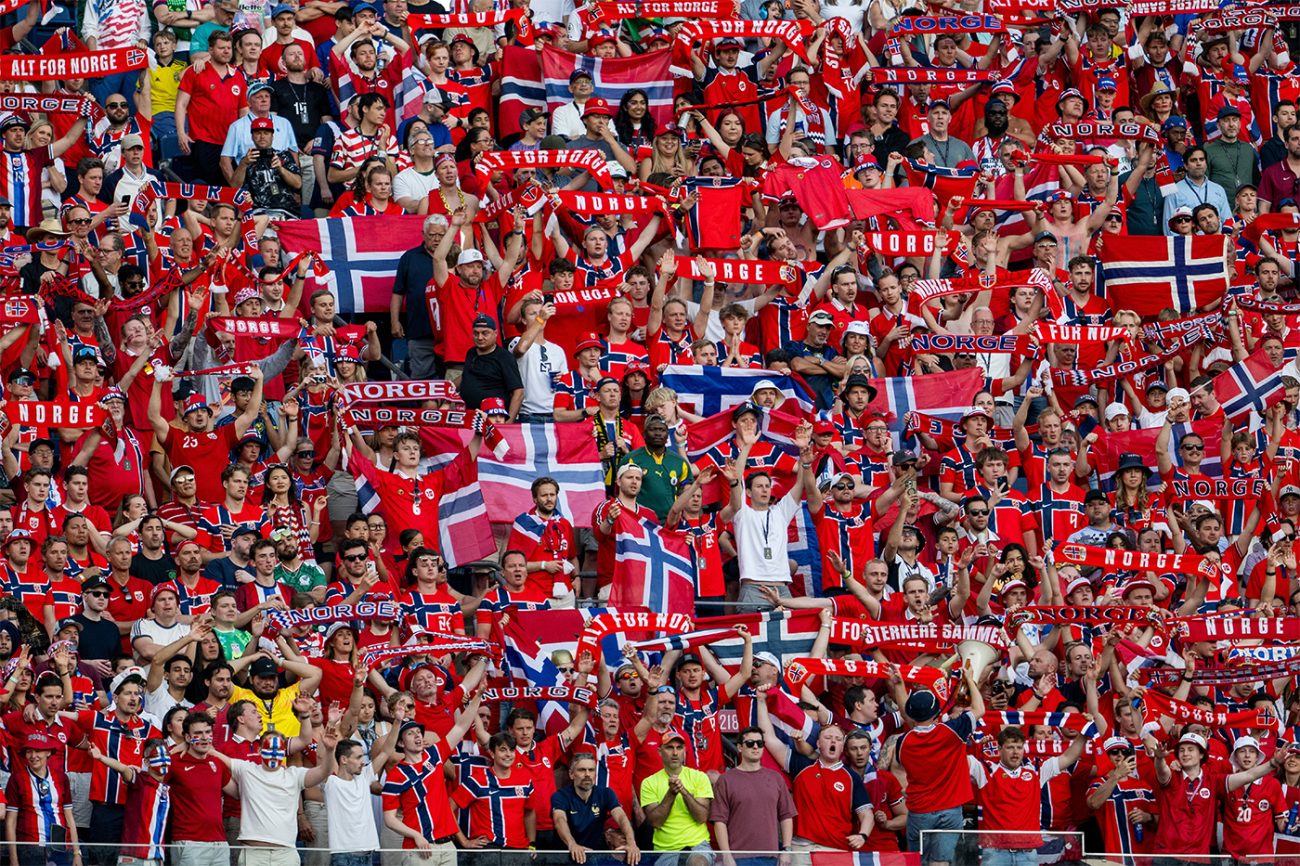
Klein also made note of the great camaraderie between both teams’ fans, who he said welcomed each other into their chants. He said this friendliness is often the case early in the World Cup in the group stage when the teams don’t necessarily have heated rivalries.
A fun experience, Klein said, came when the Norwegian fans made synchronized rowing motions while repeatedly shouting “Hu!” to help their team increase its defensive intensity. He captured it on video.
“It’s like they had this kind of psychic connection with the team,” Klein said, comparing it to U.S. fans chanting “defense” during a basketball game.