

WFP scales up emergency food support for Colombian earthquake survivors
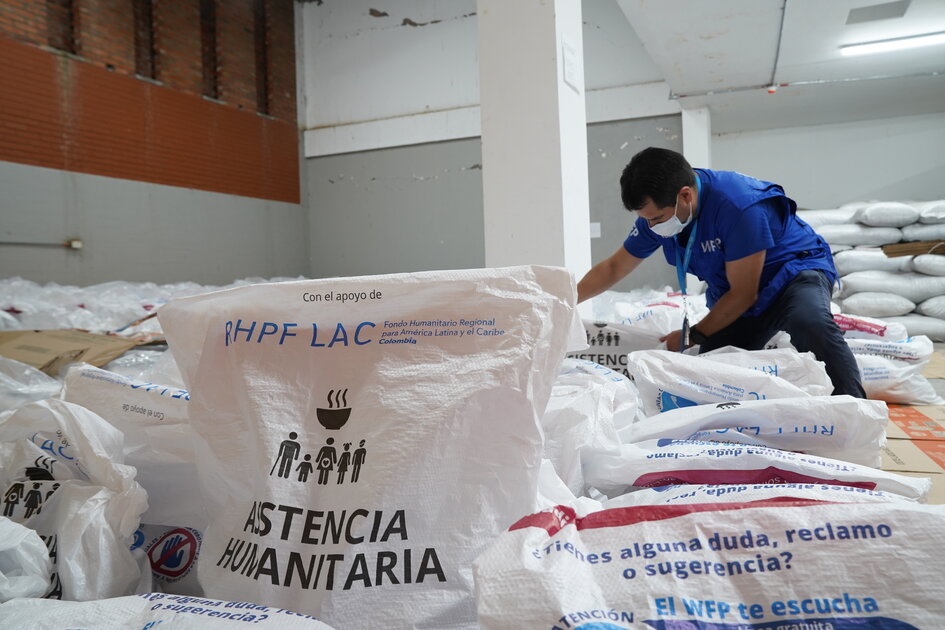
A WFP staff member prepares food baskets for distribution to households affected by the earthquake
BOGOTA, Colombia – The United Nations World Food Programme (WFP) is scaling up emergency operations in Colombia, reaching survivors in some of the country’s most affected and vulnerable regions with critical food assistance following the 7.4-magnitude earthquake that struck on 10 August.
WFP teams have been supporting government-led relief and recovery efforts with more than 2,000 people receiving food assistance in Pereira and Quibdó on Sunday alone. Operations will expand throughout the week with WFP deploying food stocks and leveraging its network of field offices and logistics hubs in Cali, Quibdó and Medellín to reach affected communities.
“The solidarity shown in the immediate aftermath of the earthquake has been extraordinary,” said Nils Grede, WFP Country Director in Colombia. “Communities, businesses and individuals have stepped forward to help those affected, but we know from experience that recovery does not end when the first wave of support subsides. Sustained humanitarian assistance will be essential in the weeks and months to come, and WFP is committed to standing alongside affected communities for as long as they need support.”
As the scale of humanitarian needs becomes clearer, WFP is appealing for an initial USD 23 million to deliver emergency food assistance to 100,000 people over three months and continues to adapt its response to conditions on the ground. In remote communities where markets are not functioning and access remains difficult, WFP is prioritizing in-kind food assistance. In urban centres such as Valle del Cauca and Risaralda, where markets and basic services are beginning to recover, cash-based assistance can be rapidly scaled up, allowing families to buy the food they need while supporting local businesses and economic recovery.
In close coordination with government authorities and humanitarian partners, WFP is also supporting the broader response through logistics expertise and common services. Four mobile storage units are on standby and additional relief items are available for deployment from the WFP-managed Humanitarian Response Depot in Panama.
Even before the earthquake, close to seven million people in Colombia faced moderate or severe food insecurity, with the worst-hit regions also impacted by conflict and displacement. In Chocó and Valle del Cauca, close to one third of the population is food insecure. These vulnerabilities are now deepening as families grapple with the loss of their homes, livelihoods, and access to essential services.
# # #
Note to editors:
Broadcast quality video footage from Chocó can be downloaded here.
Broadcast quality video footage from Risaralda can be downloaded here.
High resolution photos can be downloaded here.
The United Nations World Food Programme is the world’s largest humanitarian organization saving lives in emergencies and using food assistance to build a pathway to peace, stability and prosperity for people recovering from conflict, disasters and the impact of climate change.
Follow us on X, formerly Twitter, via @wfp_Colombia