

Vector-borne disease co-occurrence is shaped by agrarian economy and socioenvironmental contexts in the Brazilian Amazon
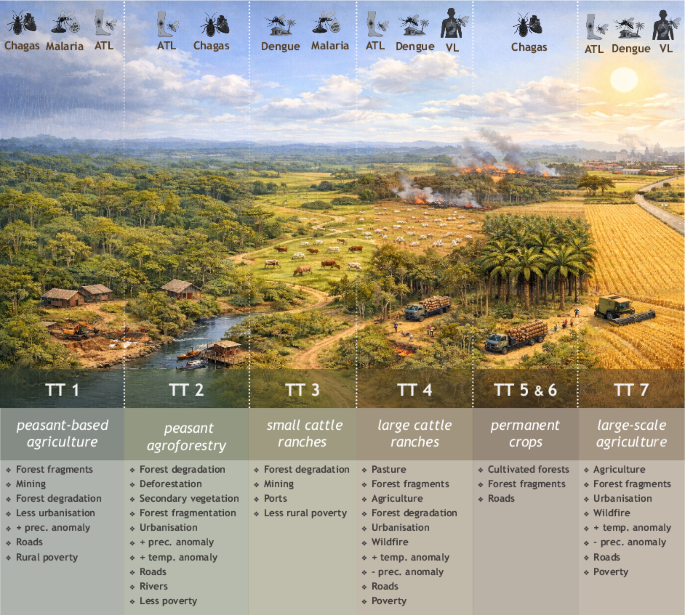
The Amazon basin, a biodiversity hotspot, is a complex mosaic of disease landscapes influenced by intricate socio-economic and environmental dynamics. Here, we employ an innovative ecosyndemics framework to dissect the interplay between vector-borne diseases such as malaria, dengue, and leishmaniasis, and their co-occurrence in relation to agrarian economies and environmental changes from 2015 to 2019. Leveraging a comprehensive dataset covering the Brazilian Amazon, we reveal how economic activities dictating land use and social structures within diverse Amazonian communities drive disease patterns by altering vector habitats and human exposure. Our findings highlight major disease clusters that correspond with specific agrarian, environmental, and socio-economic contexts. These results can help prioritise regions for further research, enhanced disease surveillance, and broader multisectoral health initiatives. This integration addresses the intertwined challenges of disease management, conservation, and sustainable development in biodiverse regions undergoing rapid ecological change.