

Turkey’s Outgoing Ambassador Praised for Strengthening Somalia Ties Amid Growing Cooperation
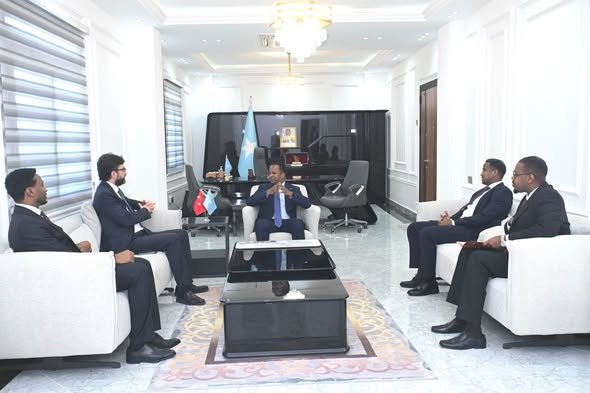
MOGADISHU — The Minister of Foreign Affairs and International Cooperation, Abdisalam Ali, has received the outgoing Ambassador of the Republic of Türkiye to the Federal Republic of Somalia, Alper Aktaş, at the ministry’s headquarters in Mogadishu for a farewell meeting following the conclusion of his diplomatic tenure in Somalia.
The Minister praised the Ambassador’s service and efforts, and the role he played in strengthening cooperation and the close ties between the governments of Somalia and Türkiye. Minister Abdisalam reaffirmed the Somali government’s commitment to deepening the brotherly relations between the two countries and wished the Ambassador success in his future roles and responsibilities.
The farewell meeting comes as relations between Mogadishu and Ankara have reached an unprecedented level of strategic cooperation, spanning security, maritime affairs, energy, aerospace, and economic development.
Deepening Security and Defence Cooperation
Turkey has become one of Somalia’s most important security partners, operating its largest overseas military base in Mogadishu, where it trains Somali troops, and has steadily increased defense cooperation with the Horn of Africa nation.
Joint Somali-Turkish military operations have achieved notable successes, including the rescue of the hijacked cargo ship MV LUTUF in August 2026, which killed 14 pirates and demonstrated the effectiveness of the defence cooperation agreement between the two countries.
A Turkish presidential committee recently visited Somalia to discuss military cooperation and resource exploration, underscoring the depth of engagement between the two governments. The relationship has expanded significantly over the past decade, with Turkey providing comprehensive military training, equipment, and capacity-building support through the TURKSOM Military Academy in Mogadishu, which has trained thousands of Somali soldiers and officers since its founding in 2017.
The Turkish military has also supplied Somalia with drones, armored vehicles and other equipment, significantly enhancing the Somali National Army’s operational capacity. Turkey has also deployed F-16 fighter jets to Mogadishu as part of broader military support provided to Somalia as the country intensifies operations against Al-Shabaab and works to strengthen national defense capabilities.
High-level discussions between Turkish and Somali officials have covered defence, maritime, and economic cooperation, with both sides committing to expand their partnership across multiple sectors.
Maritime Security and Naval Modernization
The maritime domain has become a key area of cooperation between Somalia and Turkey. A Turkish naval delegation and exploration vessels arrived in Mogadishu in February 2026, with the fleet including an oil exploration and drilling ship docked alongside security support vessels, deployed under a bilateral agreement with Ankara regarding offshore oil survey and drilling operations.
Turkish Navy warships have docked at Mogadishu’s seaport as part of strengthening maritime security cooperation, with the arrival marking a continued deepening of defense cooperation between Somalia and Turkey, specifically regarding maritime security. The docking of the Turkish naval assets comes at a critical juncture as the Federal Government accelerates its strategic plan to rebuild and professionalize the Somali Navy and Coast Guard.
Somalia and Turkey have deepened naval cooperation to rebuild the Somali Navy, with the Chief of the Somali Navy meeting with the Commander of the Turkish Naval Forces to advance cooperation in rebuilding Somalia’s maritime defense capabilities. The first shipment of training equipment for the Somali Navy recently arrived in Mogadishu, marking what authorities describe as the start of a broader plan to strengthen naval forces.
The hijacking of the LUTUF, which was carrying Turkish weapons and communications equipment bound for a Turkish military training facility in Mogadishu, highlighted the importance of maritime security cooperation and the risks faced by vessels operating off the Somali coast. Six international warships are now in the seas close to the LUTUF – two from Turkey and one each from Spain, Denmark, the US and India, according to security sources.
The resurgence of piracy off the Somali coast has drawn international concern, with Turkish naval forces playing a role in protecting shipping lanes and supporting Somali maritime security efforts. Puntland authorities have been outspoken about Turkish involvement in counter-piracy operations, with Deputy Minister of Security Abdirahman Yusuf stating that his administration had evidence that Turkey was responsible for attacks on pirate groups.
Energy, Space and Economic Cooperation
Turkey is playing a growing role in Somalia’s energy sector. Turkey and Somalia have formed a joint offshore oil exploration venture, with Ankara providing technical expertise and investment to develop Somalia’s hydrocarbon potential. Turkey’s energy minister announced that a Turkish drilling vessel is expected to arrive in Somalia to carry out Turkey’s first deepwater exploration project abroad, focusing on offshore areas in Somali waters.
Turkey has also announced plans to build a space centre in Somalia, marking a significant expansion of cooperation into the space sector. Turkey plans to construct a $350 million spaceport in Somalia as part of its ambitious space exploration program, with the facility to be built near the equator to support satellite and rocket launches. A 2022 academic study by researchers from the Turkish National Defense University formally identified Somalia as the best alternative location for Türkiye’s spaceport.
Somalia and Türkiye are boosting spaceport cooperation, with discussions ongoing regarding the development of Somalia’s strategic spaceport facility, which is expected to position Somalia as a future hub for satellite and rocket launches. A Turkish military transport docked at Mogadishu Port in February 2026, offloading a shipment of M48 and M60 Patton battle tanks that will be positioned to defend Turkish installations in the Warshiikh district, approximately 60 kilometers north of Mogadishu, where the aerospace project is advancing.
Ambassador Aktaş announced that Somalia would for the first time launch a satellite from its own soil, marking a significant milestone in the partnership between the two nations. The satellite launch is only the beginning of a project that includes the construction of a Turkish spaceport in Somalia.
The growing Somalia-Turkey partnership is part of a broader realignment in the Horn of Africa, with Turkey joining other regional and global powers such as the UAE, Saudi Arabia, and China in vying for influence. Turkey views its agreements with Somalia as extending to the entirety of Somalia’s de jure boundaries and has denounced Israel’s recognition of Somaliland, signaling that it aims to counter Israeli influence in the region.
Critical Note
Ambassador Aktaş’s farewell meeting marks the end of a significant chapter in Somalia-Turkey relations, during which the bilateral relationship has deepened into a comprehensive strategic partnership. Turkey’s investments in Somalia’s security, maritime domain, energy sector, and space industry reflect Ankara’s ambition to become a major player in the Horn of Africa.
Yet, Somalia’s deepening relationship with Turkey also carries risks. The reliance on Turkish military support, including drone strikes and training, has raised questions about the sustainability of Somalia’s security gains without continued external backing. Turkish involvement in Somalia’s oil and gas sector could also create dependencies and potential tensions with other regional and international actors.
Moreover, Turkey’s expanding military footprint has drawn criticism from opposition figures who accuse Ankara of taking sides in Somalia’s internal political disputes. The allegations that Turkish-supplied weaponry has been used against political opponents highlight the risks of external military support being repurposed for internal political purposes. For Somalia, managing these competing interests while safeguarding its sovereignty and ensuring that partnerships deliver tangible benefits for its people remains a significant challenge.
Recommended Reading On ftlsomalia.com
Credit: Source link