

Tracking viruses and building the science to understand them
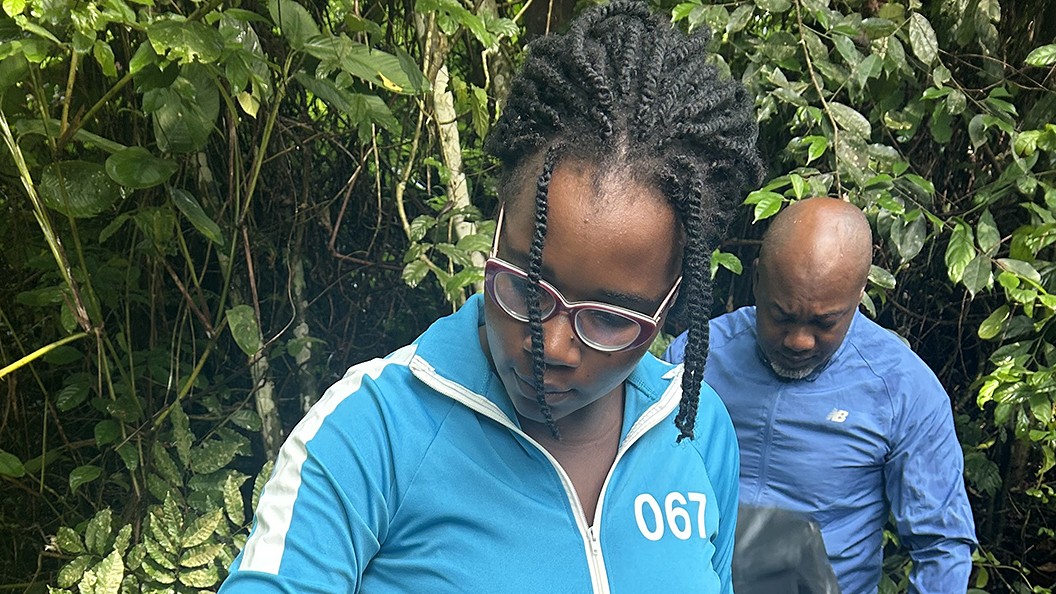
Delia Doreen Djuicy holds a Sherman trap containing a giant pouched rat captured during a field investigation in Cameroon’s Littoral Region. This rodent species is considered a potential reservoir of mpox virus and was sampled as part of efforts to better understand zoonotic transmission. Credit: Delia Doreen Djuicy
When suspected cases of mpox, viral haemorrhagic fevers, rabies and other viral diseases emerge in Cameroon, samples arrive at my laboratory at the Centre Pasteur du Cameroun in Yaoundé. I test them and report the results to the Ministry of Public Health. But my work does not end with diagnosis. I want to understand where viruses come from, how they spread and why some remain hidden.
I initially wanted to become a doctor, inspired by my mother, who was a nurse. But because the nearest university did not have a medical faculty, I studied medical analysis instead. During hospital internships, I became fascinated by the organisms behind disease and realised I wanted to understand infections.
After completing my bachelor’s degree, I pursued a professional master’s degree in Yaoundé. During the second year, I was selected for a competitive regional research master’s programme in Gabon. I completed both programmes while continuing my research work and later obtained my first research internship in France, which strengthened my interest in virology.
My PhD focused on human T-lymphotropic virus type 1 (HTLV-1), a human retrovirus that remains much less widely understood than HIV. During my doctoral research in Gabon, I worked with forest communities, collecting samples from more than 2,000 people.
That experience shaped my One Health perspective. I came to understand that viruses are connected to the environments in which they circulate, and that human, animal and ecosystem health must be considered together when investigating disease.
After completing my PhD in 2018, I returned to Cameroon and later joined the Centre Pasteur du Cameroun as a research scientist in 2022. I now lead the national reference laboratory for mpox, viral haemorrhagic fevers and rabies.
My public health work often determines my research questions. When I began studying mpox, Cameroon had limited genomic information available. I analysed reported cases from 1979 to 2022 to produce the first comprehensive study of mpox in the country.1 I wanted to show that scientists in Cameroon could lead major research, so the publication included only Cameroonian authors.
The study revealed that Cameroon is unusual because both major mpox clades circulate in the country. We found that the Sanaga River appears to separate their distribution, with different viral lineages associated with different forest ecosystems. The findings raised questions about how the virus circulates and whether different environments may host different animal reservoirs.
Building a national mpox research programme required developing the tools and expertise needed to investigate outbreaks locally. When I began working on mpox, Cameroon had limited genomic capacity and often depended on external laboratories for analysis.
Building this capacity has not been easy. Like many scientists working in resource-limited settings, I have often pursued research without dedicated funding. Many grant applications were unsuccessful, but I continued developing research questions through collaborations, available laboratory resources and training opportunities. I involved students in projects, sought support through scientific networks and continued collecting samples while searching for funding.
I learned next-generation sequencing during a regional workshop in Nigeria and worked to establish the technology locally. I later pioneered full-length mpox genome sequencing at the Centre Pasteur du Cameroun, allowing Cameroon to analyse viruses locally rather than depending entirely on outside laboratories.2
I continue pursuing unanswered questions. My HTLV-1 research investigates whether the virus may be circulating among blood donors in Cameroon. Through this work, I have collected more than 3,000 samples.
Another mystery continues to challenge me. In 2023, two children died after developing severe haemorrhagic symptoms. Tests for known viruses were negative, but further investigations showed that an infectious agent was present. Samples caused newborn mice to become paralysed and die, and sequencing efforts followed. Despite international collaboration, the pathogen remains unidentified.
Scientific research in Cameroon remains difficult because of limited funding, equipment challenges and shortages of specialised expertise. But I believe collaborations should not only involve sending samples abroad; they should transfer knowledge, technologies and skills.
I returned home because I wanted to build the scientific environment I wished existed when I started my journey, one where African scientists can lead discoveries that protect their communities and contribute solutions globally.
My motto is simple: science in Africa, for Africa, by Africans and for the world.
Credit: Source link