

This bird was just seen in Brazil for the first time ever
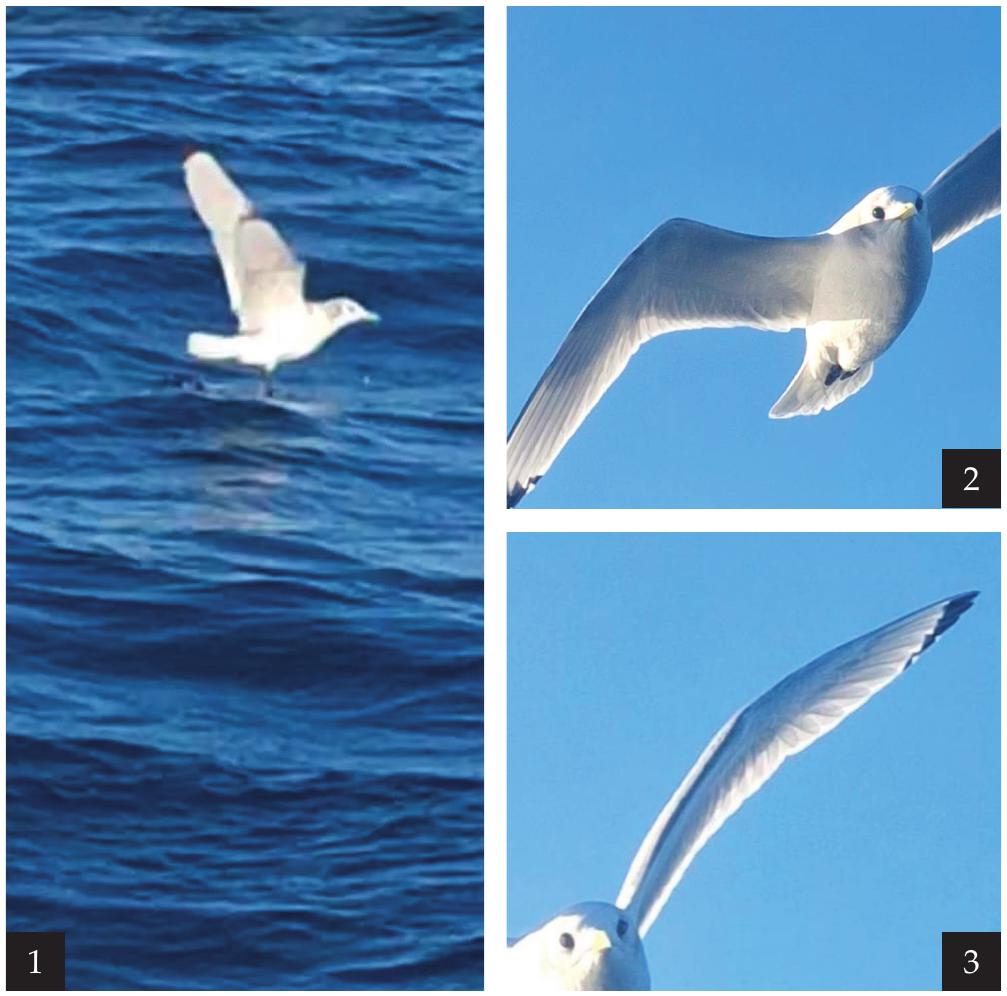
A black-legged kittiwake (Rissa tridactyla) has been seen off the coast of Rio Grande do Norte in Brazil, marking the first record of the species in the South American country.
The sighting, described in a new paper published in the journal Bulletin of the British Ornithologists’ Club, is also one of just a few documented records of the kittiwake in South America and the Southern Hemisphere.
The bird was spotted by members of a fishing trip, flying alongside their boat. Images, taken from two smartphone videos, show the kittiwake sitting on the water and soaring over the rolling sea, revealing “the neatly black-tipped wings, black tarsi [part of a bird’s lower leg] and grey rear head markings,” say the authors.
Further images capture the bird “flying above and towards the boat, enabling a good view of the head, with the all-yellow bill, dark eye and smudge below it, black feet and all-white underwing.”
The researchers identified the bird as an adult in non-breeding plumage, adding that “none of the regularly occurring species of larids [a family of seabirds that includes gulls and skimmers] is similar to the bird observed off Rio Grande do Norte.”
Black-legged kittiwakes usually spend their winters in the coastal waters of the North Atlantic, the mid-Atlantic ridge around the Azores, in the North Sea and the Bay of Biscay.
There are a handful of records of them appearing further south. For example, in 1978, 1979 and 1987, vagrant black-legged kittiwakes were documented off South Africa. But this is the first official record of the species in Brazil.
“The origin of the Brazilian vagrant is a matter of supposition,” say the authors, adding that, “irrespective of the subpopulation involved, this is an extreme case of vagrancy, either an overshooting autumn migrant or a bird displaced from its usual wintering area by storms or other factors.
“The possibility of ship-assisted passage seems unlikely but cannot be eliminated.”
Top image: black-legged kittiwake, Rio Grande do Norte, Brazil. Credit: André Felipe Nascimento Ramos | François Sagot-Martin et al., Bulletin of the British Ornithologists’ Club 2026, distributed under the Creative Commons Attribution-NonCommercial Licence.
More wildlife stories from around the world