

The World Is Starting to Discover African Fragrance

From Lagos to Accra, Dakar to Cape Town, a new generation of African fragrance houses is quietly attracting attention far beyond the continent. Most of us have not noticed yet.
Think about the last perfume you bought. Not one you were given, one you chose and paid for. Where was it made?
Most of us would say France. Some would say Dubai. Plenty would say they bought it from a shop in Ikeja and never thought about it again. Very few would say Accra, and almost nobody would say Maiduguri.
That is starting to look like an oversight.
There is a Nigerian house called Beguile operating across three continents. There is a woman in Maiduguri who took the incense her family burned every morning and evening and put it into a spray bottle. There is a house named after a nineteenth-century trader from the Niger Delta whose award-winning fragrance is built on green plantain. There is a perfumer in Cape Town working with myrrh that Himba women gather from fallen resin in northern Namibia.
These are not hobby projects.
Catherine Omai, a Nigerian perfumer, sells a fragrance called Contagious through Saks Fifth Avenue. Maya Njie has run her own perfume label out of London since 2016, and Liberty carries it. And in June, at an awards ceremony in Athens, two of the winning perfumes were ours.
So this is not a story about what might happen one day. The houses exist. The bottles ship. The awards have already been handed out. The only part still missing is that most of us have never heard about any of it.
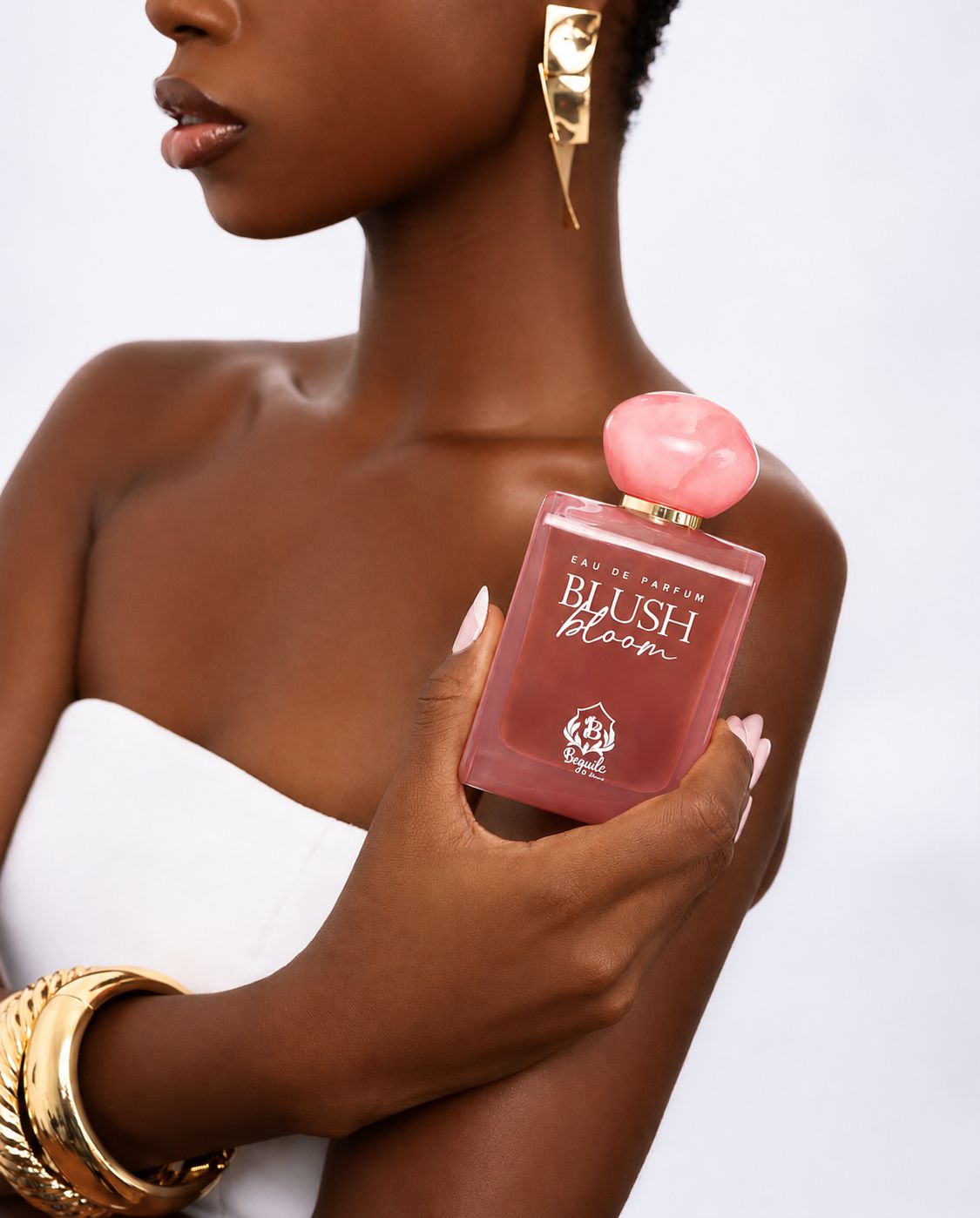
Beguile‘s line, developed in Dubai and sold across its four markets. Photo: @beguilebyomaa
So how are people finding these brands?
Through a screen, mostly.
Every house in this article is niche. Designer fragrance is what a fashion label puts its name on and sells at volume. Niche is the smaller end, where a house will lose money on a fragrance because it wanted to make it, and where buyers care about who wrote the formula roughly the way we care about producers.
Niche used to be almost impossible to sell across borders. You cannot smell a video, so for decades a house needed a distributor, a shelf, and a country with the retail infrastructure to support them. Then the shelf stopped being the only way in. A house can now run its own storefront, take payment from anywhere, and build the audience itself across Instagram, TikTok and its own website. Beguile does exactly that, selling from its own site and passing thirty thousand followers on Instagram largely on founder-led content. The scale of the shift is not small: Cosmetics Business reports that the #PerfumeTok tag alone has passed 2.3 billion views.
The independent databases serve a different buyer. Someone who meets a house through a founder’s video goes straight to the shop. Someone weighing eight unfamiliar houses at once starts on Fragrantica or Parfumo, where notes, reviews and ratings sit in one place and none of it is written by the brand. Réserve en Afrique has six fragrances on Parfumo carrying close to a hundred ratings, most of them from people nowhere near Senegal. Fragrantica has also run long interviews with the founders of Yerwa Secrets and Maison Yusif.
Then there are the people talking. Our creators run whole series on local houses now, and the comment sections fill with people who have been wearing something for three years and never once posted about it.
None of that needs a distributor’s permission. It needs the perfume to be good enough that somebody wants to talk about it unprompted.
Is there actually a market for this?
Bigger than most of us assume.
Statista values Nigeria’s fragrance market at 0.92 billion dollars in 2024, heading for 1.07 billion by 2029. IndexBox reports that we account for 37% of all African perfume consumption by volume and 48% of production. And GlobalData has forecast our region to post the fastest fragrance growth in the world, at a 9.3% annual rate.
The international houses have read the same numbers. Clive Christian chose Nigeria for the African debut of its Absolute range, bottles that start around £7,000. Maison Crivelli told Business of Fashion in January it is targeting Nigeria and Ghana.
That raises an obvious question. If we were always among their best customers, why did it take this long?
Richard Vedelago, who founded the Lagos gallery Nahous, gave Forbes Africa the answer. Nigerians have always been among the world’s top spenders on luxury goods, he said, and “we just haven’t had the infrastructure here.” Before the pandemic that gap was filled by travel, with affluent Nigerians running shopping circuits through Dubai and London. Covid closed the circuits, the demand stayed home, and the brands finally had to come to it.
The buyers were never the problem. The shelf was.
It also matters where the volume sits. Statista puts 94% of Nigerian fragrance spending outside the luxury tier, which makes the £7,000 bottle a headline rather than a market. The same research house reports demand here surging for locally made, natural and culturally inspired scents. Beguile has been building for exactly that buyer since 2021, which is a less glamorous position than the £7,000 shelf and a considerably larger one.
Some of the most useful work is happening a tier below the perfume bottle. Cececa spent years scenting commercial spaces in Lagos, for Puma and Afreximbank among others, before moving into candles and diffusers, and it learned the market from the inside out. Its managing director Mena Kezia told Forbes Africa there is “a distinct cultural palette when it comes to fragrance,” with notes that land as deeply familiar here in ways they do not elsewhere.
The retail layer has been quietly doing its part too. Seinde Signature now runs fifteen branches carrying over forty niche houses, and it is where a great many of us met the category for the first time. Its founder Olufemi Olusola spent a year giving away more than 600 bottles purely to teach Nigerians what niche perfumery is, which tells you something about the size of the education problem. “We don’t sell based on brand names,” he has said. “We sell based on quality.”
The market is real. The education is nowhere near finished.
Which houses are already doing this?
Nine of them, and no two are attempting the same thing.
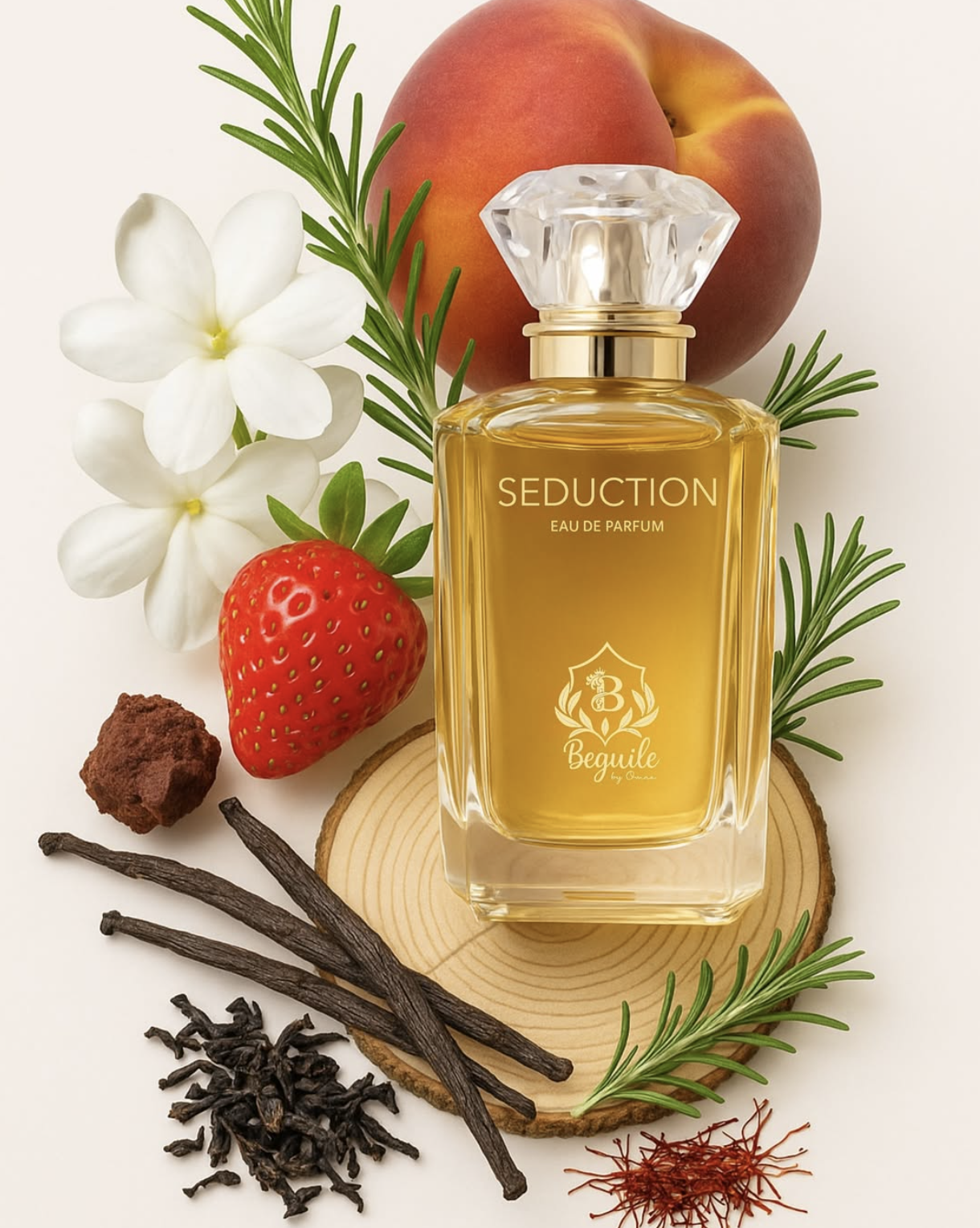
Beguile was founded in Nigeria in 2021 and now runs from bases there, in the UK, the US and Canada, with the fragrances developed in Dubai. It has taken the modern route, and the case rests on composition and performance. Mystique is the one most people arrive at first, a fruity floral that opens on bergamot and peach, turns velvety as plum and sandalwood come up under the rose and jasmine, then dries down into vanilla, tonka and amber. Reviewers report ten to twelve hours on skin. Sweet Oud is the heavier proposition, Goddess the lighter everyday one, and the rest of the line includes a separate range of oils and scents.
Most of the others work the other way round, starting from memory.
Ilé Olomu was founded by Bawo Ijirigho after fifteen years in Los Angeles music production. He named it in Yoruba rather than French: ilé means house, chosen instead of maison. Olomu was his great-grand uncle, a trader in nineteenth-century West Africa. He works with a Swiss perfumer on compositions built from green plantain, ginger and Milo, and Verdant, the plantain one, is what won in Athens. Nobody else is building perfume on that.
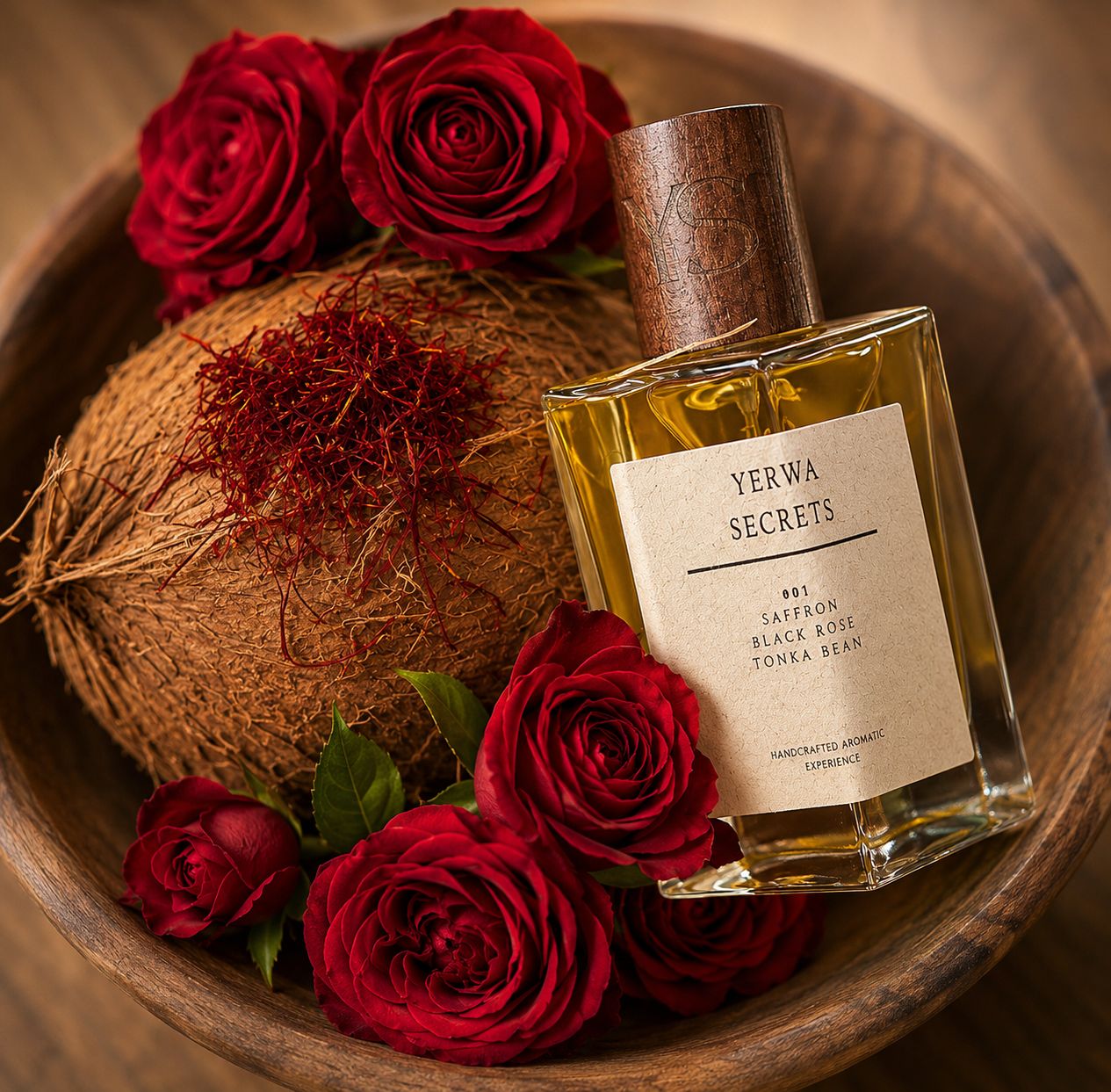
Yerwa Secrets takes its name from Yerwa, what Maiduguri people call Maiduguri. Fatima Babakura grew up there in a Kanuri household where incense burned twice a day, and started the business during lockdown. She took humra, normally sold in dropper bottles, and reworked it into a proper spray with presentation to match. She also makes incense that refuses to smell like incense, including a vanilla one. Orders come in from Mauritius and the UAE.
Catherine Omai built Contagious on a rarely extracted oud, with oakmoss and sandalwood underneath, and wrapped the bottle in aso-oke. In 2019 she took it to Pitti Fragranze in Florence, the trade fair the niche world treats as its fashion week, and became the first West African perfumer to exhibit there.
Then there are the ones building distribution.
Maison Yusif works out of a flagship store in Accra, with over twenty fragrances built around locally harvested frankincense, cocoa butter and Ghanaian peppercorns. Yusif Meizongo Jnr is the first West African perfumer certified by the International Perfume Foundation, and he ships worldwide from Ghana.
Scent of Africa is the most widely distributed house here, selling across half a dozen African markets, in airport duty free and on Ethiopian Airlines. Its founder Tanal Ghandour spent twenty years manufacturing cosmetics for the mass market in West Africa before launching a luxury brand out of Ghana.
Maya Njie is Swedish-born with Gambian roots, self-taught, working out of London since 2016. Her perfumes come from a family photo album from before she was born, and the question she puts to each photograph is what it smelled like. Aethi Opum runs black pepper and wet earth into thiouraye incense and suede. She rebuilt gowe seed as a perfumery material herself because nobody was using it.
Saint d’Ici makes botanical perfume in Cape Town with no synthetics at all. Marie Aoun left fashion to do it, and every bottle is blended and filled by hand. Her Magnolia takes its powderiness from omumbiri, the Namibian myrrh gathered from fallen resin.
Réserve en Afrique 1934 is named for the year the founders’ grandfather reached Senegal’s Sine-Saloum, where the family has worked on a protected forest ever since. It sources Madagascan vanilla, Somali opoponax and Nigerian ginger, and puts 5% of profits back into conservation. A Fragrantica reviewer at Pitti Fragranze last year called it a brand to watch.
Yerwa Secrets reworked humra into spray format out of Maiduguri, with orders arriving from the Gulf and the Indian Ocean. Photo: @yerwasecrets
Who outside the continent is paying attention?
The trade fairs and the award panels, where the industry decides among itself what counts.
Paris Perfume Week this year was the loudest moment. Maison Yusif exhibited, the first niche house from Ghana ever to do so, and the delegation arrived in kente, agbada and fugu. France 24 put Meizongo on its live evening broadcast, believed to be a first for a Ghanaian perfumer, and he used the slot to argue that the industry has told its own history wrong: “perfumery did not begin in France. It was refined there.”
But the result that matters most came out of Athens.
On 11 June, the Institute for Art and Olfaction held the twelfth edition of its awards at a cultural centre in view of the Acropolis. Maya Njie won the Artisan category for Aethi Opum. Ilé Olomu’s Verdant took People’s Choice among the independents, shortlisted alongside houses from Vietnam, Taiwan, France and the United States.
The retail evidence is quieter and adds up more slowly. Contagious is in Saks. Liberty carries Maya Njie in London, independent perfumeries in New York, San Francisco and Paris carry the others, and Réserve en Afrique runs its own US site. Beguile sells direct in all four of its markets.
Maison Yusif’s delegation at Paris Perfume Week 2026, the first niche house from Ghana to exhibit there. Photo: Maison Yusif
What is the diaspora actually buying?
Take Aethi Opum, a Swedish-Gambian perfumer’s reading of her own family archive, made in London and judged in Athens by people who had never heard of her.
The 2022 American Community Survey counted around 712,000 US residents of Nigerian ancestry, up from roughly 25,000 in 1980. The UK census recorded about 293,600 Nigerian-born residents in 2021, and past half a million once British-born children are counted.
What these houses offer someone in that position is a way of showing up as yourself that requires no explanation from you. Fragrance is the only thing we wear that people notice before they see it. Someone with no interest in wearing print to a London office can wear a fragrance built on thiouraye incense to it, and nobody in the meeting needs to be told a thing.
A Zikoko review of Beguile’s Mystique this year made the same point in reverse. The big imported houses we all buy are composed around somebody else’s memories, so wearing one means “putting on someone else’s reference points.” A fragrance built closer to home asks less of the wearer, which is a small thing until you have spent years doing the translating.
Scent of Africa has said openly it is looking at the United States because of the size of the diaspora there. Yerwa Secrets fields orders from the Gulf. Beguile built bases in London and North America. These are not brands waiting to be found by our people abroad. They were built around them.
Is being African enough to sell a perfume?
No. A perfume with nothing going for it but origin gets bought exactly once.
Somebody buys from one of ours out of curiosity, or out of solidarity, and that first purchase is the easy one. Coming back is the real test, and it has nothing to do with where the bottle was made. It has to do with whether the thing lasted eight hours in real weather, whether the atomiser worked, whether the second bottle smelled like the first, and whether there was stock when they went looking.
That is why the Athens result carries more weight than any amount of press. The Art and Olfaction Awards are judged blind by an international panel of perfumers and critics, on technical and artistic merit alone. Aethi Opum and Verdant were not chosen for their passports.
The uncomfortable part is where these fragrances are actually composed. Ilé Olomu‘s are built in Zürich, Beguile’s in Dubai, Scent of Africa’s in France. Those are sensible decisions, and Swiss and French perfumery infrastructure is genuinely the best there is. But the romantic version of this story, the one where our houses compose our scents on our own soil, is not true yet. Most of what has been built so far is brand, story and distribution. The chemistry is the part still outsourced.
The record includes misses too. A reviewer of Catherine Omai’s Contagious Gold found the sillage soft and the longevity weak for the money. Being taken seriously includes being allowed to disappoint somebody.
The houses still standing in ten years will be the ones that solved the boring problems: consistent batches, packaging that survives shipping, enough stock to restock, distribution that does not depend on one person’s suitcase.
So where should you start?
Beguile’s Mystique is the easiest first buy, with Sweet Oud if you want performance and the oils if you prefer something that stays close. Ilé Olomu sells 30ml bottles and Verdant is the award winner. Maya Njie and Saint d’Ici both sell discovery sets, which is the sane way in. Maison Yusif ships worldwide from Accra. And if you would rather smell forty niche houses in an afternoon before spending anything, Seinde Signature has fifteen branches and no obligation to buy.
None of these houses needs us to root for them. They are on shelves, in databases and in front of blind judging panels already. The discovery everyone keeps predicting has been under way quietly for years. The only real question left is how long the rest of us take to catch up.
Sponsored Content
Crédito: Link de origem