

The Risks of Downplaying China’s Military
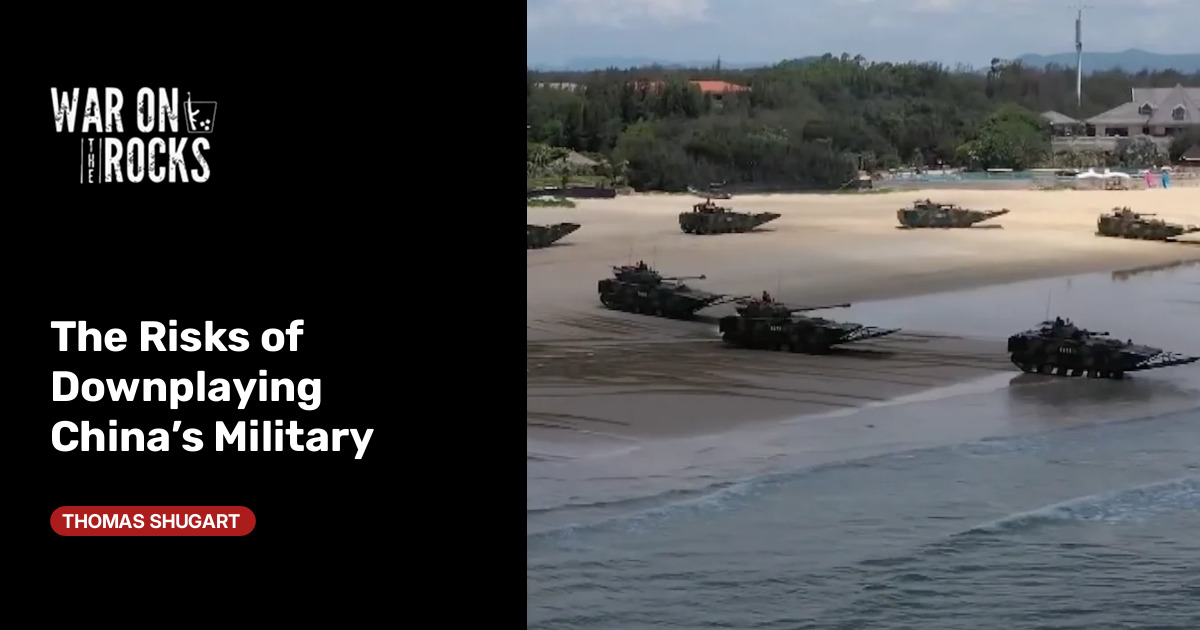
China has spent years modifying civilian ferries to launch amphibious armored vehicles, developing specialized equipment to move forces ashore without conventional port facilities, hardening dozens of air bases, and rapidly expanding the missile forces that could be used to deter or defeat a U.S. intervention. Yet at the same time, a recurring line of analysis has argued that concerns about China’s military capabilities are overstated — and that an invasion of Taiwan remains beyond the reach of the People’s Liberation Army.
These analyses differ in important ways. Some emphasize the Chinese military’s political character, lack of combat experience, and institutional shortcomings. Others point to the extraordinary military, economic, geographic, and political obstacles an invasion would face, or to purges and other signs of dysfunction within the Chinese military. Most recently, Adm. (ret.) Dennis Blair argued in Foreign Affairs that China cannot conquer Taiwan and is unlikely to become capable of doing so anytime soon.
There is some validity in these arguments. An invasion of Taiwan would be an enormously difficult undertaking, China’s military has well-documented shortcomings, and military capabilities should never be equated mechanically with likely success in war. But uncertainty about whether China would succeed is not the same thing as confidence that it could not. The available evidence does not support a categorical judgment that China lacks — and will continue to lack — the military capability to take and hold Taiwan. China may already possess a credible path to success, even though that success — particularly in the face of U.S. intervention — would be far from assured.
I have great respect for Blair’s service as commander of Pacific Command and as director of national intelligence, and I agree with several of his conclusions, including that coercion short of invasion is unlikely to achieve Beijing’s political objectives and that continued Taiwanese and allied investments are essential. But his recent article provides a useful example of a broader analytical problem: Genuine Chinese shortcomings can be given more weight than the capabilities Beijing has built to overcome them. Specifically, despite acknowledging improvements in Chinese military capabilities, he underestimates the scale of the transformation of the People’s Liberation Army over the past two decades.
Blair and other sanguine observers of the risks from China overlook key sources of capacity brought to bear by China’s strategy of military-civil fusion, especially civilian sealift. And while many of the capabilities China has built serve purposes beyond Taiwan, they are also directly relevant to deterring — or defeating — the outside intervention that could determine whether an invasion succeeds. Finally, he treats U.S. and allied modernization as dynamic, timely, and of sufficient scale to deter China, with comparatively little attention to the continued improvements the Chinese military has achieved in the meantime.
Amphibious Lift Is Not Just About Gray Hulls
Blair identifies amphibious lift as China’s most important shortfall, citing a 2025 Pentagon report that says so, and treats it as a binding constraint on an invasion’s success. If China had to rely only on the purpose-built amphibious ships of the Chinese navy, that would be a powerful argument. But it does not. The same Pentagon report Blair cites for the amphibious-lift shortfall immediately notes that the Chinese navy continues to train with civilian roll-on/roll-off vessels to mitigate it. This fact has been discussed in detail in previous Department of Defense reports.
Nor are these civilian vessels relevant only after an initial landing has secured ports. The Chinese military has repeatedly exercised modified civilian ferries as part of amphibious assault operations, including launching amphibious armored vehicles directly from them for movement ashore. China has spent years developing, modifying, organizing, and exercising dual-purpose commercial shipping for wartime use. Such vessels could therefore augment both the assault echelon and the much larger movement of follow-on forces and supplies.
China has also built special-purpose self-propelled transfer bridges to facilitate over-the-shore deliveries from roll-on/roll-off ships, and has been practicing using civilian landing craft — which exist in large numbers — to further supplement its sealift. Any serious assessment of Chinese amphibious capacity has to account for the civilian shipping Beijing has spent years preparing to mobilize.
An Invasion Requires More Than Amphibious Lift
On the topic of maritime power projection, Blair describes China’s capability as “roughly comparable to that of France, Japan, or the United Kingdom.” For a start, that comparison is difficult to reconcile with publicly available force structure data: By my count, China’s navy has more than twice as many combatant vessels as all three of those navies combined. Just as importantly, it does not account for China’s Coast Guard, maritime militia, long-range land-based anti-ship missile forces, and civilian shipping, all of which would matter for maritime power projection — and all of which are the largest of their kind in the world.
Also, a Taiwan campaign has never been just about moving troops across the strait. China would also have to deter or defeat outside intervention. Blair is right when he says that blue-water ships, long-range missiles, air and missile defenses, and long-range sensors reflect Chinese objectives extending well beyond Taiwan. But these are not mutually exclusive categories. The same forces would be central to a Taiwan campaign, because China would have to deter or defeat outside intervention as well as overcome Taiwan itself. This is not merely an inference. Chinese military doctrine makes the connection explicit. Authoritative Chinese military documents make clear that the ability to deter or defeat a military intervention by the United States is a key requirement to even attempt an island landing.
China’s force structure reinforces the point. For example, according to a 2025 U.S. Department of Defense report, China has deployed 550 intermediate-range and 1,300 medium-range ballistic missiles that can range across the region; and China has for years been conducting target practice on mockups of specific U.S. and allied bases, ships, and aircraft. China has also developed what appears to be a fixed vertical launch system for large numbers of cruise- and/or medium-range ballistic missiles, and has been building 800-plus offensive missiles a year. Whatever other purposes these systems serve, they would constitute a central part of the force China could employ to isolate Taiwan and attack U.S. and allied forces attempting to intervene.
Blair also identifies insufficient naval gunfire and an inability of Chinese airpower to make up the difference as obstacles to an invasion. But naval gunfire is only one source of supporting firepower. China has developed long-range precision-strike rocket artillery well suited to this mission, and the Pentagon’s 2025 report says the Chinese air force now has a large number of advanced aircraft that can reach Taiwan without refueling and conduct ground-attack operations there.
The Balance Is Moving on Both Sides
The strongest case for an improving regional military balance is that U.S. and partner capabilities are improving. U.S. forces have performed well in recent combat, and Taiwan, Japan, and the Philippines are all taking steps to strengthen their defenses. But a military balance is a comparison, not a list of improvements on one side, and China has hardly stood still.
Setting aside the difficulties the United States has faced in translating tactical excellence into strategic gains, recent American operational success against Iran has been noteworthy and reflects the professionalism, training, and equipment of U.S. and partner forces. That said, Iran is not China. Iranian missile forces, and the intelligence networks feeding them targeting data, are far less capable than their Chinese counterparts. A U.S. submarine sinking an Iranian frigate with minimal anti-submarine capability is a far cry from taking on a Chinese amphibious task force escorted by modern warships equipped with towed arrays, powerful hull-mounted active sonars, and capable anti-submarine helicopters — all under the cover of modern maritime patrol aircraft. The point here is not that American performance against Iran predicts success or failure against China, but that the two military problems are dramatically different.
As for combat experience, neither China nor the United States has recent experience fighting a peer air or naval opponent. American forces possess far more recent combat experience overall, but the relevance of that experience to a large-scale maritime war in the western Pacific should not be overstated. The last time the U.S. Navy fought anything like a peer navy was at the Battle of Leyte Gulf in 1944, and there are only two currently commissioned U.S. Navy ships that have sunk an enemy warship in combat: USS Charlotte, the nuclear-powered attack submarine that sank the Iranian frigate Dena, and USS Constitution, a frigate from the War of 1812.
Scale also matters. Blair cites U.S. bases in the region that have been “extended and fortified” as evidence of improvement. There has been progress, but the comparison with China is sobering. Over the past decade or so, the U.S. Air Force has built 22 hardened aircraft shelters at its air bases in the region; and its Agile Combat Employment concept has a goal of spreading air operations across perhaps a few dozen airfields, most of which are small and almost completely unhardened. At the same time, China has been engaged in a massive program of air base hardening, building more than 400 hardened shelters over a similar timeframe — and pouring enough concrete to pave a four-lane highway from Washington, D.C., to Chicago. It now has more than 130 air bases within 1,000 nautical miles of the Taiwan Strait, most of them large and well-hardened.
Hypersonic weapons illustrate a similar issue. Blair is correct that both China and the United States are deploying them. But if U.S. hypersonic weapons are claimed as evidence that the balance is moving in America’s favor, timing and scale matter. And in fact, the Pentagon describes China as possessing “the world’s leading hypersonic missile arsenal,” and the Defense Intelligence Agency estimates that China already has roughly 600 deployed hypersonic weapons. The United States, in contrast, is only beginning to field its first operational hypersonic systems, and in very small numbers thus far.
Blair’s analogy to Ukraine also looks different when examined with respect to scale. He argues that technological trends favor Taiwan and points to a drone-centered defense modeled on Ukraine. He cites in particular a 2025 proposal by the Taiwanese government to buy these systems, one that had the drone funding stripped out of it by Taiwan’s legislature. Taiwan’s president has now made a follow-on proposal to build roughly 200,000 drones over the next five years, which on its face sounds like a lot. But Ukraine built more than 4 million drones in 2025, and plans to build 7 million in 2026; in other words, those 200,000 proposed Taiwanese drones, built over five years, would equal roughly 10 days of Ukraine’s current production rate. This is to say nothing of the fact Ukraine has borders with friendly NATO countries, and that in the event of an invasion China’s plan would no doubt be to isolate the island — hindering the import of the raw materials and components necessary to continue building drones at scale. China is also by far the world’s largest drone manufacturer, and is working aggressively to integrate drones into its own military operations.
Drones may indeed strengthen Taiwan’s defense, but the Ukrainian experience does not by itself show that technological trends favor Taiwan when Taiwan’s proposed scale, wartime access to external supply, and China’s own drone-production capacity are so different.
Taken together, despite recent U.S. and allied improvements, I do not think the public evidence supports a categorical conclusion that China cannot take and hold Taiwan, or that it will not attempt to do so. Even assuming a U.S. intervention, I do not think the available evidence supports confidence that China could not succeed. Whether an invasion would succeed would depend on variables that cannot be known in advance: Taiwanese resistance, the effectiveness of U.S. intervention, China’s ability to sustain forces ashore, and many others. But China appears to possess — if not now, sometime soon — the combination of lift, fires, air and maritime power, and counter-intervention capability necessary to give such an operation a plausible path to success. That is not to say this would be a sensible course of action, much less that victory would be easy or assured. But authoritarian leaders sometimes take chances on uncertain military adventures that are not beneficial for their populaces, even if such decisions do not make sense to outside observers.
Military Analysis Is Not About Reassurance. It’s About Accuracy
Blair is right that unwarranted alarmism can be harmful, and that exaggerating Chinese capabilities could breed fatalism or overconfidence. But avoiding alarmism is not the same as choosing the most reassuring interpretation of uncertain evidence. The issue is not whether the Chinese military is ten feet tall — clearly, it isn’t — but whether the evidence supports reassuring conclusions. Throughout his article — and others like it in recent years — relevant Chinese capabilities are discounted or omitted, future U.S. and allied improvements are treated as though they have or will materialize on schedule with their intended effects, and continued Chinese improvements receive comparatively little attention.
In the end, alarming facts sometimes produce alarming conclusions. Our objective should not be to produce reassuring conclusions (or alarming ones, for that matter) but rather to arrive at an accurate analysis. If the facts and trends are alarming, then an accurate assessment should be, too.
Conclusion
None of this means Taiwan is doomed, or that a Chinese invasion would be easy. Deterrence can succeed, and continued U.S., Taiwanese, and allied investment can matter a great deal — if undertaken with the urgency the situation demands. The U.S. and its allies must continue and accelerate measures that make Chinese success less likely: harden and disperse regional bases, field munitions and resilient logistics at meaningful scale, and help Taiwan build the stockpiles and unmanned systems it would need to sustain a defense while under attack — and isolated.
The People’s Liberation Army has undergone a remarkable transformation over the past two decades — one broader, deeper, and more relevant to a Taiwan campaign than Admiral Blair acknowledges. The possibility that China could succeed in such an attempt should not be dismissed simply because success is uncertain. U.S. and partner investments in military capability have been driven in large part by recognition of China’s military challenge. Underestimating that challenge could weaken political support for continuing those efforts at the pace necessary to maintain the peace. China’s military threat is not a mirage. Meeting it will require assessments driven not by reassurance or alarmism, but by the best available evidence.
Thomas Shugart is a retired U.S. Navy submarine warfare officer. He is an adjunct senior fellow at the Center for a New American Security and the founder of Archer Strategic Consulting.
Image: CGTN via USNI