

The Future of Space Travel Could Come Down to This Potato
In recent decades, the country has experienced more frequent and severe weather events and more dangerously hot days in the year. Dry seasons have stretched longer, creating water shortages for growing operations and fanning record numbers of wildfires. Extreme heat damages crops, shrinks yields, and encourages the proliferation of disease-causing pests—and it’s grueling and hazardous for farm staff who work outdoors. When the rainy season does arrive, the skies pour with brutal intensity, leading to damaging flooding.
A tray of young chickpea plants grown from the seeds of plants zapped with gamma rays before being planted, each set exposed to increasingly higher dosages. Marina Koren
To build a galactic granary that could benefit both earthly and extraterrestrial growers, Augusto Tulmann Neto, a plant-breeding expert at the Center for Nuclear Energy in Agriculture (CENA) at the University of São Paulo’s campus in Piracicaba, is studying how to genetically tweak seeds for survival. On the greenhouse grounds, an hour west of Campinas, Tulmann shows me a tray of young chickpea plants with peach-fuzz leaves in damp soil. They’re different heights, neatly arranged from tallest to shortest, as if an invisible shrinking wand has swept across them, and in a way it has: the seeds of the plants were zapped with gamma rays before being planted, each set exposed to increasingly higher dosages. The process randomly alters their DNA within seconds, introducing random mutations. In the case of these irradiated chickpeas, Tulmann Neto says, “something happened with the hormones that promote growth.”
Such irradiation technology has been in use for decades to induce certain characteristics in crops, such as increased hardiness to droughts and disease, and it could help prepare plants for the celestial wilderness too, Tulmann Neto says. While scientists can’t predict the mutations that may appear in the first round, they can screen future generations grown from the same plants for the traits they want. For chickpeas, that may include flowering earlier than usual, a feature that allows plants in extremely dry conditions to complete their life cycles before heat stress wreaks too much havoc. Crops modified to thrive with the limited water supply on a moon base, Tulmann Neto says, may be even better equipped to endure parched conditions on this planet.
How to Space-Proof Plant Experiments
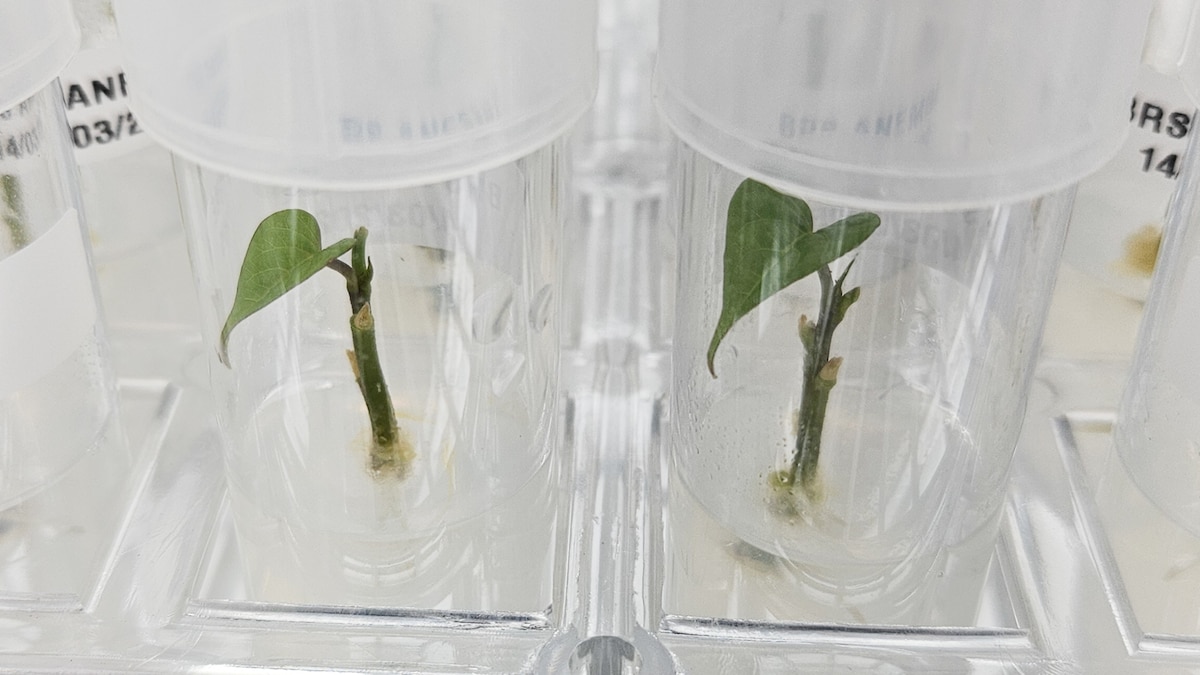
Last year, the Space Farming Brazil Network dispatched their first crop subjects— sweet-potato plants and chickpea seeds—to the edge of space on a Blue Origin rocket. They were variants from Embrapa’s collection, already enhanced to be more productive and nutritious. (Researchers are still waiting for these samples to arrive in Brazil for study, Fávero says.)
As the project grows, the team’s space-bound setups will undergo trials at the National Institute for Space Research (INPE) in São José dos Campos, which assembles and tests satellites before launch. The laboratory houses several machines that simulate the space environment, giving hardware a preview of the unfathomable cold that awaits them; the largest of these thermal-vacuum chambers is the size of a barn. Here, unassuming doors lead to other cavernous rooms, where the technical infrastructure produces almost magical effects. In the anechoic chamber, the walls are covered with thousands of spiky pieces of foam that expertly absorb sound waves, leaving behind a pure, echoless silence.