

The Artificial Intelligence Arms Race: America Is Spending Billions, But China May Have Found a Cheaper Way to Win

The competition between the United States and China to build the world’s most capable artificial intelligence models has evolved from an American-led race into an effective two-horse contest. For much of the generative AI era, the United States appeared to hold a comfortable lead. American companies developed many of the most advanced foundation models, attracted enormous amounts of private capital, controlled much of the cloud infrastructure on which those models ran, and benefited from privileged access to the world’s most advanced AI chips. China, meanwhile, possesses enormous engineering talent, a vast domestic technology market, strong government support, and a large research base, but generally appeared to trail the United States at the frontier.
That distinction has become much harder to sustain. Stanford University’s 2026 AI Index reports that U.S. and Chinese models have repeatedly traded places near the top of performance rankings since early 2025. As of March 2026, the leading U.S. model held only a 2.7% advantage over the leading Chinese model. Stanford nevertheless cautions that benchmarks are becoming less reliable, citing evidence of invalid questions and potential benchmark gaming. In other words, the numerical gap should not be taken as a precise measure of real-world superiority. It does, however, demonstrate how dramatically the competitive landscape has changed.
The most significant development in the race was the emergence of Chinese models such as DeepSeek. DeepSeek-R1’s performance in early 2025 challenged the assumption that frontier AI required an unlimited supply of the newest and most expensive American-designed chips. The lesson was not simply that China could build a powerful model. Rather, it was that algorithmic efficiency, model architecture, and engineering ingenuity could partially offset restrictions on computing resources. Newer Chinese systems, including models from Alibaba, Z.ai, Moonshot, and other developers, have since reinforced that insight.
In a July 2026 study, the Center for Strategic and International Studies (CSIS) in Stanford, CA, found that Chinese models can compete with U.S. systems on many real-world tasks, particularly when cost and openness are considered alongside raw benchmark performance. For example, the latest Kimi K3 model, developed by the Beijing-based startup Moonshot, has earned respect from the best versions of Anthropic’s Claude and OpenAI’s ChatGPT. For this reason, reputable U.S. business media outlets like CNBC opined in August 2026 that the U.S. lead over China in AI models is all but gone!
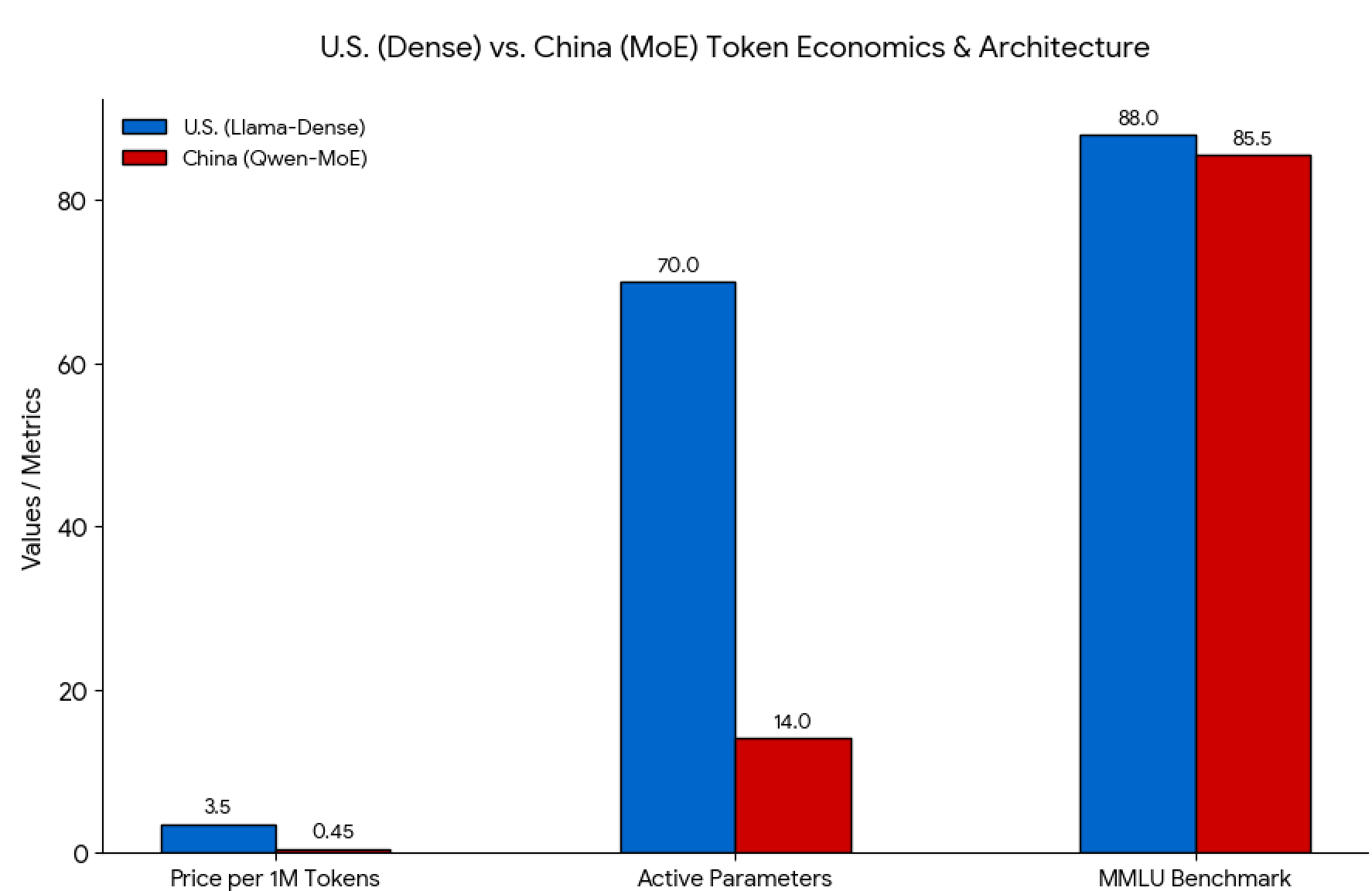
Source: Artificial Analysis
The competition now hinges on two distinct strategies. The U.S. approach remains heavily oriented toward advancing the frontier of raw intelligence. American companies have enormous financial resources and are building increasingly large data centers, sophisticated networking systems, and massive computing clusters. The underlying philosophy is straightforward: if more computing power can produce better reasoning, greater reliability, and more capable AI agents, then build more computing power. This is an expensive strategy, but it allows American companies to keep pushing the technological ceiling.
In contrast, China’s strategy has increasingly focused on efficiency and diffusion. This suggests that the U.S. has emphasized a vertical pursuit of “frontier intelligence,” while China’s strategy has relied on a horizontal pursuit of “ecosystem density.” Chinese companies have relied heavily on open-weight models, efficient architectures, and lower-cost deployment. DeepSeek’s sparse mixture-of-experts architecture exemplifies this philosophy. Rather than activating every parameter for every task, sparse models selectively use portions of the network. The result can be substantially lower computational cost for a given level of performance. A Bloomberg survey of Chinese AI models on August 20, 2026, found that many of the latest Chinese models could duplicate U.S. AI models at an average cost 87% lower than comparable U.S. models!
Securing energy sources to power energy-intensive data centers has proven crucial in this AI arms race, and on this front, China has a long-term advantage. Along these lines, China expects the AI competitive race will not be won by producing the smartest models or the most advanced microchips, but by possessing the most powerful physical and digital infrastructure, supported by the $3.8 trillion-dollar Six Networks initiative, an integral part of China’s Five-Year Plan! This initiative seeks to upgrade China’s physical and digital infrastructure and spans six areas, including electricity, water, telecommunications, computing, logistics, and underground pipe networks.
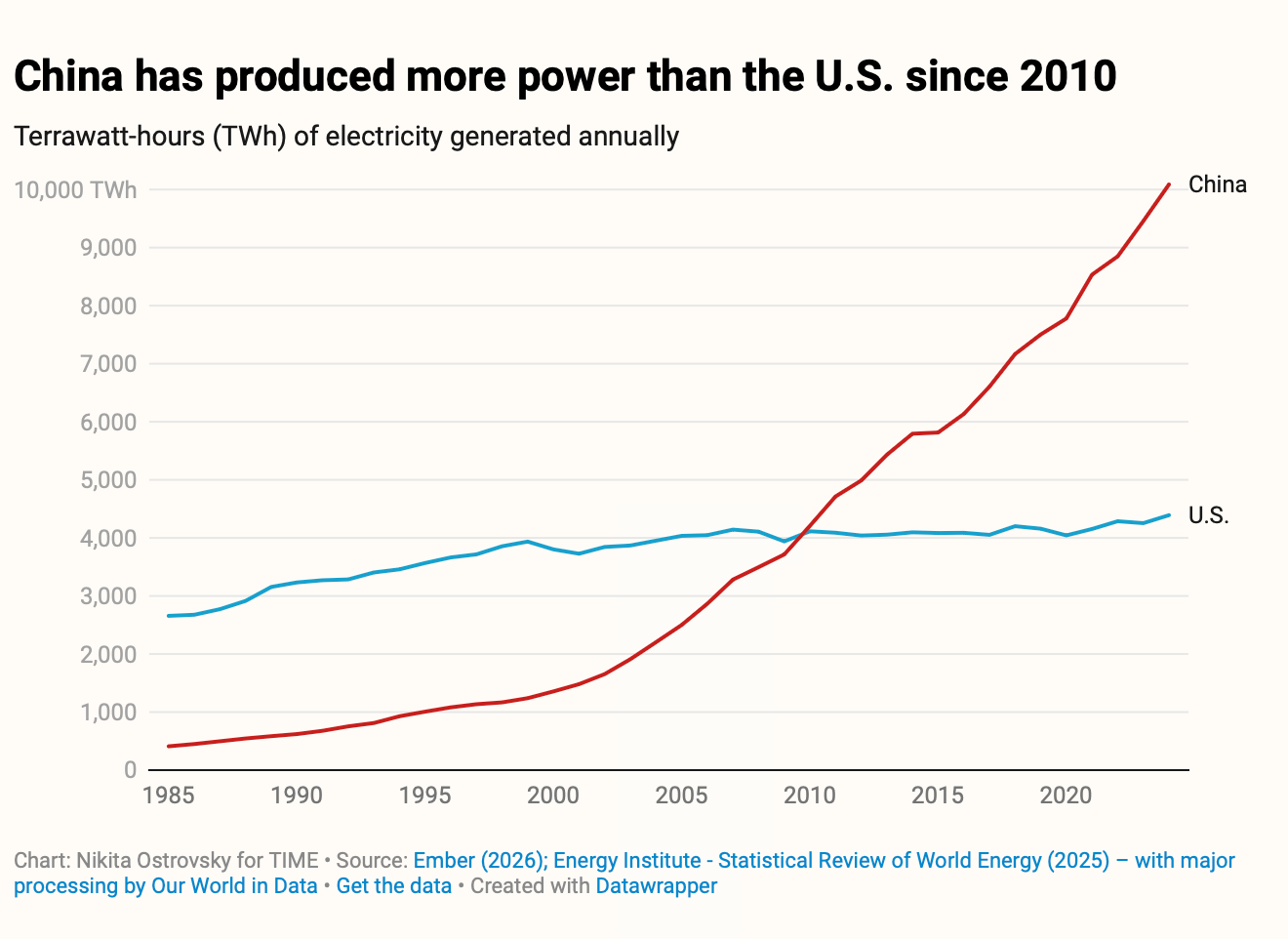
Source: Time Magazine
This distinction is important because the AI race is not simply about which country can produce the smartest model in a laboratory. It is also about which country’s models are adopted across businesses, governments, software applications, robotics, manufacturing systems, and everyday consumer products. A model that is 2% better but several times more expensive may not necessarily win the commercial market. This is where China has a competitive advantage: a less expensive model that is only slightly less powerful but easier to download and customize can become the model of choice for many companies. This is where China has developed a potentially significant advantage.
Chinese companies have embraced open-weight distribution more aggressively than many leading U.S. frontier laboratories. Models such as Alibaba’s Qwen and DeepSeek can be accessed across multiple platforms and, depending on licensing and configuration, deployed locally. This has eased concerns about data sovereignty by giving companies greater control over their AI infrastructure at an affordable price.
Not surprisingly, CSIS notes that Chinese models are increasingly attractive because they combine capability with lower cost and openness. Chinese models have also gained substantial traction on developer platforms, underscoring that their influence is no longer confined to China’s domestic market.
China’s Lower Costs of Compute
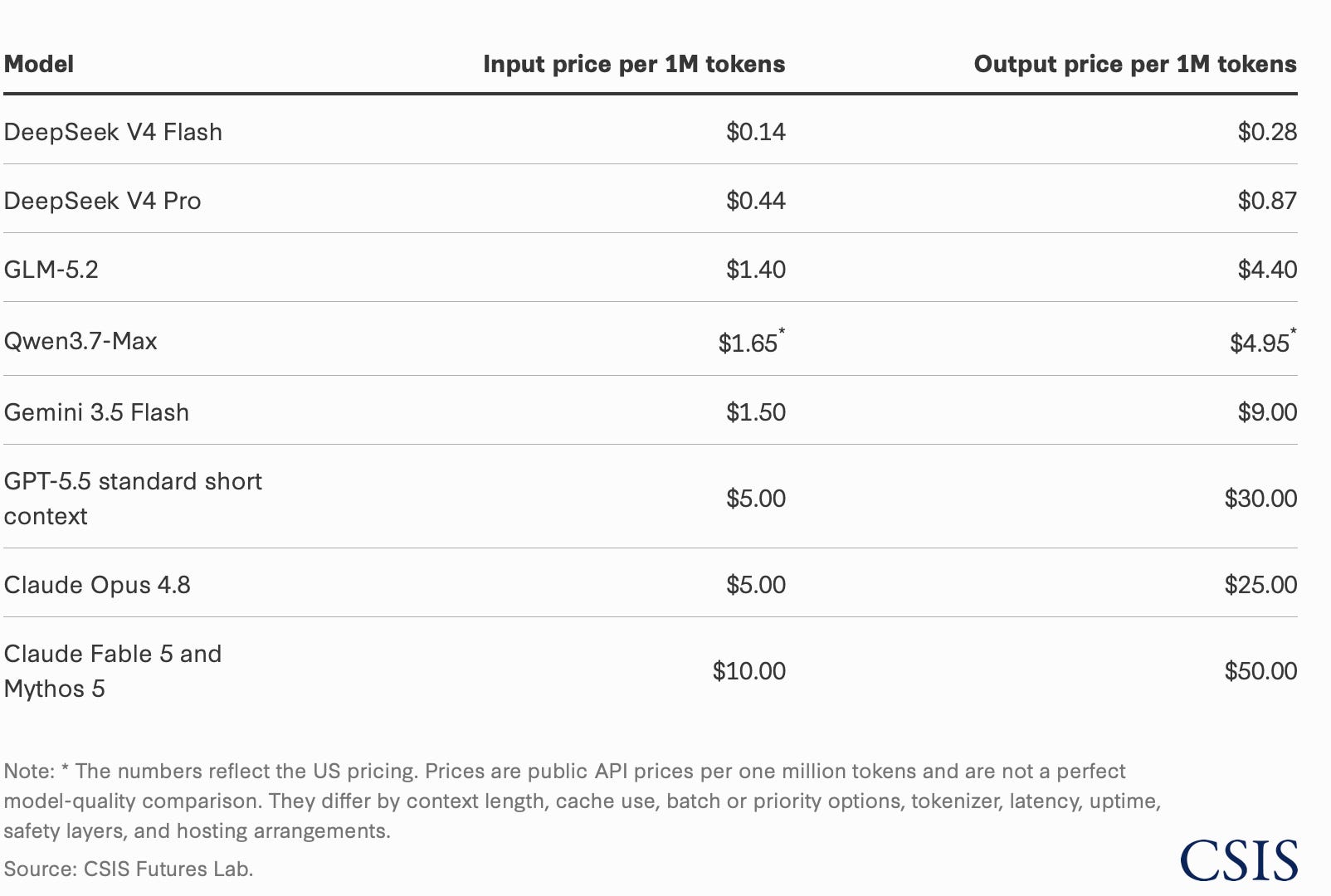
Source: Time Magazine
Of course, the United States has some advantages of its own. The most obvious is capital. Stanford estimates that U.S. private AI investment reached about $285.9 billion in 2025, compared with $12.4 billion in China. That is an extraordinary difference. At the same time, Stanford cautions that private investment figures do not capture the full scale of China’s state-directed AI financing, so the comparison should not be taken as a complete accounting of national AI spending.
America also retains a major infrastructure advantage. The United States hosts thousands of data centers and a deep ecosystem that includes hyperscale cloud providers, semiconductor designers, advanced networking companies, universities, and venture capital firms. Stanford reports that the United States hosts 5,427 data centers, more than ten times the number in any other country. That infrastructure provides an important foundation for training and deploying increasingly computationally intensive AI systems.
The U.S. also remains ahead in producing the most notable frontier models. Stanford reports that industry produced more than 90% of notable AI models in 2025, with the United States retaining an advantage in the number of top-tier models and higher-impact patents. Nonetheless, China retains a commanding lead in publication volume, citations, and patent output. This illustrates an important asymmetry: America remains particularly strong at converting research and capital into frontier commercial products, while China has enormous research scale and increasingly sophisticated engineering capabilities.
Still, China must continue to contend with a disadvantage in computing hardware, as U.S. export controls have restricted Chinese access to some of the most advanced AI accelerators. This creates a structural constraint because frontier models increasingly require enormous amounts of computation not only for training but also for inference and reasoning. Chinese engineers have responded by improving algorithmic efficiency and developing domestic alternatives, but efficiency cannot indefinitely substitute for large quantities of cutting-edge computing power.
This forms what might be called the “compute wall.” If frontier AI increasingly relies on exponentially more computing power, the importance of America’s access to advanced chips, data centers, and capital cannot be overstated. However, if China maintains its edge in algorithmic innovation—which reduces the computing needed for certain levels of intelligence—then China’s hardware improvements could boost its capabilities and potentially shape the next stage of the global AI race.
Nonetheless, the United States faces its own vulnerabilities. The cost of maintaining leadership at the frontier is rising rapidly. AI companies and hyperscalers are investing enormous sums in data centers, power, networking, and semiconductor capacity. Stanford reports that compute spending and infrastructure investment have reached record levels even as AI revenues have grown rapidly. The American strategy therefore carries substantial economic risk: companies must convert enormous capital expenditures into sustainable commercial returns.
America also faces a potential talent challenge. The United States remains home to more AI researchers and developers than any other country. However, Stanford reports that the flow of AI talent into the United States has declined sharply from its earlier peak. Maintaining America’s advantage may therefore depend not only on computing infrastructure but also on the ability to attract and retain the world’s best researchers and engineers.
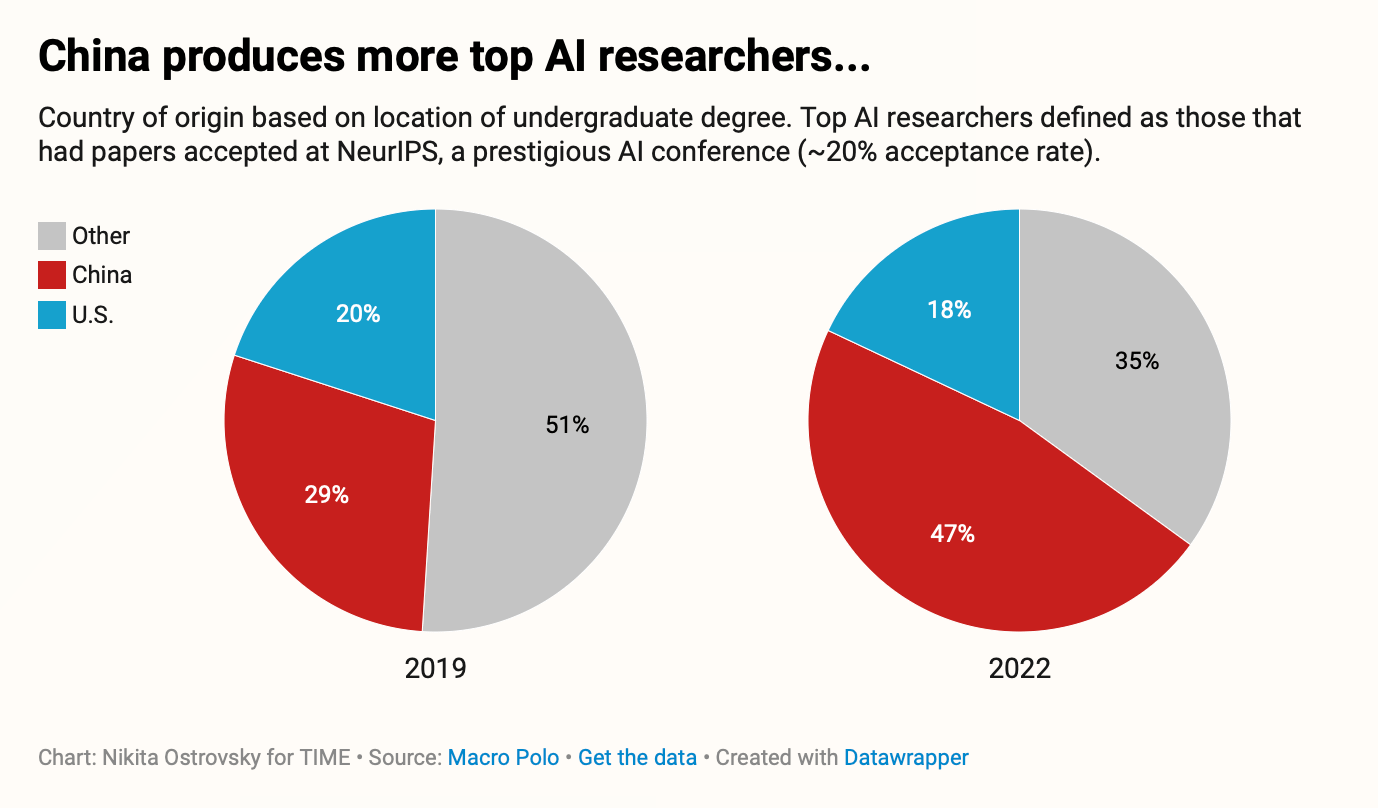
Source: Time Magazine
In contrast, China maintains an advantage in industrial deployment. Its vast manufacturing base provides a natural environment for embedding AI across factories, logistics, autonomous systems, and robotics. Stanford reports that China leads the United States in industrial robot installations. If the next phase of AI competition shifts beyond chatbots and toward physical automation, China’s manufacturing ecosystem could be a major advantage.
The two countries’ regulatory systems also create distinct strengths and weaknesses. China’s centralized regulatory structure can limit public-facing models, particularly by restricting the range of information available to them. The U.S. system is more decentralized and market-driven, giving companies greater latitude to experiment but also exposing them to other constraints, such as litigation, fragmented state regulation, and changing policy requirements. Neither system is free of regulatory constraints!
One year from today, the most likely outcome is not a decisive American or Chinese victory but continued near-parity at the model level. Chinese developers are likely to continue narrowing the gap in coding, reasoning and multimodal capabilities, while American developers continue to push the frontier forward. If that happens, the distinction between the two ecosystems may increasingly be determined by price, reliability, openness and deployment rather than benchmark scores alone.
Within two years, the race could begin to diverge more clearly. The United States may increasingly focus on massive frontier systems that require unprecedented computing power. At the same time, China is likely to focus on efficient models embedded in robotics, manufacturing, edge devices, and enterprise applications. That would not mean China had lost the frontier race. It would mean the definition of “winning” had shifted from building the single smartest model to controlling large portions of the AI ecosystem.
In five years, a key development might be the rise of two distinct global AI ecosystems. The United States could remain the leading provider of cutting-edge cloud AI, backed by large capital markets, sophisticated chips, massive data centers, and top AI firms. Meanwhile, China might lead as the primary source of affordable, open-weight, locally deployable AI, especially in manufacturing-heavy economies and parts of the Global South. This scenario would reflect a technological split rather than a clear victory for either country.
Summary and Concluding Thoughts
Looking ahead, both countries appear likely to converge as Chinese firms overcome hardware constraints through domestic semiconductor advances and continued algorithmic innovation. In turn, American companies are likely to respond to Chinese open-weight competition by lowering prices and releasing more capable models for developers. Competition could therefore produce a global AI market in which American and Chinese innovations continually borrow from, compete with, and improve upon each other.
Therefore, the preponderance of evidence suggests that the U.S.-China AI race should no longer be viewed as a simple contest between China and the U.S. The gap in model capabilities has narrowed dramatically, while differences in capital, computing infrastructure, openness, cost, and industrial deployment remain substantial. Stanford’s 2.7% performance gap matters, but it represents only one metric of success.
The United States remains dominant in frontier infrastructure, private investment, and leading model production. Meanwhile, China has become a strong contender in model efficiency, open-weight deployment, research, and industrial use. In the coming years, the key question may not be which nation creates the most advanced model, but which one successfully combines intelligence, cost-effectiveness, computing infrastructure, talent, and global reach.
The competition between China and the United States has entered a new phase. America still has the resources to lead at the frontier, but China has shown it need not duplicate America’s strategy to win. If the United States is the high-performance racehorse built for maximum speed, China increasingly resembles a highly efficient competitor built to run farther on fewer resources. The winner may ultimately be determined not by who reaches the next benchmark first, but by who can turn AI capability into a durable economic and technological ecosystem.
China appears to be taking the lead in this area of the race!