

Switch to ethical sourcing rises global demand for Tanzania’s organic cotton
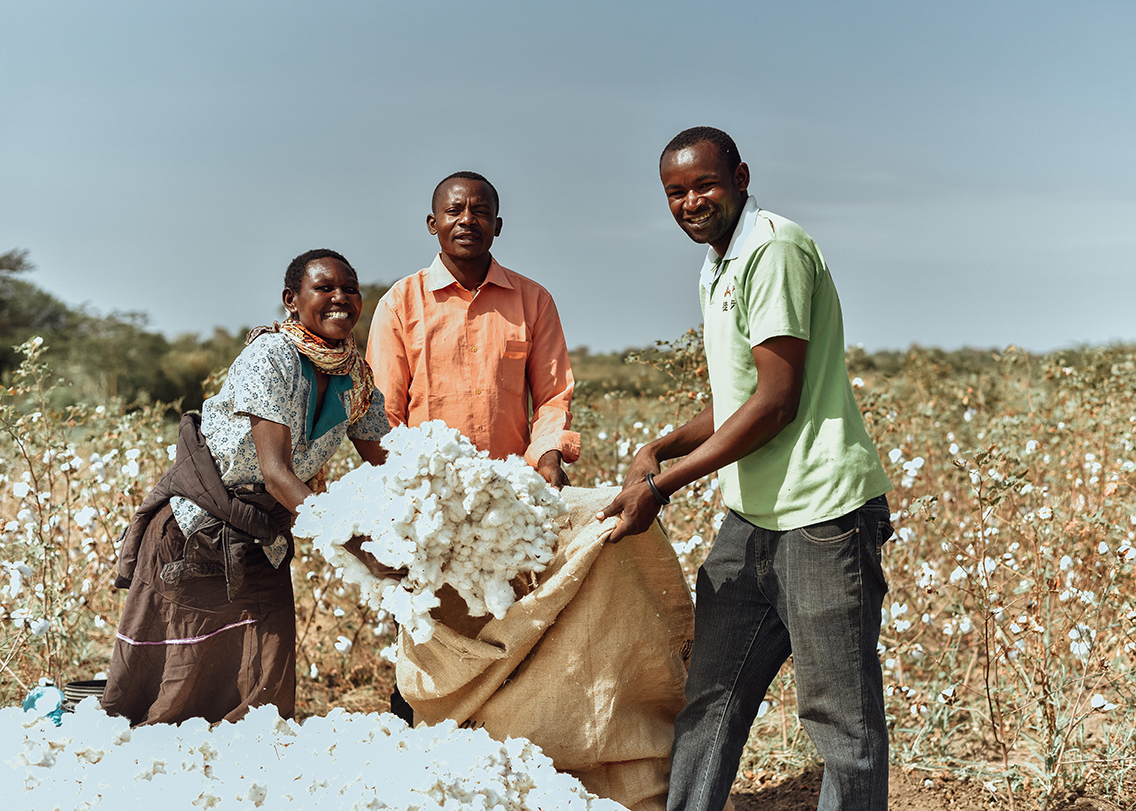
The environmental toll of conventional cotton farming has prompted a shift among global fashion and retail brands towards organic, sustainable sourcing. Demand has been rising steadily, and Tanzania has emerged as one of the world’s prime suppliers. But climate change threatens an industry that could be worth $2bn.
The Simiyu region in northern Tanzania is famed not only for the Serengeti National Park and its annual wildebeest migration, but also for its growing reputation as a hub for sustainable agriculture. The region has become the epicentre of organic cotton farming in Tanzania, helping cement the country’s status as Africa’s leading producer of certified organic cotton.
According to Anamringi Macha, Simiyu’s Regional Commissioner, organic cotton output has grown from 10,300 tonnes in 2021/22 to 12,285 tonnes in 2022/23. This, he says, places Tanzania among the top global producers, alongside market leaders such as China, India, Turkey and Tajikistan.
Organic cotton differs fundamentally from conventional cotton in that it is cultivated exclusively from non-genetically modified seeds and without synthetic pesticides, herbicides, or fertilisers. Farmers rely instead on natural processes – like crop rotation, composting, and biological pest control – to maintain soil fertility and protect local ecosystems. They typically operate through cooperatives, whilst certification is handled by independent auditors under international organic standards.
By contrast, conventional cotton often relies on monoculture – planting cotton on the same land year after year – supported by heavy use of synthetic fertilisers and pesticides. Over time, this degrades the soil and adversely impacts its ability to retain water.
The steep environmental toll of conventional cotton farming has prompted a shift among some global fashion and retail brands towards sustainable sourcing. As a result, demand for organic cotton has grown steadily over the years, with Tanzania emerging as a key supplier to international buyers seeking ethically produced fibre.
Rapid Rise
Tanzania’s organic cotton journey began in the mid 1990s, when NGOs and local cooperatives launched pilot projects in Simiyu and neighbouring regions to test pesticide-free cultivation. The model gained traction in the 2000s, and by the mid 2010s, Tanzania had become Africa’s largest certified organic producer, with thousands of smallholder farmers trained in ecological farming techniques.
Analysts expect Tanzania’s organic cotton farming sector to benefit from a continued rise in demand for ethically sourced fibre in the years ahead. According to 6Wresearch, Tanzania’s organic cotton market was estimated at $1.44bn in 2025 and is projected to reach $2.05bn by 2032, growing at a compound annual growth rate (CAGR) of 5.1% during this period.
“This growth trajectory is fuelled by increasing global consumer demand for sustainable and eco-friendly textiles. As awareness of sustainable farming practices rises, more smallholder farmers in Tanzania are adopting organic methods, further enhancing the country’s capacity to meet this burgeoning demand,” the research firm notes.
The promise of more inclusive growth
One of the more uncomfortable truths about cotton farming – whether conventional or organic – is the precarious socioeconomic position most smallholder farms find themselves in
In Tanzania and across much of Africa, these farmers often remain trapped in poverty despite years of toil. High input costs, barriers to market access, limited access to formal financial services, volatile global commodity prices, and mounting climate-related losses combine to erode their incomes and keep them poor.
Experts argue that given the premium that buyers are willing to pay for certified fibre, organic cotton offers an opportunity for more inclusive growth. Certification also typically comes with added support to the farmer to help them through the transition from conventional cotton to organic varieties.
In Tanzania, schemes such as Cotton made in Africa (CmiA Organic) connect smallholders directly to international textile buyers committed to ethical sourcing. Through these partnerships, farmers gain access to stable contracts and better prices, shielding them from the volatility that plagues conventional cotton markets.
Under the CmiA Organic framework, certified farmers receive a premium of 10 to 20% above the standard farmgate price. This premium is paid through cooperatives and distributed as both cash bonuses and community investments, helping to fund village schools, water wells, and training centres. The model ensures that the benefits of sustainability reach beyond individual households to strengthen entire farming communities.
Moving from conventional to organic cotton is not instantaneous. Farmers must undergo a three-year transition period during which their fields are monitored to ensure that all synthetic inputs are phased out, and soil health is restored. During this time, yields may temporarily dip, and cotton cannot yet be sold as organic, posing a serious income challenge for families who depend on cotton as their sole cash crop.
To bridge this gap, NGOs and buyers working under the CmiA Organic umbrella in Tanzania provide technical and financial support. Farmers receive training in composting, pest management, and crop diversification, along with access to microcredit and guaranteed purchase agreements. Extension officers visit regularly to guide them through compliance requirements and record-keeping.
By the end of the transition, farmers emerge with healthier soils, lower input costs, and access to a lucrative export market that rewards sustainability. Certification thus becomes both a shield against poverty and a lever for empowerment. The Aid by Trade Foundation, which handles CmiA standards, reports that it has certified 9,000 tonnes of Tanzania’s organic cotton,
According to the Organic Cotton Accelerator, a global initiative founded in 2016 to strengthen the integrity and profitability of the organic cotton sector, the success of the model boils down to economics.
“Farmers moving away from synthetic inputs often see yields drop before the soil recovers and organic practices fully take hold. Without price premiums and forward purchase commitments from brands, this period is simply too risky for most smallholders to absorb on their own,” it says.
“Income is the starting point. Everything else follows from that. If organic cotton doesn’t pay, farmers don’t stay with it. It’s that straightforward,” it adds. “The broader environmental benefits of organic farming are real. Healthier soils, less chemical runoff, lower emissions. But for a smallholder farmer in a low-income context, these don’t translate into immediate financial returns.”
Climate change poses a growing threat
All of Tanzania’s organic cotton is rain-fed, a reflection of the limited irrigation infrastructure available to smallholder farmers. While organic certification does not strictly require that cotton to depend solely on rainfall, advocates say the practice helps ease pressure on local water sources and keeps production environmentally sustainable.
Yet this dependence on rain has a darker side; it exposes farmers to increasingly erratic rainfall patterns driven by climate change.
For generations, farmers have relied on traditional knowledge of the seasons, passed down over generations, to determine when to plant. For the most part this has worked. But those rhythms are now breaking down. Rains that once arrived predictably now come weeks late or in false starts, with brief downpours that trick farmers into early planting followed by long dry spells that kill young seedlings.
The harvest season also brings its own risks. Cotton requires dry conditions for the exposed lint to be picked clean. When unseasonal, torrential rains strike late in the cycle, they can stain or rot the fibre before it reaches the gin, slashing both quality and income.
Beyond the challenge posed by erratic rainfall, rising temperatures combined with sudden droughts deplete moisture in the soil, preventing the development of healthy cotton bolls. Cotton requires stable moisture, particularly during its flowering phase. This yet again illustrates the mounting challenges posed by climate change and the corresponding need to scale up adaptation efforts to cushion smallholder farmers who rely on the crop for their livelihoods.
Crédito: Link de origem