

Sudan Youth Parliament warns of ‘deepening de facto partition’
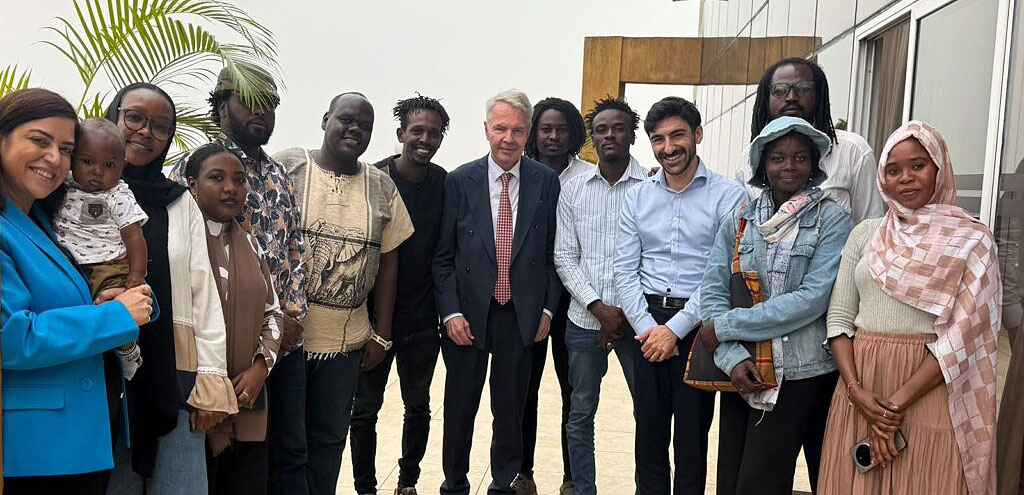
As political initiatives for Sudan multiply and fears grow that the country’s military divide could harden into a lasting political and institutional reality, the Sudan Youth Parliament has unveiled a new strategy for September 2026 to September 2028, placing grassroots groups, young people, and women at the centre of its vision for resolving the crisis.
The strategy was launched on 30 August, the International Day of the Victims of Enforced Disappearance, as the country enters its fourth year of war. The parliament says the conflict has reshaped Sudan’s political and social geography, while creating increasingly entrenched divisions on the ground.
The strategy comes as army chief and Sovereignty Council chair Abdelfattah El Burhan pushes for an internal Sudanese dialogue, alongside continuing regional and international efforts to secure a ceasefire and political settlement.
A pivotal moment
The secretary-general of the Sudan Youth Parliament, Mundhir Mustafa, describes the publication of the document as coming at a “very pivotal” moment, as Burhan seeks to establish an internal political dialogue outside the international and regional mechanisms that have been working to facilitate Sudan’s political process.
Mustafa tells Dabanga that pursuing this course could prompt the Rapid Support Forces (RSF) to take parallel political steps, creating two competing authorities and political projects, and threatening to reproduce the division rather than produce a unified process to end the war.
The Sudan Youth Parliament fears, Mustafa says, that the Quad and Quintet tracks could somehow be absorbed into parallel domestic political efforts, rather than leading to a single process bringing Sudanese parties together around a clear path to end the war.
The Quad consists of the United States, Saudi Arabia, the United Arab Emirates, and Egypt. The Quintet comprises the African Union, IGAD, the Arab League, the European Union, and the United Nations.
From direct fighting to institutional division
The document starts from the assessment that the war has moved beyond direct military confrontations into a more complex reality in which military control overlaps with the construction of parallel institutions and authorities, while the nature of the fighting itself is changing.
Taj El Sir Anwar, chairman of the parliament for 2024–26, says the period from autumn 2025 to summer 2026 has seen a shift from direct confrontations to what he describes as “urban war of attrition”, alongside increased use of attack drones and changing military tactics.
Mustafa Bush, chairman of the Representation and Elections Committee, says the continuing fighting has entrenched a de facto geographical and institutional division between two central authorities: one based in Port Sudan and controlled by the army and its allies, and the other in Nyala, linked to the RSF and the Tasees council.
The document identifies the most serious danger facing the country over the next two years as the transformation of this temporary, war-imposed division into a more permanent political and institutional reality that will be harder to reverse.
Foreign interests deepen the crisis
The document also links this domestic reality to the impact of foreign intervention on the course of the war.
El Fatih El Nour, rapporteur and chairman of the Obstacles Removal Committee, says the map of foreign intervention in Sudan reflects a convergence of conflicting strategic, security, and economic interests. These interests, he argues, have deepened regional alignments and made the conflict more complicated.
The document says the intersection of these interests with continued external support for the parties to the conflict has made a unified political process harder to achieve, tying the fate of a Sudanese settlement to multiple regional and international calculations.
Multiple mediators, competing tracks
The document devotes considerable attention to regional and international mediation efforts, arguing that their proliferation has so far failed to strengthen the political process.
Omar Shoul, chairman of the Activities and Events Committee, says the architecture of mediation over Sudan suffers from “fragmentation and structural contradictions” between different initiatives, weakening the prospects of reaching a unified framework for ending the war.
Abdullah Quraida, chairman of the Training and Studies Committee, says the Quad track focuses more heavily on a humanitarian truce, a ceasefire, and direct negotiations with the military parties.
Abdel Halim Adam, a candidate for chair of the Foreign Relations Committee, says the Quintet track represents, in the parliament’s view, a broader political framework for a comprehensive civilian solution.
Mohamed El Bakhit, director of the Political Representation Office, meanwhile criticises the dialogue initiative proposed by the army leadership in Port Sudan, arguing that it represents an internal track that does not address the roots of the crisis or guarantee an inclusive political process.
Fears of two entrenched authorities
The document puts the possibility of the current division continuing among the main risks facing Sudan over the next two years.
It sets out five possible scenarios for the country over the next 24 months, placing “hardened de facto partition” at the top, with a probability of 40 per cent.
Under this scenario, the parliament says, de facto authorities continue to operate in areas under their control and develop their political and institutional structures separately, making the division increasingly difficult to resolve.
The parliament links this possibility to stalled political initiatives, continuing military operations, multiple centres of decision-making, and growing foreign intervention. It also points to the risk that parallel domestic initiatives could become political umbrellas for authorities controlling territory, rather than mechanisms for ending the division.
Grassroots groups fill the state vacuum
Against the conflict between military and political forces, the document places considerable weight on the role played by grassroots groups since the war began.
Mustafa tells Radio Dabanga that emergency response rooms, women’s initiatives, youth groups, and other local networks have played what he describes as a “heroic” role in maintaining community cohesion and providing services and relief, during periods when state institutions and the warring parties have retreated from their responsibilities towards civilians.
Mustafa argues that supporting these groups is no longer simply a humanitarian issue, but is directly linked to the future of the political process and the unity of the country.
The document places this role within the context of a wider humanitarian crisis, saying that 19.5m people face acute food insecurity, while more than 135,000 people are in the catastrophe and famine phase.
Limited funding, calls for greater support
Mustafa says current funding available to grassroots groups amounts to only about 20 per cent of actual needs arising from the crisis, arguing that this level of support does not match the scale of the role they play.
He says increasing support for emergency response rooms, women’s and youth initiatives, and other local networks is essential to preserving Sudan’s unity and accelerating the restoration of stability.
Strengthening these groups could also help shift the centre of political activity away from traditional elites and institutions towards a broader civilian base more closely connected to communities affected by the war, he says.
Shifting the centre of political power
The Sudan Youth Parliament’s vision goes beyond supporting humanitarian work, seeking instead to give these groups a greater role in political decision-making.
Mustafa says the parliament intends during its next term to create greater space for representation by emergency response rooms, women’s and youth groups, and other grassroots forces, and to establish a safe and effective route for their participation in the political process.
Restoring stability in Sudan requires “shifting the centre of political activity to a civilian centre”, he says, so that the forces that have sustained communities during the war become an essential part of determining the shape of the coming peace and transition.
He adds that a genuine end to the war and the beginning of a new political transition will not be possible, in his view, without greater support for grassroots groups and giving them a meaningful place in the political process.
This vision is based on the belief that traditional civilian forces alone will not be able to rebuild the political process unless the networks that have emerged within local communities during the years of war are included.
A new term for the Sudan Youth Parliament
The document also has an internal dimension, coming as the Sudan Youth Parliament’s first electoral term approaches its end. The term began in September 2024 and ends in September 2026.
The parliament is preparing for a new term running until September 2028, which is expected to bring substantial changes to its leadership and structures.
Muawiya Mohamed Adam, a candidate for deputy secretary-general, says the parliament is entering its second term with accumulated institutional foundations and legitimacy gained on the ground, which he sees as a basis for implementing its new strategy.
The new plan includes establishing 18 state-level youth parliaments, creating a secure digital register targeting 5,000 members, and ensuring at least 60 per cent representation for women and displaced people, alongside producing 24 policy papers and human rights monitoring reports.
The parliament also seeks to strengthen what it calls “civilian diplomacy”, with the aim of ensuring representation for young people and grassroots groups in any future arrangements for peace and democratic transition.
Note: This article has been translated from Arabic with the assistance of artificial intelligence tools, and subsequently reviewed and adapted by a human editor before publication.
Credit: Source link