

Springfield event calls for protection of Haitian families | Local
Every morning, Viles Dorsainvil wakes up, prays and asks God for enough courage to make someone else’s life a little better.
It is a heavy request these days.
Dorsainvil, executive director of the Haitian Community Help & Support Center in Springfield, spends his days helping Haitian families navigate an immigration crackdown that has left parents and children crying, students questioning their futures and families afraid they could be separated.
At the same time, he is living through his own uncertainty.
“I used to be a TPS holder, and now I am an asylum seeker myself,” Dorsainvil said. “But the thing is, I cannot let fear overcome me, overcome the work that I do.”
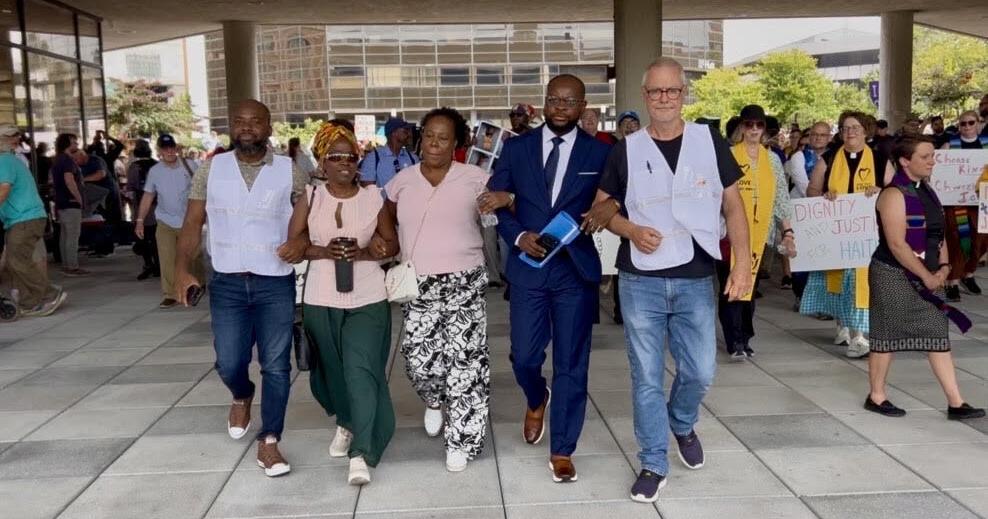
On Sunday, Aug. 30, Dorsainvil was surrounded by people who came to Springfield to tell the city’s Haitian community they do not have to carry that fear alone.
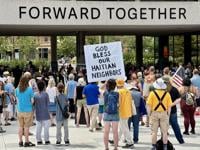
Faith leaders, immigration advocates, Haitian residents and supporters gathered in the hundreds outside Springfield City Hall for “Unshackle Springfield,” an interfaith potluck and gathering focused on the effects of federal immigration enforcement on the city’s Haitian community.
The gathering began with a communal meal and transitioned into prayer, speeches, marching around city hall, singing and calls for changes to federal immigration policy. Organizers said participants traveled from Ohio and across the country, including California, Maryland, Massachusetts, Illinois, Colorado and New York.
“We are not here to condemn anyone,” Pastor Bernadette Dor-Dominique, a Haitian-American minister, teacher and community advocate who serves at Champion City Church, told those gathered. “We are here because we believe in people. We are here because we believe in promises. We are here because we believe in justice. We are here because we believe in compassion. We are here because we believe in human dignity. And above all, we are here because we believe in the power of unity.”

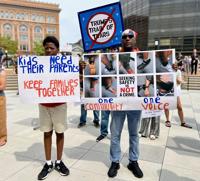
Hundreds gathered at Springfield City Hall Plaza Sunday, Aug. 30, to call for the protection of the city’s Haitian community.
The event came during a period of profound uncertainty for Haitian immigrants in Springfield and across the United States following the end of Temporary Protected Status for roughly 350,000 Haitians.
TPS allows people from designated countries experiencing conditions such as armed conflict or natural disasters to temporarily live and work legally in the United States.
The Trump administration moved to terminate the protections for Haitians, and a U.S. district judge on Aug. 5 lifted an order that had prevented their deportation after the U.S. Supreme Court sided with the administration in June. The Associated Press reported that the first deportation flight following the end of TPS arrived in Haiti Aug. 20 carrying more than 160 people, including former TPS holders. Another flight carrying more than 50 people arrived Thursday.
Those deportations are occurring as Haiti remains engulfed in gang violence and political instability.
The U.S. State Department places Haiti under its highest travel warning — Level 4, “Do Not Travel” — because of crime, kidnapping, terrorism, unrest and limited health care. The department says violent crime is rampant, kidnapping is widespread and the U.S. government’s ability to provide emergency services there is extremely limited.
That contradiction was repeatedly invoked Sunday.
Pastor Carl Ruby of Central Christian Church in Springfield told attendees that people deported to Haiti have been seen getting off planes and “running for their lives.”
The AP reported Thursday that a deportation flight carrying more than 50 people landed in Cap-Haitien rather than Port-au-Prince because Haiti’s main international airport is considered too dangerous. Gang violence has displaced nearly 1.5 million people in Haiti, and more than 3,000 people were reported killed during the first half of this year.
‘Don’t give up on your dream’
For Dorsainvil, the crisis is measured not only in immigration cases and government policies, but in the people who come to his organization looking for help.
The Haitian Community Help & Support Center has documented more than 31 people who have been detained, he said Sunday. Of those cases known to the organization, two people have already been deported.
There are other cases the organization does not know about, he said, and staff members are still working to gather information.
Once someone is deported, Dorsainvil said, communicating with them can become extremely difficult.
“Instead, we speak with the relatives, the wives that they left behind here,” he said.
Dorsainvil said one of the groups he worries about most is young Haitians trying to build futures through education.
He communicates with Haitian students attending Clark State College through WhatsApp groups, encouraging them to continue their education even as the immigration crackdown makes some wonder whether the careers they are studying for will still be possible.
“I would like them to continue to be hopeful for the future,” he said. “I know it is hard for them because they study their career, and all of a sudden there is all this type of immigration crackdown, and they tend to lose hope.”
His message to them is simple:
“Don’t give up. Don’t give up on your dream.”
Even if someone is ultimately deported, Dorsainvil said, he wants that person to remain connected to the Springfield organization.

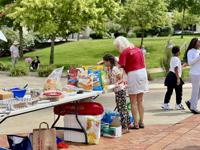
Sunday’s gathering began with a communal meal and transitioned into prayer, speeches, marching around city hall, singing and calls for changes to federal immigration policy.
“We’ll continue to advise you. We’ll continue to guide you through. We’ll continue to be there for you,” he said.
He tells them an old Haitian saying that, translated literally, means that as long as your head has not been cut off, you can still wear a hat.
In other words, he said, “As long as you are alive and waking up each morning, keep pursuing your dream.”
Dorsainvil is trying to follow his own advice.
Along with running the support center and helping families through the immigration crisis, he is a graduate student working on his thesis and taking courses in public administration, fundraising and grant writing.
Sometimes, he said, concentrating long enough to read a chapter or complete an assignment is difficult.
He has his own immigration case to think about. Then there are the families calling for help.
“I have chapters to read. I have homework to submit, and I have all this workload from the community to carry on with,” he said.
So he begins each day with his prayer.
“Give me courage to see this day and do something,” he said he asks God. “Just to do a simple gesture to make someone’s life different.”
“That’s how we go every day.”
Organizers call for an end to ankle monitors
Troy Jackson, executive director of Undivided, said Sunday’s event was assembled in less than a week, with participating organizations and faith communities mobilizing supporters locally and nationally.
The response, he said, demonstrated how strongly people wanted a way to act.
“I think folks are hungry to get involved and do something,” Jackson said.
Organizers outlined several demands Sunday.
Among them was an end to what they described as an expanding use of electronic ankle monitors on Haitian immigrants in Springfield.
Jackson said organizers believe the practice could be a precursor to wider use of electronic monitoring nationally and said it is already having what he described as a “horrific impact” locally.
He said people wearing ankle monitors can become isolated even within immigrant communities because people in mixed-status families may fear being around someone they believe is being monitored by immigration authorities.
Organizers also called for the release of two Haitian pastors they said are currently being held in immigration detention and for a permanent way for people who cannot safely return to their home countries to remain in the United States.

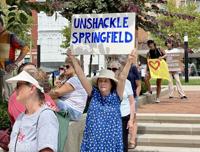
Faith leaders, immigration advocates, Haitian residents and supporters gathered in the hundreds outside Springfield City Hall for “Unshackle Springfield,” an interfaith potluck and public witness focused on the effects of federal immigration enforcement on the city’s Haitian community.
Jackson described the detained pastors as peacemakers and important sources of pastoral care for their communities.
“We just want to provide a permanent way to protect people who are not safe in their home country, are not safe here now,” he said. “That is not our nation at our best or our faith communities at their best.”
Jackson said supporters can contact elected officials, talk about what is happening in Springfield and continue showing up.
The shirts worn by some participants Sunday carried a phrase: “Be a faithful witness.”
“People right now are counting on us to be faithful, and people right now and future generations are going to look for how we responded to this moment,” Jackson said. “We need to say no to hate and indifference, and yes to love.”
‘I’ve never been afraid of my country before’
Some of those who answered that call Sunday came from just down Interstate 70.
Maggie Reck, 82, and Mark Gmeiner, 73, traveled from Dayton to attend.
The two said they support peace and justice efforts in the Dayton area and try to respond when they learn about communities that need support.
For Gmeiner, the situation facing Haitians is particularly difficult to reconcile with the federal government’s own warnings about Haiti.
The United States tells its own citizens not to travel there, he noted.
“But I guess it’s safe enough to send Haitian immigrants back to,” he said. “Which is just so blatantly unjust and horrid that I just felt like I at least wanted to show up.”
Showing up matters even if one person standing outside city hall cannot change federal immigration policy, he said.
“The more people that show up, the less likely it is that people will think nobody cares,” Gmeiner said. “If nobody shows up, then it’s kind of a blank check to the government to do what they want.”


Maggie Reck and Mark Gmeiner traveled from Dayton to attend the Sunday, Aug. 30, “Unshackle Springfield” event at Springfield City Hall.
Reck said visibility can slowly bring people who are not following an issue into the conversation.
As more people participate, she said, others may begin asking what brought them there.
For Reck, the political climate has produced an emotion she said she had never experienced before in eight decades of life.
“I’ve been observing, let’s say over a decade, the changes in attitude in some people, and then how that translates into action, and seeing how that affects society, the flow of society,” she said. “I don’t have an explanation. I can’t put my finger on it, but I see and I feel the effects of what’s been happening.”
Then she put it more simply.
“I’m 82 years old,” Reck said. “I’ve never been afraid of my government before. I’ve never been afraid of my country before, but I am now.”
Still, she has not given up on the possibility of change.
Reck compared movements for peace and justice to water flowing through a stream. Small rocks may barely disturb it. Larger ones can force the water in another direction.
Eventually, she said, the water creates a new path.
“We’re just going forward in love and peace in the way that we’ve been doing a lot of our lives,” she said.
‘I’m not alone’
That sense of solidarity was felt by Michaell, a Haitian woman who asked that her last name not be published.
Michaell has lived in Springfield since 2021.
Asked how Sunday’s event made her feel, she answered with three words:
“I’m not alone.”
Seeing people stand alongside Springfield’s Haitian residents brings “power” and “connection,” she said, and can help change the narrative surrounding the community.
The day’s subject was painful for many, but the event itself was not devoid of happiness.
People prayed. They ate together. They sang.
Michaell sang, too.
For her, there was nothing unusual about carrying joy into a gathering born from fear and uncertainty.
“This is Haitian people,” she said. “Even (when) we suffer, we are in pain, we always keep our joy.”
It is possible, she said, to speak out about suffering without allowing suffering to become the only thing the world sees when it looks at Haitian people.
“We speak up, yes,” she said. “But we always keep our joy.”

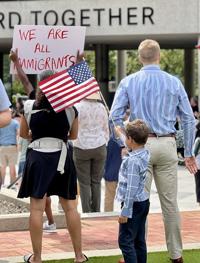
Sunday’s event comes at a time of profound uncertainty for Haitian immigrants in Springfield and across the United States following the end of Temporary Protected Status for roughly 350,000 Haitians.
That was part of the intention behind Sunday’s event, according to organizers, who deliberately structured “Unshackle Springfield” differently from a traditional protest. The first hour was devoted to a potluck, with people of all walks of life sitting together and sharing food, before the “public faith witness” began.
The format, organizers said, was meant to reflect how Springfield residents and faith communities have been responding to the immigration crisis all along, by feeding people, supporting families and continuing to show up for one another.
For Dorsainvil, showing up is something he believes he has to keep doing, even when he is afraid himself.
He sees parents crying.
He sees children crying.
He sees students wondering whether to abandon dreams they have spent years pursuing.
And he carries his own uncertainty about what will happen to him.
“If I try to be courageous,” Dorsainvil said, “it is because of them.”