

Somalia’s Ruling Party Backs Gudlawe for Second Term as Hirshabelle Election Dispute Deepens
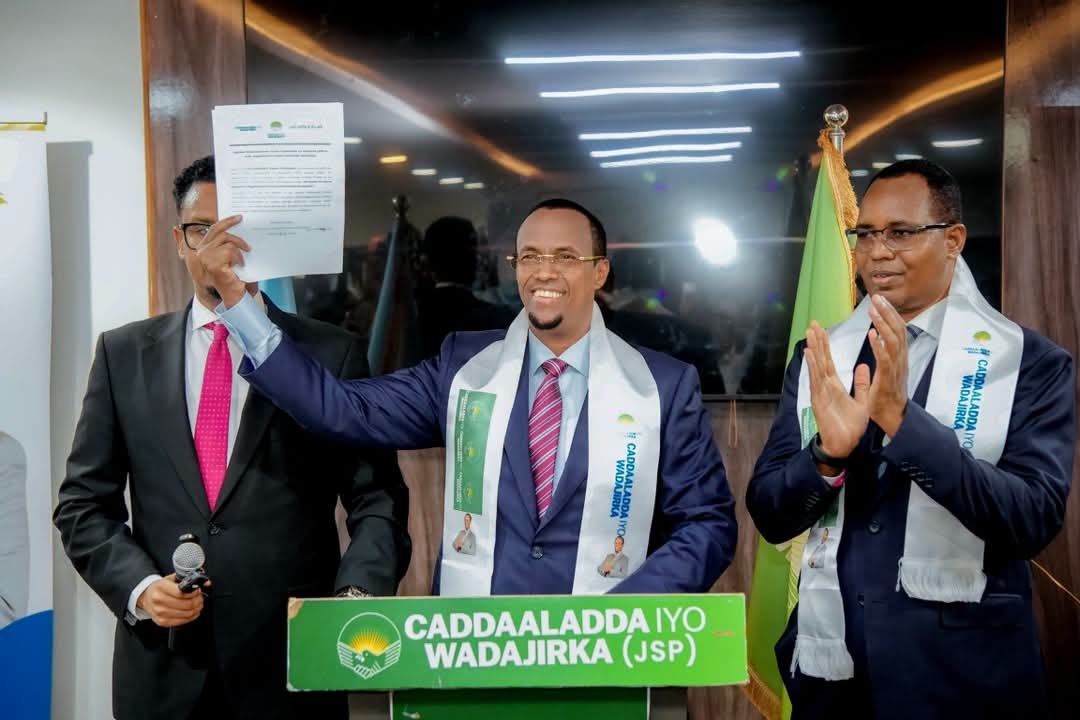
MOGADISHU — Somalia’s ruling Justice and Solidarity Party (JSP) has formally nominated Hirshabelle President Ali Abdullahi Hussein Guudlawe as its candidate for the upcoming regional leadership election, a decision that has intensified political tensions in Hiiraan region where local stakeholders have rejected the electoral process without a prior political agreement.
The JSP Executive Committee approved Guudlawe’s candidacy during a meeting at the party’s headquarters in Mogadishu, chaired by Secretary-General Hussein Sheikh Mohamud. Guudlawe was later presented with a certificate confirming his nomination during a ceremony at the party headquarters.
“The executive committee has decided by majority that Mr Ali Abdullahi Hussein will be the official candidate of the Justice and Solidarity Party in the election for the leadership of HirShabelle State,” JSP said in a statement.
JSP Secretary-General Dr. Hussein Sheikh Mohamud called on party members and supporters to rally behind Guudlawe and prepare for the upcoming election. Speaking at the ceremony, Guudlawe said the period of political rivalry should end and urged political stakeholders to work together to build an inclusive future for Hirshabelle.
Hawadle Clan Rejection and Power-Sharing Dispute
Guudlawe’s nomination has sharpened opposition from senior politicians in Hiiraan who argue that the next Hirshabelle president should come from their region. The dispute dates back to HirShabelle’s formation in 2016 from Hiiraan and Middle Shabelle, when a federal government-brokered agreement designated Jowhar in Middle Shabelle as the state capital and allocated the presidency to the Hawadle, who are predominantly based in Hiiraan.
The arrangement was informal, and the two sides developed different interpretations of how long it should last. Hawadle politicians viewed the presidency as part of a longer-term power-sharing settlement, while Abgaal politicians saw the arrangement as temporary and expected the post to rotate.
Tensions intensified in 2020 when Guudlawe, an Abgaal politician, won the presidency while Jowhar remained the state capital, prompting many Hawadle political figures to argue that Middle Shabelle had secured both of HirShabelle’s most important political assets.
Hirshabelle Vice President Yusuf Ahmed Hagar Dabageed, a Hawadle politician from Hiiraan, has accused President Hassan Sheikh Mohamud of abandoning a political commitment to return the presidency to the Hawadle community. He said Hawadle elders, politicians and business figures had held consultations with the president and understood that a candidate from the community would receive support in the coming leadership transition.
Dabageed said the president later changed his position and decided to back Guudlawe. “I asked him, if I secure the support and seek the seat, what then?” Dabageed said of his conversation with President Hassan Sheikh. “He said, ‘I will give it to Ali Guudlawe.’”
Election Preparations and Opposition
The National Independent Electoral and Boundaries Commission has scheduled polling for September 30 after postponing an earlier August 20 vote. Under the revised timetable, polling stations are due to be announced on September 15, followed by voter registration and the distribution of voter cards from September 16, and verification of candidate lists.
The elections will take place across 12 districts in the Hiiraan and Middle Shabelle regions. In the Hiiraan region, six districts have been designated: Beledweyne, Jalalaqsi, Buulo Burde, Matabaan, Jawiil, and Farlibaax. In the Middle Shabelle region, the six districts are Jowhar, Balcad, Warsheekh, Cadale, Mahadaay, and Raage Ceelle.
Opposition to Guudlawe is not uniform across Hiiraan, however. Regional and district officials, ministers, lawmakers and hundreds of residents held a demonstration in Beledweyne on Saturday in support of JSP and Guudlawe’s expected nomination. An official who addressed the demonstration said participants supported both JSP and Guudlawe’s candidacy, as well as the planned electoral process in Beledweyne.
Dabageed warned on Friday that elections could not proceed in Hiiraan without an agreement involving traditional elders, politicians, civil society groups and other local stakeholders. He said elections could not be held “even in a single village” in Hiiraan without consensus and warned that anyone attempting to proceed without a political settlement would bear responsibility for the consequences.
JSP Dominance and Electoral Credibility
The JSP was formally launched in 2025 with President Hassan Sheikh Mohamud as its leader and presidential candidate, bringing together key federal and regional figures under a single political platform. The party has since become the dominant electoral force in federal member state contests.
In June 2026, all three winning parliamentary candidates in Baidoa belonged to the JSP, and critics have questioned whether the party’s repeated successes reflect genuine popular will or the federal government’s influence over regional electoral processes.
Gudlawe has led Hirshabelle for nearly six years, and his tenure has been marked by both achievements and criticism. He has held the presidency since 2020 and had already declared that he wanted another term. He and President Hassan Sheikh Mohamud come from the same clan, which is why critics in Beledweyne read the endorsement as preference dressed as party procedure.
Critical Note
The formal nomination of Guudlawe as the JSP candidate crystallizes a political dispute that has been building for months. The party’s decision to back the incumbent, despite the informal power-sharing understanding that allocated the presidency to the Hawadle, confirms the fears of Hiiraan politicians that the federal government is prioritizing political expediency over the reconciliation needed to stabilize Hirshabelle. The opposition is not merely about a candidate but about the broader structure of a federal member state that has been contested since its formation.
The dispute also raises questions about the credibility of the electoral process. If the JSP’s victories in regional states are perceived as products of federal influence rather than genuine contests, the legitimacy of the resulting administrations will be undermined. The Macawisley fighters who attacked the voter registration centre in Beledweyne have already signaled their rejection of the process, and the counter-protests show that the political dispute is far from resolved.
For the NIEBC, the challenge is to conduct a vote that is credible and inclusive despite these tensions. For the federal government, the test is whether it can secure its preferred outcome without alienating the Hawadle community and fueling further resistance. The coming weeks will determine whether the September 30 election can proceed peacefully or whether the political dispute escalates into a crisis that could destabilize the region.
Recommended Reading On ftlsomalia.com
Credit: Source link