

‘Shark graveyard’ in Egypt’s Western Desert reveals a lost tropical sea from the age of the dinosaurs
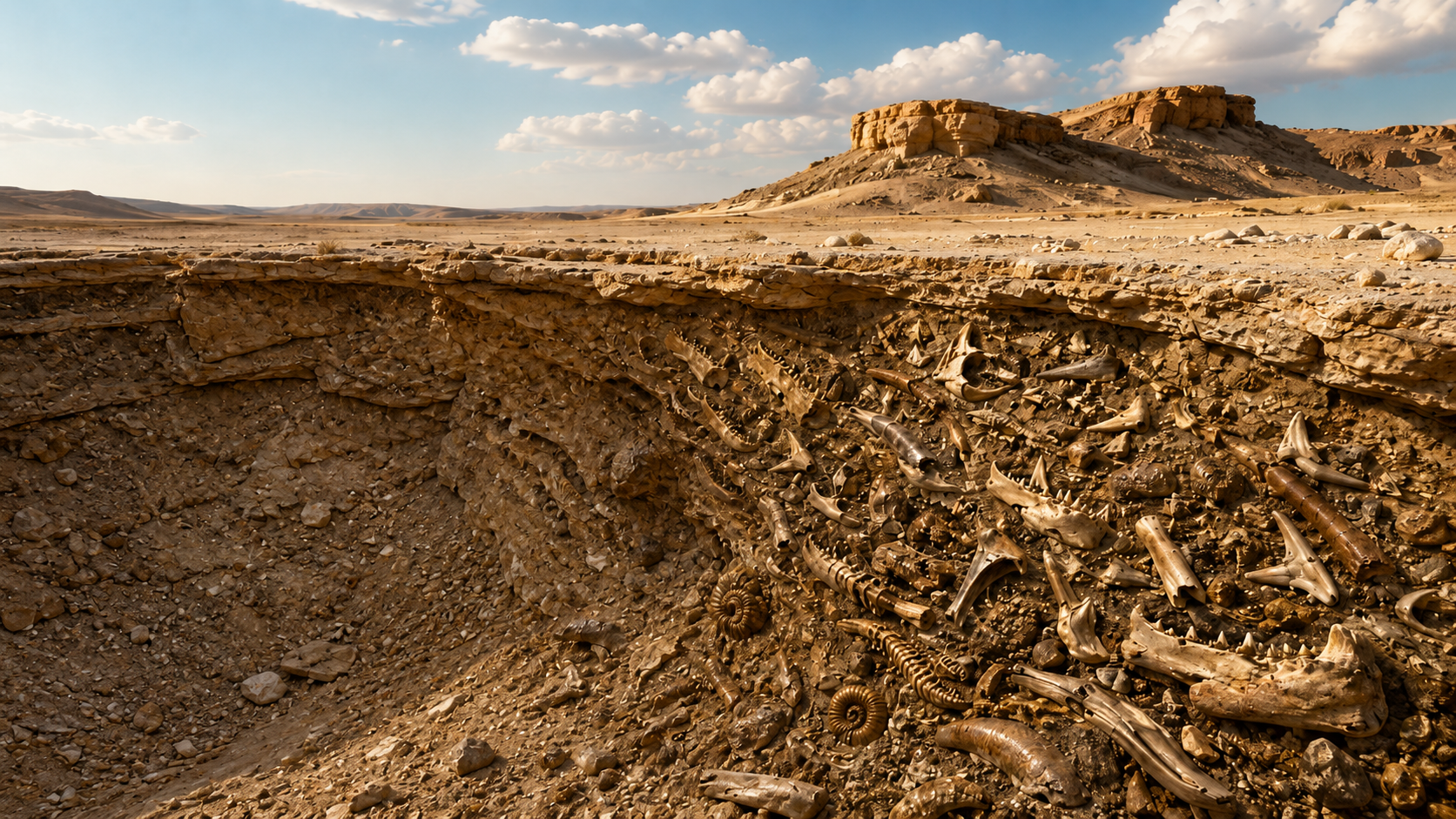
- Fourteen fossil teeth from Egypt’s Western Desert reveal five extinct shark species that once lived in a tropical sea during the Late Cretaceous.
- Two species had never before been reported in Egypt, while another may represent the first African record and youngest known occurrence of its kind.
- The fossils raise the known shark diversity at Abu-Tartur to at least seven species and point to a nutrient-rich marine ecosystem filled with predators.
Today, the Abu-Tartur Plateau sits within Egypt’s dry Western Desert. About 70 million years ago, the scene looked very different.
Warm seawater covered the region, and sharks hunted above a seafloor where marine remains accumulated in phosphate-rich sediments. Fourteen fossil teeth recovered from those rocks now reveal a surprisingly diverse predator community from that vanished sea.
The fossils represent at least five extinct species of lamniform sharks, the group commonly known as mackerel sharks. Combined with two species previously reported from the same area, they raise the known shark diversity at Abu-Tartur to at least seven species.
The findings appear in the journal Cretaceous Research. Tarek Yassin of Cairo University led the study with Jorge D. Carrillo-Briceño, René Kindlimann, Alhussein Ibrahim and Mohamed K. AbdelGawad.
Egypt’s desert was once a tropical sea
The fossils come from the Duwi Formation at the Abu-Tartur phosphate mine between Egypt’s Dakhla and Kharga oases.
The formation dates to the Late Cretaceous, when high sea levels brought fully marine conditions into parts of Egypt. The fossil-bearing phosphate bed is associated with the late Campanian stage.
The area already had a rich fossil record. Researchers have found remains of fish, sea turtles and marine reptiles within Upper Cretaceous rocks of Egypt’s southwestern desert.
Two other lamniform sharks, Scapanorhynchus cf. S. rapax and Cretoxyrhina cf. C. mantelli, had previously been reported from Abu-Tartur.
The new collection substantially expands that record.
Yassin and Alhussein Ibrahim surface-collected 14 isolated shark teeth from black and yellow layers of a phosphate bed in the Maghrabi-Liffiya sector of the plateau. The specimens are now housed at Cairo University.
Researchers identified them by comparing their shape and anatomy with published descriptions and fossil specimens held in Swiss collections.
Teeth reveal five more shark species
The teeth look strikingly different from one another.
Some have narrow triangular crowns. Others carry small side cusps. Teeth assigned to Scapanorhynchus have tall, slender, needle-like central cusps, while Squalicorax teeth have broader triangular crowns with serrated cutting edges.
Their colors range from yellow and brown to gray and black. The team attributes much of that variation to chemical weathering within different parts of the phosphate deposit.
Four teeth were tentatively assigned to Cretalamna cf. C. maroccana. Two belonged to Scapanorhynchus cf. S. raphiodon, three to Serratolamna cf. S. serrata, four to Squalicorax bassanii and two to Squalicorax pristodontus.
All five are being reported from Abu-Tartur for the first time.
Two carry wider significance. Serratolamna cf. S. serrata and Squalicorax bassanii had not previously been reported from Egypt.
The Scapanorhynchus fossils may be even more unusual.
A possible first for Africa
The two teeth assigned to Scapanorhynchus cf. S. raphiodon measure 19.1 and 24 millimeters high. Both have the narrow, curved, needle-like crowns associated with the species.
Scapanorhynchus belongs to the same family as the modern goblin shark.
Previously reported fossils of S. raphiodon come from areas including Europe, Asia, the Middle East and North America. The Egyptian specimens could represent its first known occurrence in Africa.
They may also extend the species’ known history.
Previous records place S. raphiodon from the Albian through the early Campanian. The Abu-Tartur material comes from later Campanian deposits, potentially making it the youngest known occurrence.
The authors remain cautious. They tentatively assigned the teeth to the species and say additional specimens and future taxonomic revisions are needed before either claim can be confirmed.
A food-rich ecosystem for predators
Taken together, the sharks provide clues about the sea that once covered Abu-Tartur.
The researchers interpret the phosphate deposit as part of a tropical to subtropical marine setting along the outer continental shelf and upper slope. Nutrient-rich waters may have risen toward the surface through upwelling, supporting high biological productivity.
That productivity could have supported a food web containing small fish, mid-level predators and larger hunters.
Different sharks may also reflect different parts of the marine environment. The presence of Squalicorax could point toward some influence from shallower shelf waters, while Scapanorhynchus is associated with deeper conditions. Cretalamna and Serratolamna support an open-shelf setting.
The authors describe the broader setting this way: “The phosphatic nature of the deposit demonstrates that this interval represents a condensed section, formed during phases of low sedimentation but high biogenic input, resulting in time-averaged fossil accumulations that integrate taxa from multiple ecological niches.”
That qualification is important.
The teeth do not necessarily represent sharks living together at one exact moment. Slow sediment accumulation allowed biological remains from different times and ecological settings to become concentrated within the same phosphate layer.
Seven sharks in one region
The five newly described species join the two previously identified lamniform sharks from Abu-Tartur, producing an assemblage of at least seven species.
That makes the plateau one of Egypt’s more diverse localities for fossil shark teeth.
The fossils also connect Egypt with other Late Cretaceous shark communities across North Africa and the Middle East. Several of the same genera and species have been found in Morocco, Syria, Palestine and Jordan.
For the researchers, those connections help reconstruct both the diversity of ancient sharks and the environments they occupied as seas spread across northern Africa.
“The phosphatic nature of the deposit demonstrates that this interval represents a condensed section, formed during phases of low sedimentation but high biogenic input, resulting in time-averaged fossil accumulations that integrate taxa from multiple ecological niches. Collectively, this assemblage highlights a nutrient-enriched, high-productivity marine ecosystem along a phosphogenic shelf margin, most likely developed during a transgressive systems tract in the Late Cretaceous.”
The dry plateau now preserves that ecosystem in fragments, with serrated, triangular and needle-like teeth marking the predators that once moved through a tropical sea where desert stretches today.
Dig deeper into Cretaceous sharks and ancient marine food webs
These resources explore the evolution, ecology and geographic distribution of Cretaceous sharks, including fossil communities preserved in phosphate deposits across Africa and neighboring regions.
Researchers used calcium isotopes to reconstruct feeding relationships among Late Cretaceous sharks and rays in Morocco, finding a trophic structure resembling modern marine communities and evidence that Squalicorax pristodontus consumed tetrapods. (Gondwana Research, 2025)
This study describes a new extinct shark species from Moroccan phosphate deposits and shows how variation among isolated teeth can complicate fossil shark classification, a problem directly relevant to identifying fragmentary Cretaceous shark remains. (Journal of Paleontology, 2025)
Fossil evidence from an Early Cretaceous lamniform pushes the emergence of gigantic body size in this shark lineage back by roughly 15 million years, helping clarify how lamniforms developed into major marine predators. (Communications Biology, 2025)
More than 1,300 fossil shark and ray teeth from the latest Cretaceous reveal changing species richness in a deep-water marine community, offering a broader comparison for shark assemblages around the ancient Tethys Ocean. (Cretaceous Research, 2023)
This Egyptian study examines fossil Squalicorax teeth from another exposure of the Duwi Formation, providing an important regional comparison for the newly documented Squalicorax species at Abu-Tartur. (Historical Biology, 2021)
Related Stories
Credit: Source link