

Shafaq News..What is killing Iraq’s fish? The evidence points to no single cause
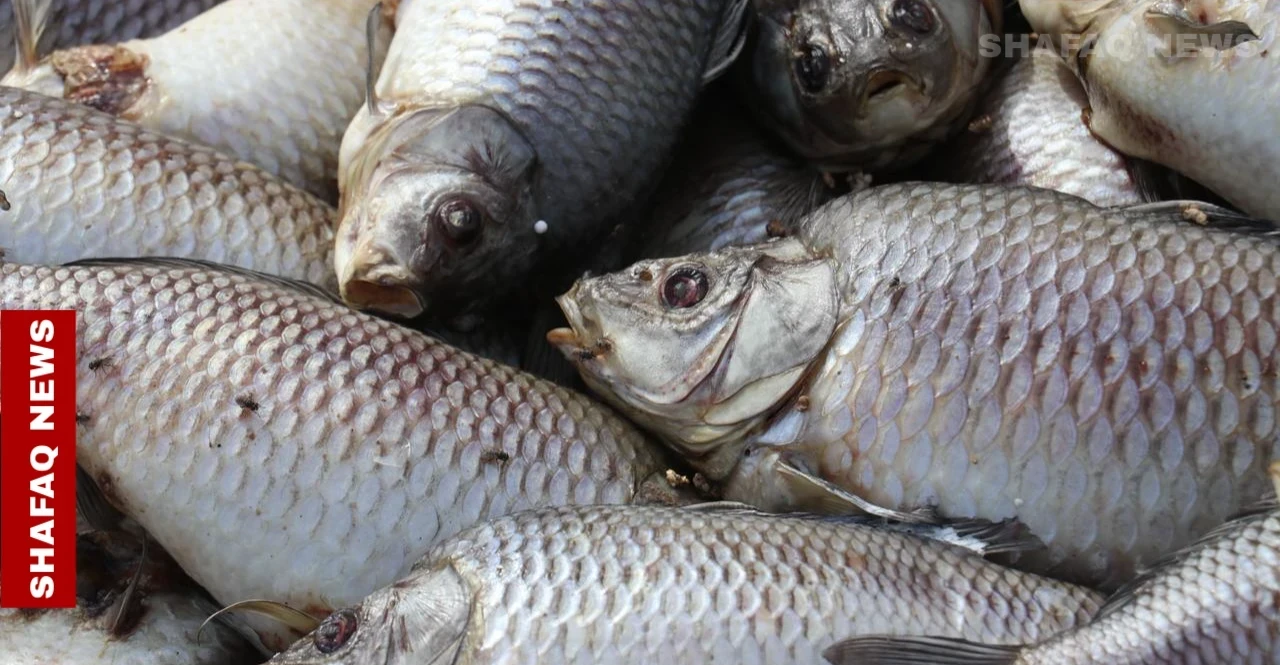
Shafaq News
A rare eyeless fish still survives
in Al-Anbar’s stable groundwater while mass die-offs spread across Iraq’s
rivers, marshes, and farms. The contrast frames the country’s central failure:
not that its fish are dying, but that Iraq often cannot say why.
The evidence points to no single
cause. Water scarcity and oxygen depletion are documented in some areas;
pollution is suspected but unconfirmed in others; salinity, disease, and
destructive fishing add further pressure. In most cases, the testing needed to
isolate one factor from another was never done, and the diagnostic gap, more
than any single toxin or drought, is what leaves each die-off unresolved.
The losses come amid a steep
contraction in the industry. Iraqi Fish Producers Association head Iyad
al-Talibi told Shafaq News that annual production has fallen from more than
900,000 metric tons in 2018 to an estimated 250,000–300,000 today. That collapse
—roughly two-thirds of national output in under a decade— turns the issue from
an environmental concern into a broader food-security problem.
The Green Iraq Observatory estimated
on August 8 that more than 1,000 metric tons of fish had been lost nationwide
during 2026.
Maysan: Scarcity Suspected, Lab
Evidence Lacking
Maysan offers the most consistent
case for linking deaths to falling water levels, though the evidence rests
largely on official attribution rather than measurement.
Fish began dying in the Al-Amshan
Canal in early August after water releases dropped sharply, according to the
provincial council’s Agriculture and Water Committee. Environmental activist
Mortada al-Janubi attributed deaths in the Al-Ezz River and central marshes to
receding water and falling oxygen. Maysan lawmaker Duha al-Sadkhan told Shafaq
News that hundreds of tons were lost in Al-Mejar Al-Kabir district, with damage
estimated at three billion to five billion Iraqi dinars ($2.28M – $3.80M).
The stronger evidence is historical.
In August 2024, testing after extensive mortality in Al-Huwaizeh Marsh, on the
Iraq-Iran border, identified critically low water levels and oxygen depletion
as the principal factors; environmental expert Ahmed Saleh put mortality there
near 95 percent. That episode was measured. The 2026 Al-Amshan deaths have been
attributed to the same mechanism, but Shafaq News found no publicly available
testing confirming it. The distinction matters: a plausible explanation is not
necessarily a proven cause.
The World Bank warned in 2022 that
dams, water abstraction, and wetland drainage were cutting river flows and
threatening inland fisheries. For fish held at high density in cages or ponds,
reduced flow compounds the danger: poor circulation drives oxygen stress and
disease.
Wasit: Pollution Is Credible But
Unproven
If Maysan points to scarcity, the
April die-off in Wasit remains genuinely unsettled, with attention fixed on
whether contaminated water moving from the Diyala into the Tigris caused the
losses.
The Green Iraq Observatory
attributed the episode to untreated sewage and industrial waste carried
downstream after releases from Hamrin Dam rose, and it documented more than 20
cases of poisoning and skin injury requiring hospital treatment. Al-Talibi blamed
sewage entering the Tigris through the Diyala and estimated that about 95
percent of Kut’s floating cages were affected.
But no public laboratory data
reviewed by Shafaq News reported the measurements that would separate pollution
from oxygen depletion, infection, or several causes acting together: dissolved
oxygen, ammonia, heavy metals. Iraq’s 2018 mass mortality shows why that gap
matters: an international investigation concluded that Koi Herpesvirus was the
principal cause, with poor water quality and overcrowding raising
susceptibility rather than triggering the deaths. The obvious culprit was not
the killer.
Pollution remains a real threat
regardless. A World Bank document in May 2026 estimated that more than 70
percent of sewage in Iraq’s urban areas enters rivers untreated. Water
Resources Minister Muthanna al-Tamimi announced legal action in July against parties
accused of polluting the Tigris and Diyala, citing joint inspections with the
Environment Ministry. Months later, no public information identifies the
defendants or indicates whether the cases have advanced.
The South: Salt Changes The Habitat
The same loss of freshwater that
starves fish of oxygen creates a second pressure farther south, where weaker
river flows let saltwater push deeper into the Shatt Al-Arab and connected
wetlands.
A 2025 study by researchers from the
universities of Basrah and Babylon recorded a salinity of 29.9 practical
salinity units in Al-Hammar Marsh, where every fish sampled at one station
during the intrusion was a marine species. At Abu Al-Khaseeb, at 25 units,
marine species made up 82.8 percent of recorded abundance. The findings do not
name salinity as a cause of the recent die-offs, but they show how sharply
declining flows can rewrite which fish a habitat can hold.
Read more: Hawizeh Marsh faces catastrophic fish die-off
Illegal Fishing Keeps Removing Stock
Destructive fishing also continues
to strip breeding populations already weakened by water loss.
Iraq’s Law No. 48 of 1976 bans
poisons, explosives, chemicals, and electrical devices, with penalties up to
imprisonment and confiscation of boats and catches. Yet the Supreme Judicial
Council found electrofishing, explosives, pesticides, and illegal nets still in
use in 2024 and urged consolidating provisions scattered across separate laws,
a legislative fix that has not come.
The World Bank likewise flagged
electrofishing and breeding-season fishing as persistent, poorly enforced
threats. Agriculture Ministry spokesperson Qusay al-Hattab told Shafaq News
that teams document violations with GPS equipment, but no public nationwide
figures show how many were recorded in 2025 or 2026, or how many led to
convictions.
Read more: Death in the current: Pollution decimates Iraq’s river ecosystems
Millions Released, Survival
Untracked
Against these combined pressures,
the government’s most visible response is restocking. The Agriculture Ministry
released about 155 million fish in the 2026 season, al-Hattab said —up from
roughly 95 million the year before— including more than 11 million into Anah
Lake in Al-Anbar in April alone. The Animal Resources Directorate produced more
than 1.5 million native fish between 2023 and 2025, among them Binni, Qattan,
and Shabout.
What happens next is unknown. No
published data reviewed by Shafaq News show how many released fish survive to
maturity or form breeding populations. The releases are countable and
immediate; the water they enter is often the same unmeasured water where fish
have been dying. Restocking may replace some of the losses without addressing
the conditions behind them, while no publicly available data show whether the
program is producing sustainable fish populations.
That is the shape of the problem. In
Maysan, insufficient water and oxygen depletion. In Wasit, pollution that is
plausible but unconfirmed. In the south, salt is reshaping habitats. Behind all
of them, disease that has turned catastrophic before and illegal fishing that
never stopped. The investigation finds no single nationwide killer, and, more
often, no test capable of naming the local one.
Until that changes, Iraq risks
replacing dead fish faster than it can explain why they died, treating the
losses without fully understanding their causes. In Al-Anbar’s caves,
meanwhile, the blind fish endures in something increasingly scarce elsewhere: stable
conditions.
Written and edited by Shafaq News
staff.
Comments are closed.