

Shafaq News..Iraq-Syria relations: From caution to pragmatic engagement?
Shafaq news
Nearly 20 months after the fall of Bashar al-Assad’s
government on December 8, 2024, relations between Iraq and Syria are moving
from a period of anxiety and caution toward a new phase marked by greater
communication and pragmatism.
The relationship has never followed the pattern of
normal ties between neighboring states. Throughout its history, Iraq-Syria
relations have been shaped by complex political and security calculations, with
their trajectory repeatedly changing according to the balance of power and
circumstances in both countries.
The rise of Ahmad al-Sharaa to the Syrian presidency
initially became one of Baghdad’s main sources of concern. Yet contacts between
the two countries soon began at the intelligence level, taking an increasingly
containment-oriented approach. Gradually, Iraq’s rhetoric shifted from
expressing multiple security and political concerns toward cautious,
incremental engagement.
The evolution can be seen in the changing language of
Nouri al-Maliki, head of the State of Law coalition. On February 19, 2025,
al-Maliki held al-Sharaa responsible for killings and destruction that had
affected Iraqis in previous years. Less than a year later, on February 4, 2026,
he described al-Sharaa as a brother and said he was prepared to establish
bilateral relations with Damascus if he won the elections. At the same time, he
directly accused Bashar al-Assad of having “exported terrorism” to
Iraq throughout his years in power.
The shift does not mean that all differences have
disappeared. Rather, it reflects Baghdad’s growing assessment that engagement
with Damascus is becoming necessary to address shared security, political and
economic interests.
Over the past year and a half, several major issues
have begun to shape the relationship: security cooperation, the Kurdish issue,
judicial coordination, and economic ties, particularly oil transportation. The
latter has gained additional urgency amid the crisis created by the closure of
the Strait of Hormuz during the ongoing US-Israeli war with Iran, the route for
most of Iraq’s seaborne crude exports.
A Relationship Still Marked by an Imbalance
Despite the expanding contacts, the road between
Baghdad and Damascus is not yet free of obstacles. The imbalance in official
visits remains particularly visible.
Iraqi officials have made a succession of visits to
Damascus, including National Intelligence Service chief Hamid al-Shatri,
Foreign Minister Fuad Hussein, Kurdistan Region President Nechirvan Barzani
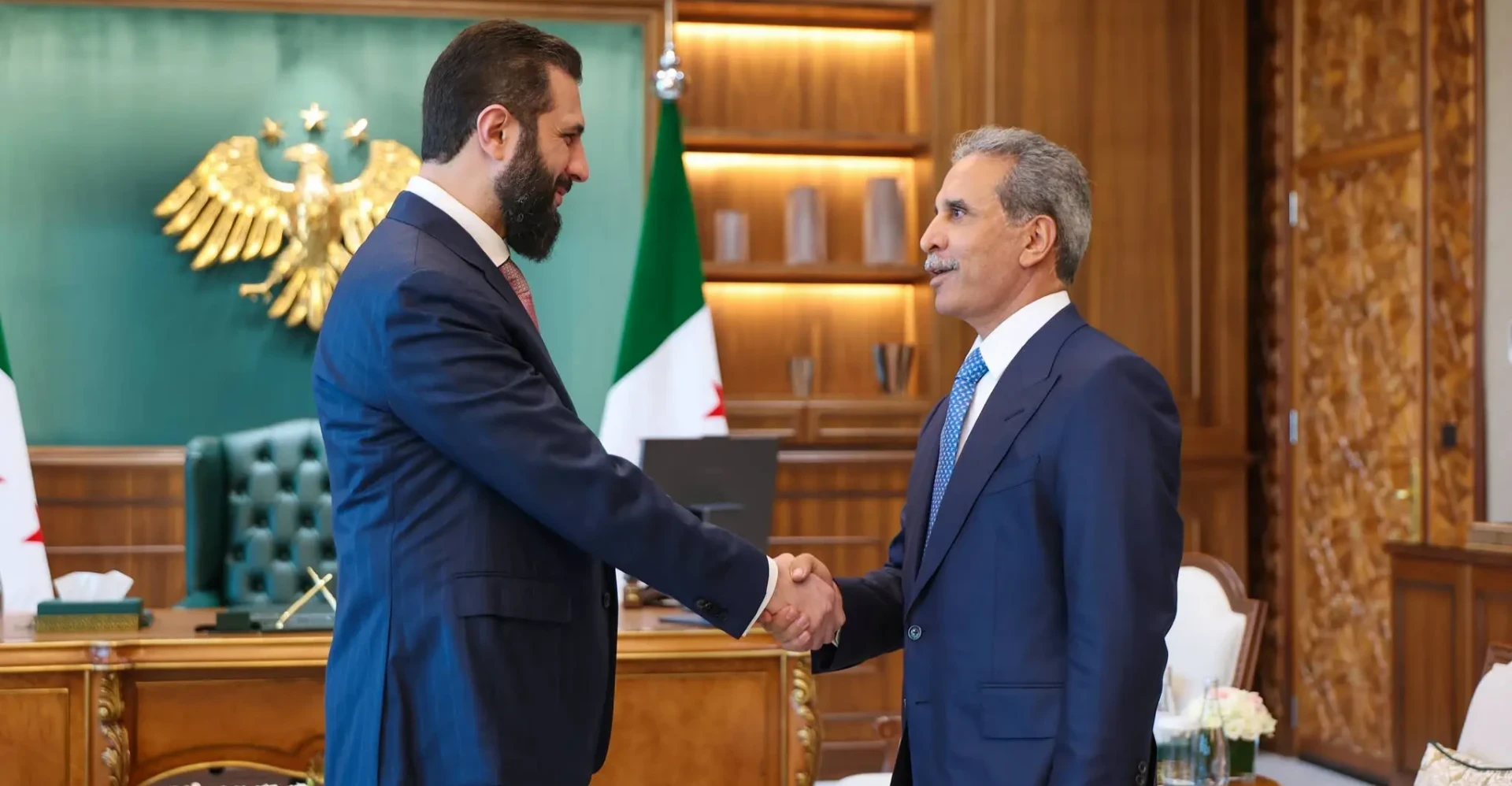
and, most recently, Supreme Judicial Council President Faiq Zidan.
Syrian official visits to Baghdad, by contrast, have
remained limited. They have largely consisted of two visits by Foreign Minister
Asaad al-Shaibani in 2025: one ahead of the Arab Summit hosted by Baghdad and
another during the summit itself.
Al-Sharaa has not yet visited Baghdad, for reasons
that remain present on both the Iraqi and Syrian sides. One of the most
prominent has been the Iraqi political debate over whether to host the Syrian
president.
Recent developments, however, suggest that this phase
may increasingly belong to the past. The succession of high-level visits, most
recently Zidan’s trip to Damascus, points to a relationship moving toward a
more regular institutional framework.
Faiq Zidan’s Visit: Important, But not Enough
The visit by Zidan carries particular significance
because it expanded bilateral engagement into the judicial sphere.
Baghdad-based political analyst Sabah al-Akaili said
the visit was important, but it should be followed by reciprocal visits
involving security, economic, and political officials. “Iraq and Syria need to
consolidate balanced relations at a time when the region is going through a
critical phase.”
He pointed to the historical relationship between the
two countries and their mutual interests as reasons for greater coordination.
ISIS detainees transferred to Iraqi prisons were among
the main issues discussed during the meetings, alongside judicial and legal
cooperation, the exchange of expertise, transitional justice, transparency,
combating corruption, and other shared judicial cases.
Read more: From Syrian prisons to Iraqi provinces
The ISIS file naturally occupies a central position in
the judicial track. Iraq holds around 7,000 members of the organization, with
at least 3,000 of them being Syrian nationals.
Al-Akili argued that coordination over trials,
transfers, and legal procedures has become both a security and judicial
necessity. The issue also extends to the possibility that individuals wanted by
Iraqi courts may be present inside Syria.
Baghdad’s Fears: A Historical Backdrop
Iraq’s concerns have been deeply connected to its
roughly 600-kilometer border with Syria.
For many Iraqi officials, the collapse of al-Assad’s
government presented the possibility of a new security vacuum that could be
exploited by ISIS cells and other armed groups to carry out attacks in both
countries.
Al-Sharaa’s background added another layer to those
concerns. His previous association with al-Qaeda in Iraq under the name of Abu
Mohammad Al-Joulani became a major point of anxiety among Iraqi political and
security circles. Baghdad was also concerned about the fate of Syrian prisons
and camps holding ISIS members and their families in northeastern Syria.
Another factor was the presence of Iraqi armed
factions and their networks inside Syria. The fall of al-Assad raised questions
about what would happen to existing arrangements of influence and regional
supply lines.
During the initial period, Baghdad therefore adopted a
highly cautious position. It did not rush toward full political recognition of
the new reality in Damascus, instead monitoring the behavior of the new Syrian
administration while seeking answers about border security, terrorism, and the
future of detainees.
On December 26, 2024, just 18 days after al-Assad’s
fall, National Intelligence Service chief Hamid al-Shatri arrived in Damascus
at the head of a senior delegation to meet the new Syrian administration. It
was the first major and direct Iraqi contact with the new authorities while
formal political relations between Baghdad and Damascus remained largely
frozen.
The visit was more than a brief security contact. It
carried messages concerning border control, preventing armed groups from
entering Iraq, the fate of ISIS members, and the prisons holding them. The
atmosphere was so tense at the time that al-Sharaa’s reception of al-Shatri
sparked widespread debate after the Syrian president was seen carrying his
personal weapon.
On April 25, 2025, al-Shatri returned to Damascus at
the head of a broader Iraqi government delegation that included officials from
the Border Forces, the Border Crossings Authority and the ministries of oil and
trade. The agenda was no longer limited to security. Both sides discussed
counterterrorism, trade and the possibility of re-exporting Iraqi oil through
Syrian ports on the Mediterranean.
The Iraqi tone gradually changed, while Syrian
communication with Baghdad also expanded.
On August 28, 2025, al-Shatri made a third visit to
Damascus and met al-Sharaa. Their discussions covered border security,
counterterrorism, and the situation of the Iraqi community in Syria.
Meanwhile, the issue of ISIS families in al-Hol camp
moved toward a solution. Iraq received most of the families transferred from
the camp and continued to place them in social reintegration programs.
During his visit to Baghdad on March 14, 2025,
al-Shaibani met Iraqi officials and said the new Syrian administration wanted
to strengthen relations with Iraq, cooperate to prevent foreign interference,
and confront the challenges of reconstruction.
Expanding Contacts: Energy Diplomacy?
The clearest expansion of the relationship came on
June 29, 2026, when Foreign Minister Fuad Hussein visited Damascus in his first
official trip to Syria. He met al-Sharaa at the People’s Palace, with
discussions focusing on strengthening bilateral relations and coordinating
positions on shared challenges.
A week later, Iraq and Syria held their first publicly
announced border meeting between their border forces in the al-Qaim area. The
meeting addressed mechanisms for field coordination, information sharing, and
control of the border strip.
Energy cooperation had already begun developing on a
parallel track. On March 31, 2026, the first shipments of Iraqi oil were
transported by tanker trucks through the al-Waleed border crossing toward
Baniyas. On April 1, the first convoys carrying Iraqi fuel oil crossed through
al-Tanf toward Baniyas.
The discussion subsequently expanded to the
rehabilitation of the historic Kirkuk-Haditha-Baniyas pipeline, with US support
for the project and Iraqi-Syrian talks on expanding its capacity.
The project has acquired additional importance as
regional tensions threaten conventional export routes. Diversifying Iraq’s
access to Mediterranean markets could provide Baghdad with an alternative to
routes exposed to disruption around the Gulf.
Al-Akaili described the energy file as activated but
still “below the level of ambition.” He argued that continuing
instability around the Strait of Hormuz makes cooperation with Syria on oil
exports more urgent, while stressing that such cooperation requires clear
agreements between the two countries.
Nechirvan Barzani‘s Role
The visits by Iraqi officials to Syria have been
accompanied by another important channel: the engagement of Kurdistan Region of
Iraq President Nechirvan Barzani, whose role has built on previous meetings and
contacts between Erbil and Damascus.
On April 17, 2026, he met al-Sharaa on the sidelines
of the Antalya Diplomacy Forum. Their discussions covered relations among the
Kurdistan Region, Iraq, and Syria, particularly in the economic and trade
fields. They also discussed regional developments, the situation of Kurds and
other communities in Syria, and the agreement between Damascus and the Syrian
Democratic Forces (SDF).
Days earlier, on April 6, al-Sharaa had spoken by
telephone with Barzani, discussing regional developments, Iraqi-Syrian
relations, and the situation of Kurds and other communities in Syria. Al-Sharaa
also condemned attacks targeting the Kurdistan Region amid the US-Israeli war
with Iran.
On August 3, Barzani traveled to Damascus and met
al-Sharaa, further reinforcing the emerging channel between Erbil and the
Syrian capital.
Kurdish politician Abdul-Salam Barwari, speaking to
Shafaq News, said Barzani could play a role in easing tensions that accompanied
the arrival of Syria’s new authorities.
“Iraq and Syria are neighbors and must try to
find harmony, because each needs the other,” Barwari said, noting that the
circumstances surrounding the arrival of the new authorities in Damascus had
created tensions inside Baghdad.
“Barzani is capable of helping ease these
tensions,” he added, stressing that Barzani’s movement between Erbil,
Baghdad and Damascus could help open the way for more reciprocal visits.
Barwari also identified the Baniyas pipeline,
counterterrorism, and Iraqi-Syrian coordination as among the issues connected
to this broader diplomatic track.
Barzani’s engagement has also extended beyond
relations between Erbil and Damascus. As previous Shafaq News interviews with
observers have highlighted, northeastern Syria places three principal actors in
the same equation: Damascus, Syrian Kurdish forces and Baghdad, alongside the
United States, Turkiye and other regional actors.
By hosting SDF commander Mazloum Abdi and maintaining
contacts over the future of the SDF, Erbil has sought to help prevent the
process of integrating Syria’s civilian and military institutions from turning
into another confrontation.
The position emerging from Barzani’s diplomacy rests
on a clear formula: a unified and stable Syria, while safeguarding the rights
of Kurds and other communities, Barwari affirmed.
A New Phase
Syrian researcher Ahmad Kamel believes that the
developments cannot be separated from the political changes that have taken
place in both countries.
Syria, he observed, has entered a new era, while Iraq
is also experiencing a significant political transition. Kamel noted that the
current Iraqi government led by Prime Minister Ali al-Zaidi, as well as the
previous government of Mohammed Shia al-Sudani, had sought to establish good
relations with Syria. Iraq’s new government was sworn in under al-Zaidi in May
2026.
“The success of the new Iraqi government in
placing weapons under state control and ending the phenomenon of armed militias
will put Iraq before a new phase.”
He indicated that Damascus is responding positively to
Baghdad’s outreach and seeking a relationship based on common interests and the
management of shared risks.
“Damascus is returning the greeting with an equal
or better one.”
“Relations are becoming institutionalized, but
remain asymmetric, cautious and incomplete,” he added, linking the
development to what he described as a new economic geography in the region.
Kamel contended that Iraq, Syria, Lebanon, Jordan and
Turkiye could together form an alternative network to maritime corridors that
are increasingly exposed to risk.
Kamel pointed to increased truck traffic between Iraq
and Syria and efforts to rehabilitate oil pipelines as evidence that “what was
merely a political concept has begun turning into economic realities.”
Read more: Syria’s calm: An end to threat or a start of a complex security phase for Iraq?
Written and
edited by Shafaq News staff.