

Sent to Congo. Left With No Safe Choice.
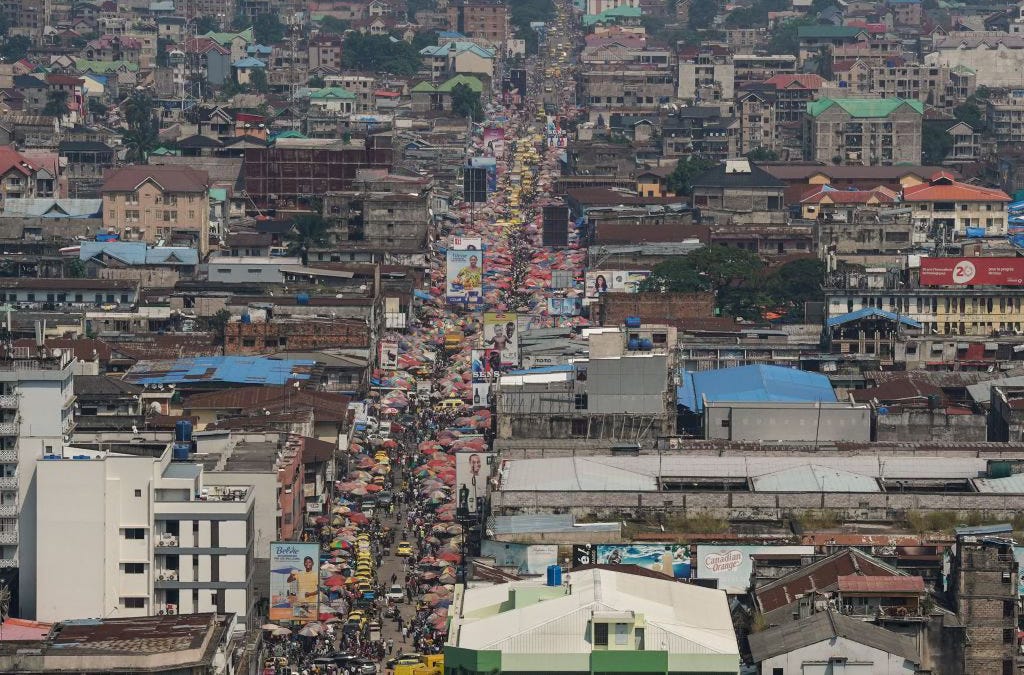
They knew they were being deported but were unaware of the nightmare that awaited them. They were flown across the Atlantic, in chains, to a country they had never seen — one mired in war, poverty and corruption. They didn’t even find out their final destination until they were onboard.
I previously reported on this group of 15 Latin Americans — from Colombia, Ecuador and Peru — in U.S. immigration custody who were placed on a flight on April 17 and sent to Kinshasa, the capital of the Democratic Republic of Congo, without a clear explanation of why they were being sent there or what would happen when they arrived. Some had been in the middle of court cases to remain in the U.S. or had expressed fear of returning home. NPR reported a bit more about their situation today.
When the men and women landed, the confusion was immediate. One man described feeling abandoned, realizing that there was no clear support system waiting for them. Another questioned why he had been sent to Congo at all, saying he had never even been in Africa before. They are not just far from home; they are somewhere entirely unrelated to their lives.
“I know that Congo has an armed conflict, with a yellow fever outbreak,” one Ecuadoran man told NPR, describing why he wanted to leave DRC immediately. Two of the deportees have never been vaccinated against the fever.
They were taken to a hotel in Kinshasa, where they remain under conditions that are neither fully free nor formally detained. They told NPR they cannot work, cannot integrate and do not know how long they will be allowed to stay. Their hotel has become a holding site, one security officers have urged them to remain in while they try to figure out whether they have any options. Water in the hotel cuts out for days, rats roam free and mosquitoes are rampant. But it’s still marginally safer inside the hotel for these deportees, who don’t speak any of the local languages, which include French and Lingala.
“Outside is another world,” said one Colombian woman. Kinshasa is a city of 15 million people in a country that the U.S. State Department calls a “high-risk area.”
At the same time, the deportees say they are being encouraged to return “voluntarily” to their home countries. But that encouragement exists alongside the reality that they have no path to stay in Congo, no way back to the United States and often credible fear that prevents them from wanting to go home. The choice being offered must feel impossible — yet five of the deportees interviewed by NPR said they want to go back to their home countries regardless of threats because Congo is “dangerous and poor.”
This removal from the United States, transfer to a third country and pressure to return home reflects an ongoing, growing program I’ve reported on before. In some cases, the U.S. has spent more than a million dollars per migrant when detention, transport and contracting costs are combined, underscoring how much infrastructure now exists to move people rather than resolve their cases — rather than offer them compassion instead of expulsion.
The Trump administration is also considering sending as many as 1,100 Afghans who helped U.S. forces during the war in Afghanistan to Congo — a ruthless decision, and one that many Congolese are resisting. NPR reports that on Monday protesters burned tires in the capital and marched with banners against hosting what they called “Afghan mercenaries.”
“They want to take these folks from the number one refugee crisis in the world and drop them off in the number two refugee crisis in the world,” said Shawn VanDiver, director of AfghanEvac. “What kind of plan is that? That’s not a plan. That’s purposely placing these folks in harm’s way.” President Trump, for his part, told reporters last week that he wasn’t aware of this plan.
I’ve previously reported on migrants being deported not only to their home countries but to countries they have no connection to, through agreements that allow the U.S. to send people elsewhere when direct deportation is difficult. What happens after those transfers is far harder to track, and far easier to ignore. In the case of a group of men deported to South Sudan, in July 2025 border czar Tom Homan lied.
He told Politico: “They’re free as far as we’re concerned. They’re free, they’re no longer in our custody, they’re in Sudan.”
But they were neither free nor even in Sudan; they were in South Sudan.
The Latin American men and women in Kinshasa are now living in a kind of permanent limbo. They are not resettled, not returned home and not free to build a future where they are. Instead, their options have shrunk to two: stay in a place where they cannot live, or return to a place where they may not be safe.
They were transported across continents without choosing their destination, placed in conditions that restrict their autonomy and are now being pushed toward a decision they fear. And despite at least one Ecuadorian man comparing his situation to human trafficking, he told NPR: “I’m here in a place where I can’t do anything. I want to return to my country.”
And the term “human trafficking” is not necessarily an exaggeration: Moving people across borders without meaningful consent and using pressure to shape what comes next sounds pretty much like human trafficking to me. Such trafficking is a violation of our fundamental human rights. And the American government just doesn’t seem to care. Deportation flights are not only running consistently, they are increasing in frequency.
In the meantime, the men and women from Latin America remain, bewildered and likely scared, in that hotel in Kinshasa, waiting, still trying to figure out what to do next.
Credit: Source link